
Enterprise Generative AI: Applications, Challenges, and Best Practices

Table of Contents
Are you wondering how your organization can stay competitive in today’s rapidly evolving business landscape? The answer lies in generative AI technology that transforms how enterprises operate, innovate, and serve customers. Your company faces constant pressure to innovate faster, reduce costs, and manage complex operations at scale.
Generative AI for enterprise represents a strategic capability enabling automation, knowledge creation, and intelligent decision-making across organizational functions. By the end of this guide, you will understand how generative AI transforms business operations and why leaders make it their digital transformation cornerstone.
Generative AI empowers teams to work smarter, make better decisions, and deliver exceptional customer value. Let us explore this transformative technology and discover how it revolutionizes your enterprise.
Key Takeaways
- Readers will be able to understand what enterprise-grade generative AI is and how it differs from consumer AI tools in terms of scale, security, and governance.
- Identify the most impactful enterprise use cases for generative AI across customer support, sales, operations, finance, HR, and decision-making.
- Evaluate the measurable business benefits of generative AI, including productivity gains, cost reduction, faster time-to-market, and improved customer experience.
- Recognize the critical data, security, compliance, and governance requirements necessary for successful enterprise AI adoption.
- Address common challenges and limitations such as data readiness, system integration, model accuracy, and change management.
- Apply a structured, phased approach to implementing generative AI aligned with business goals, supported by clear governance and scalable architecture.
Table of Contents
What Is Generative AI in an Enterprise Context?
Enterprise-grade generative AI differs significantly from consumer tools you might use daily. Generative AI for enterprise refers to artificial intelligence systems creating content, automating processes, and generating insights at organizational scale and security levels.
Your enterprise needs address sensitive data, complex workflows, and strict compliance requirements. Enterprise-grade generative AI provides enhanced scalability, robust security frameworks, comprehensive governance controls, and seamless integration with existing systems.
Unlike consumer AI tools prioritizing ease of use, enterprise solutions handle massive data volumes while maintaining privacy and regulatory compliance. You need systems integrating with customer relationship management platforms, enterprise resource planning systems, and critical business applications.
Key differentiators include advanced access controls, audit trails, custom model training capabilities, and enterprise-level support. These features ensure generative AI implementation aligns with security policies and business objectives.
Why Enterprises Are Adopting Generative AI
Successful organizations invest in generative AI for enterprise to address fundamental business challenges including productivity bottlenecks, overwhelming data volumes, rising operational costs, and competitive pressure.
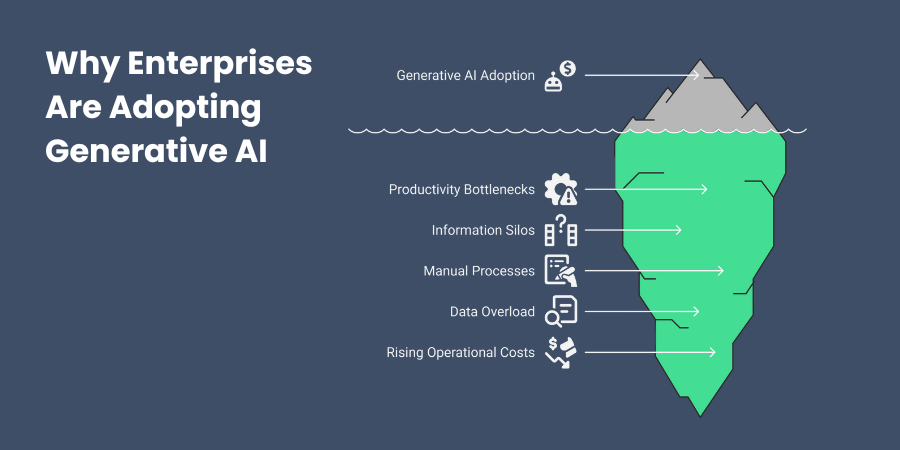
Your teams probably spend countless hours on repetitive tasks that could be automated. Information silos prevent efficient knowledge sharing across departments while manual processes slow decision-making and innovation.
Organizations implementing generative AI gain significant advantages by reducing time-to-market, improving customer experiences, and optimizing operational efficiency in previously impossible ways.
Data overload challenges are particularly relevant as enterprises generate massive daily information but struggle extracting actionable insights quickly. Generative AI transforms this challenge by automatically analyzing patterns, generating summaries, and providing intelligent recommendations.
Rising operational costs represent another compelling driver as manual processes, inefficient workflows, and redundant tasks drain resources. Generative AI addresses these pain points by automating routine work and augmenting human capabilities.
Key Enterprise Use Cases of Generative AI
Generative AI for enterprise benefits organizations across different functions through impactful use cases transforming enterprises today.
Customer support operations use generative AI to automatically handle routine inquiries, generate personalized responses, and provide agents with intelligent suggestions for complex issues. This means faster resolution times and improved satisfaction scores.
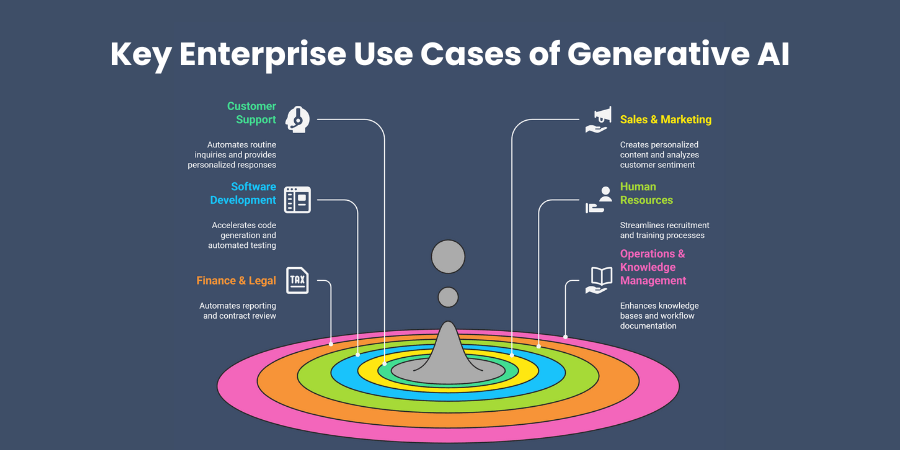
Sales and marketing teams leverage generative AI to create personalized content at scale, generate compelling proposals, and analyze customer sentiment from various touchpoints. You can produce customized marketing materials for different segments without overwhelming creative teams.
Software development processes benefit from accelerated code generation, automated testing procedures, and documentation creation. Developers focus on complex problem-solving while AI handles routine coding tasks.
Human resources streamlines recruitment processes, generates job descriptions, creates training materials, and automates initial candidate screening. HR teams focus on strategic talent management initiatives.
Finance departments benefit from automated report generation, expense categorization, and financial analysis. Legal teams use AI for contract review, compliance checking, and legal research acceleration.
Operations and knowledge management represent powerful applications through intelligent knowledge bases, automated workflow documentation, and process improvement recommendations based on operational data analysis.
Generative AI for Enterprise Automation
Generative AI for enterprise transforms organizational automation capabilities beyond traditional rule-based automation by introducing intelligent decision-making and adaptive responses to complex scenarios.
Current automation systems handle straightforward, predictable tasks effectively. However, generative AI enables automation of workflows requiring contextual understanding, creative problem-solving, and dynamic adaptation to changing conditions.
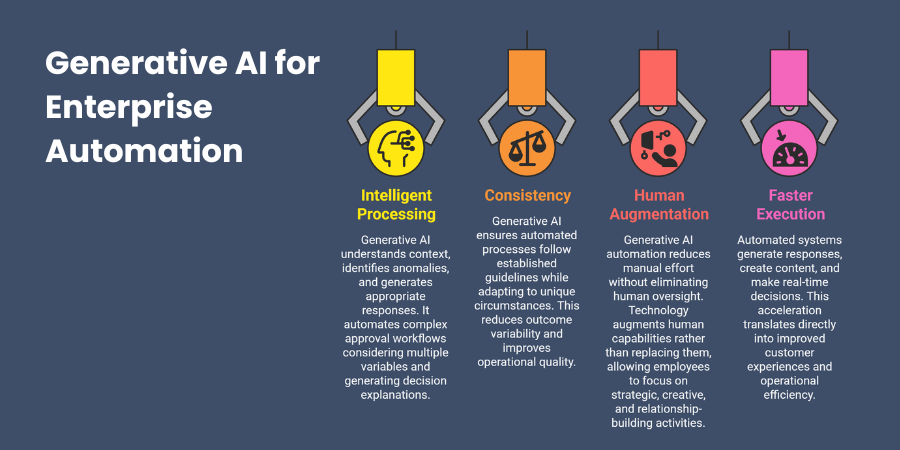
Intelligent document processing not only extracts data but understands context, identifies anomalies, and generates appropriate responses. Organizations can automate complex approval workflows considering multiple variables and generating decision explanations.
Consistency benefits are remarkable for operations as generative AI ensures automated processes follow established guidelines while adapting to unique circumstances. This reduces outcome variability and improves operational quality.
Teams appreciate how generative AI automation reduces manual effort without eliminating human oversight. Technology augments human capabilities rather than replacing them, allowing employees to focus on strategic, creative, and relationship-building activities.
Faster execution becomes possible when automated systems generate responses, create content, and make real-time decisions. This acceleration translates directly into improved customer experiences and operational efficiency.
Generative AI in Enterprise Decision-Making
Generative AI enhances organizational decision-making processes by providing intelligent insights and predictive capabilities that transform information analysis, option evaluation, and strategic planning.
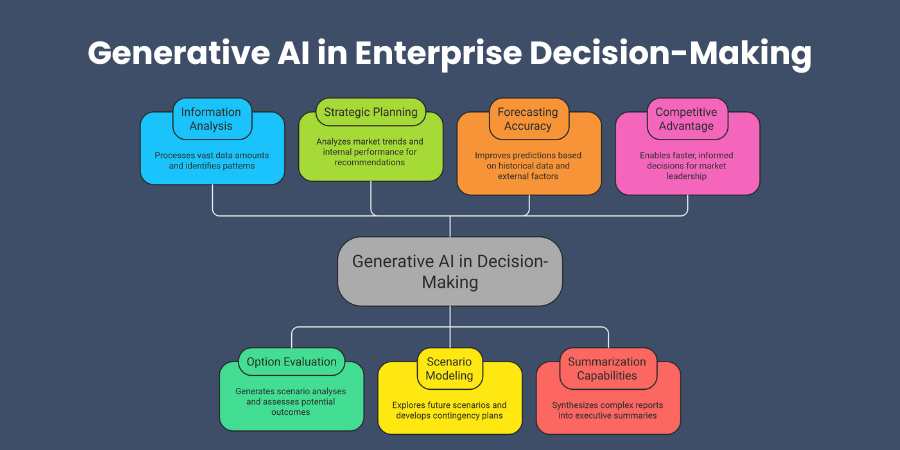
Decision-making challenges include processing vast data amounts, synthesizing information from multiple sources, and predicting strategic choice outcomes. Generative AI addresses these challenges by automatically summarizing complex information, identifying patterns, and generating scenario analyses.
Strategic planning processes benefit when generative AI analyzes market trends, competitive intelligence, and internal performance data to generate comprehensive strategic recommendations. You receive actionable insights informing planning decisions beyond data summaries.
Scenario modeling becomes sophisticated with generative AI enabling exploration of multiple future scenarios, understanding potential risks and opportunities, and developing contingency plans based on intelligent analysis.
Forecasting accuracy improves when generative AI analyzes historical patterns, market conditions, and external factors to generate predictions. Financial planning, resource allocation, and capacity management decisions benefit from accurate projections.
Summarization capabilities are valuable for executive teams as complex reports, market research, and operational data automatically synthesize into executive summaries highlighting critical insights and recommended actions.
Competitive advantage grows when you make faster, more informed decisions based on comprehensive analysis that would take human analysts significantly longer to complete.
Benefits of Generative AI for Enterprises
Implementing generative AI for enterprise delivers measurable business impacts across productivity, cost optimization, innovation acceleration, and customer experience enhancement.
Productivity gains are substantial and immediately noticeable with teams reporting 30-50% time savings on routine tasks. Content creation, data analysis, and report generation become significantly faster and more efficient.
Cost optimization occurs through reduced manual labor requirements, improved resource allocation, and elimination of redundant processes. You achieve more with existing resources while reducing operational expenses across departments.
Faster time-to-market becomes possible when generative AI accelerates product development, marketing campaign creation, and customer onboarding processes. Organizations respond more quickly to market opportunities and customer needs.
Employee efficiency improvements extend beyond simple task automation as workforce becomes more capable and confident when supported by intelligent AI systems providing suggestions, generating content, and automating routine work.
Customer experience enhancement results from personalized interactions, faster response times, and accurate information delivery. Customers receive better service while teams handle increased volumes without proportional resource increases.
Enterprise Data, Security, and Governance Considerations
Security and governance implications of implementing generative AI require careful consideration for successful adoption.
Data privacy requirements demand careful consideration when selecting and implementing generative AI solutions. You need systems maintaining data sovereignty, implementing proper encryption, and providing clear data lineage tracking.
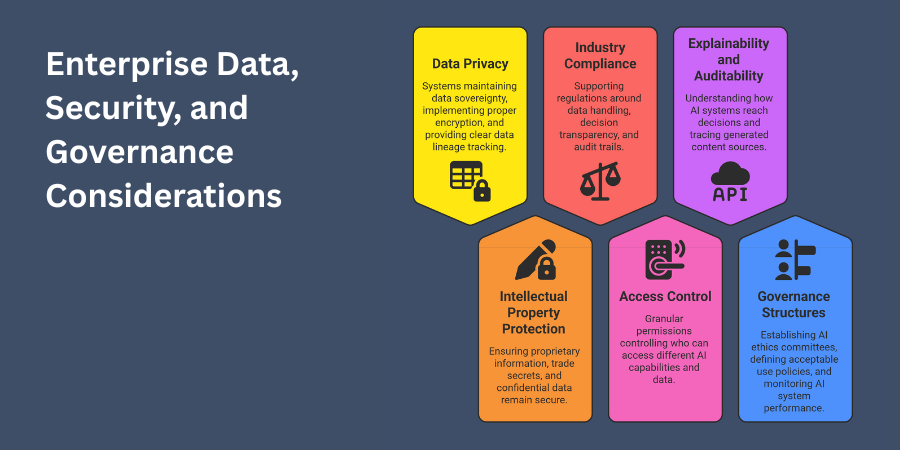
Intellectual property protection represents a critical organizational concern. You must ensure proprietary information, trade secrets, and confidential data remain secure when processed by generative AI systems through careful vendor selection and robust contractual protections.
Industry compliance requirements likely include specific regulations around data handling, decision transparency, and audit trails. Generative AI implementation must support these requirements through comprehensive logging, explainable AI capabilities, and regulatory reporting features.
Access control becomes complex with generative AI systems requiring granular permissions controlling who can access different AI capabilities, what data they can process, and how generated content is distributed.
Explainability and auditability are essential for risk management and regulatory compliance. You should understand how AI systems reach decisions, trace generated content sources, and provide explanations for automated actions.
Governance structures must evolve to address AI-specific risks and opportunities including establishing AI ethics committees, defining acceptable use policies, and creating processes for monitoring AI system performance and impact.
Challenges and Limitations of Generative AI in Enterprises
Understanding implementation obstacles helps you prepare effectively and develop mitigation strategies for generative AI adoption.
Data readiness probably represents the most significant initial challenge as generative AI systems require high-quality, well-organized data to function effectively. You may need considerable investment in data cleaning, standardization, and integration before achieving optimal results.
Integration complexity with existing systems can be substantial as enterprise architecture likely includes legacy systems, custom applications, and third-party platforms that may not easily connect with new AI capabilities.
Model hallucinations pose real organizational risks as generative AI systems can produce confident-sounding but incorrect information leading to poor decisions or customer misinformation. You need robust validation processes and human oversight mechanisms.
Change management challenges emerge when workforce encounters new AI-powered tools and processes. Some employees may resist adoption while others may over-rely on AI without maintaining critical thinking skills.
Regulatory concerns continue evolving as governments develop new AI-related regulations. You must stay informed about changing compliance requirements and ensure AI implementations remain compliant with emerging standards.
Skill gaps in your organization may limit ability to effectively implement and manage generative AI systems requiring investment in training existing employees or hiring new talent with AI expertise.
How to Implement Generative AI in an Enterprise Environment
A structured, phased approach maximizes success chances while minimizing risks and disruption for generative AI implementation.
Strategy alignment phase should begin with clearly defining how generative AI supports business objectives requiring executive sponsorship, cross-functional buy-in, and clear success metrics before proceeding with technical implementation.
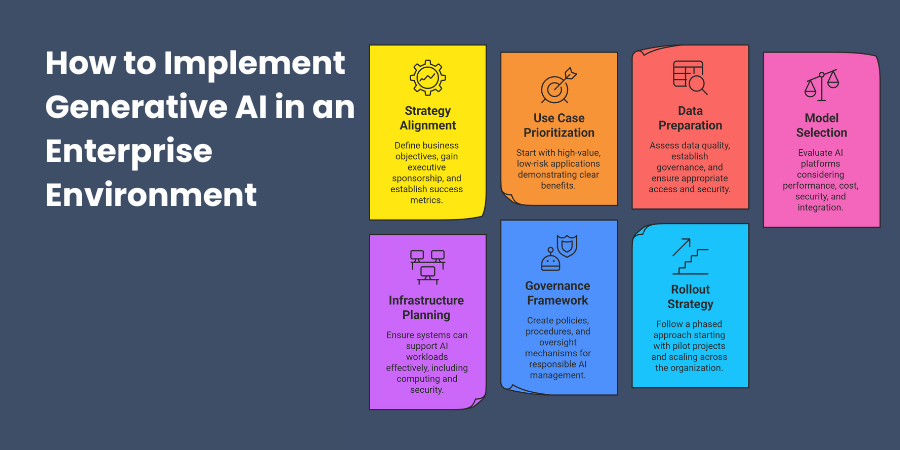
Use case prioritization becomes critical for initial success by starting with high-value, low-risk applications demonstrating clear benefits without requiring complex integrations or sensitive data processing.
Data preparation often requires significant effort but provides the foundation for AI success through assessing data quality, establishing data governance processes, and ensuring appropriate data access and security controls.
Model selection involves evaluating different AI platforms considering factors like performance, cost, security features, and integration capabilities. Your choice should align with technical requirements and long-term strategic goals.
Infrastructure planning ensures systems can support AI workloads effectively including computing resources, network capacity, storage requirements, and security infrastructure necessary for enterprise-grade AI deployment.
Governance framework establishment creates policies, procedures, and oversight mechanisms needed to manage AI systems responsibly including risk management, compliance monitoring, and performance evaluation processes.
Rollout strategy should follow a phased approach starting with pilot projects, expanding to department-level implementations, and eventually scaling across your entire organization with each phase providing learning opportunities.
Build vs Buy: Enterprise Generative AI Solutions
The decision to build custom generative AI systems or purchase existing solutions significantly impacts implementation timeline, costs, and long-term capabilities.
Building custom solutions offers maximum control and customization possibilities by developing AI systems tailored specifically to unique requirements, data structures, and business processes. This path provides competitive differentiation but requires substantial technical expertise and development resources.
Building makes sense when you have unique requirements that existing products cannot address, possess strong internal AI capabilities, and need maximum control over AI systems.
Purchasing existing solutions accelerates implementation and reduces technical risks as commercial generative AI platforms offer proven capabilities, ongoing support, and regular updates without requiring internal development resources.
Buying works well when requirements align with available products, you prefer faster implementation, and want to minimize technical risks. Ongoing costs may be higher but reduced complexity often justifies the expense.
Hybrid approaches combine elements of both strategies by purchasing core AI platforms while developing custom integrations, workflows, or user interfaces. This balance provides reasonable customization while leveraging proven AI capabilities.
Future of Generative AI in the Enterprise
Emerging trends suggest even more transformative capabilities are coming that will reshape how your organization operates.
AI agents represent the next evolution of generative AI capabilities as autonomous systems will handle complex, multi-step processes without human intervention. Your organization will benefit from 24/7 intelligent automation that adapts to changing conditions.
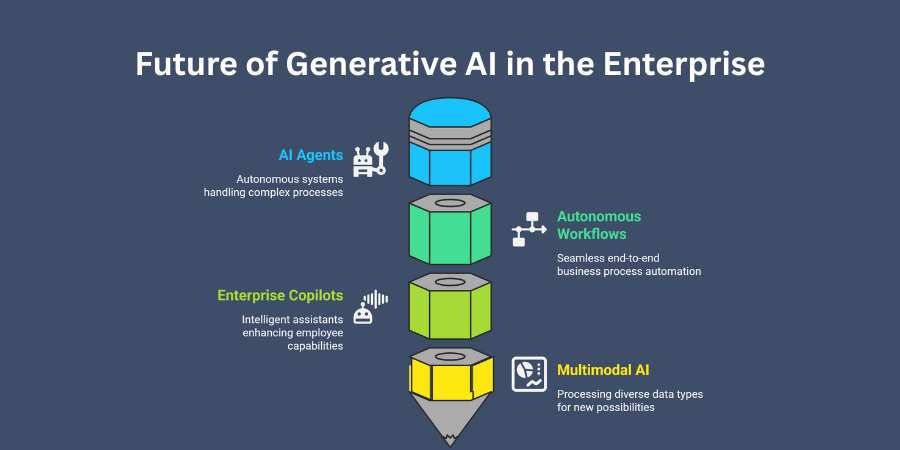
Autonomous workflows will connect multiple AI agents to handle end-to-end business processes enabling customer service, order processing, and fulfillment systems to work together seamlessly without human coordination.
Enterprise copilots will become sophisticated AI assistants that understand business context, access systems, and provide intelligent support for complex decision-making. Employees will have AI partners enhancing capabilities across all job functions.
Multimodal AI capabilities will enable systems to process text, images, audio, and video simultaneously opening new possibilities for content creation, analysis, and customer interaction.
Industry-specific generative models will emerge that understand unique requirements, regulations, and best practices of your sector providing more accurate and relevant outputs for specific business contexts.
Integration of generative AI with other emerging technologies like augmented reality, Internet of Things devices, and blockchain will create new possibilities for digital transformation initiatives.
How Shadhin Lab Helps Enterprises Adopt Generative AI
Shadhin Lab specializes in helping enterprises successfully adopt and scale generative AI technologies through expert guidance for implementation journey navigation.
Our expertise in generative AI systems spans the entire implementation lifecycle from strategy development through deployment and optimization providing comprehensive support addressing both technical and business aspects of AI adoption.
We design and implement AI agents that automate complex workflows specific to your industry and organizational needs with custom AI solutions integrating seamlessly with existing systems while providing required scalability and security.
Our automation capabilities extend beyond simple task automation to intelligent process optimization benefiting from AI systems that learn from operations and continuously improve performance over time.
Enterprise integration represents a core strength of our approach ensuring generative AI implementations work effectively with existing technology stack, data sources, and business processes without disrupting ongoing operations.
Governance-ready architectures are built into every solution we deliver providing AI systems that meet compliance requirements, provide necessary audit trails, and support risk management objectives from day one.
Our end-to-end delivery approach means you have a single partner for your entire generative AI journey from initial assessment through ongoing optimization with expertise and support needed for long-term success.
Conclusion
You now have comprehensive understanding of how generative AI for enterprise transforms organizational operations, decision-making, and competitive position. The technology represents far more than a productivity tool as a strategic capability defining successful enterprises in coming years.
The key to success lies in starting with clear objectives, choosing appropriate use cases, and implementing robust governance frameworks. Your organization has the opportunity to gain significant competitive advantages through thoughtful AI adoption.
Remember that generative AI implementation requires careful attention to data governance, security, change management, and workforce development. You succeed when approaching AI adoption as comprehensive transformation initiative rather than simple technology deployment.
The future belongs to organizations that embrace generative AI with structured, secure, and scalable approaches. Your journey starts with understanding specific requirements, evaluating available options, and taking first steps toward AI-powered transformation.
The possibilities ahead are endless, and the time to begin your AI transformation is now.
Frequently Asked Questions
What is the typical ROI timeline for generative AI implementations?
You can expect initial productivity gains within 3-6 months of implementation, with substantial ROI becoming apparent after 6-12 months. Your specific timeline depends on use case complexity and organizational readiness.
How do we ensure data security when using generative AI?
You should implement enterprise-grade AI solutions with robust encryption, access controls, and data governance frameworks. Choose vendors providing clear data handling policies and compliance certifications relevant to your industry.
What skills does our team need for successful AI implementation?
Your organization needs technical skills, business analysis capabilities, and change management expertise. Consider training existing employees while bringing in AI specialists for complex implementations.
Can generative AI integrate with our existing enterprise systems?
Yes, modern generative AI platforms offer extensive integration capabilities through APIs and connectors. You can connect AI systems with CRM, ERP, and other business applications with proper planning and implementation.
How do we measure the success of our generative AI initiatives?
You should establish clear metrics before implementation including productivity improvements, cost savings, quality enhancements, and user adoption rates. Regular monitoring and adjustment ensure AI initiatives deliver expected value.

Shaif Azad
Related Post
AI Automation Use Cases to Boost Efficiency
Are you overwhelmed by repetitive tasks that consume hours of your valuable time each day? Businesses...
Generative AI for Startups: Growth & Innovation
Are you struggling to compete with industry giants while operating on a limited budget? You face...
How to Implement AI in Business Implementation
Are you wondering how your business can stay competitive in today’s rapidly evolving marketplace? Your competitors...
