
How AI Improves Demand Forecasting Accuracy and Decision-Making
Table of Contents
Are you tired of watching your inventory costs spiral out of control while customers walk away empty-handed? Picture this scenario: you are staring at warehouses full of unsold products while simultaneously dealing with angry customers who cannot find what they need. Does this sound familiar to your business experience?
What if I told you that businesses using traditional forecasting methods are losing up to 30% of their potential revenue due to inaccurate demand predictions? Here’s something fascinating: companies implementing AI demand forecasting are seeing 20-50% reductions in supply chain errors and 65% boosts in operational efficiency.
You are probably wondering how artificial intelligence can transform your forecasting accuracy. The truth is, AI demand forecasting represents a revolutionary shift from guesswork to precision. By the end of this guide, you will understand exactly how to leverage AI demand forecasting to eliminate costly inventory mistakes and boost your bottom line.
Let us explore together how this game-changing technology can transform your business operations and give you the competitive edge you have been searching for.
Key Takeaways
- Readers will be able to understand how AI demand forecasting replaces traditional guesswork with highly accurate, data-driven predictions.
- Differentiate between traditional demand forecasting methods and AI-based forecasting in terms of accuracy, adaptability, and scalability.
- Identify the key technologies and data sources that enable AI to deliver 85–95% forecasting accuracy.
- Evaluate the business benefits of AI demand forecasting, including reduced inventory costs, fewer stockouts, and improved supply chain efficiency.
- Apply a clear, step-by-step approach to implementing AI demand forecasting within their organization.
- Measure forecasting success using critical performance metrics such as forecast accuracy, inventory turnover, and service level improvements.
Table of Contents
What Is AI Demand Forecasting?
Have you ever wondered what makes AI demand forecasting fundamentally different from traditional prediction methods? Here’s the thing you need to know: AI demand forecasting uses machine learning algorithms to analyze massive datasets and predict future customer demand with unprecedented accuracy.
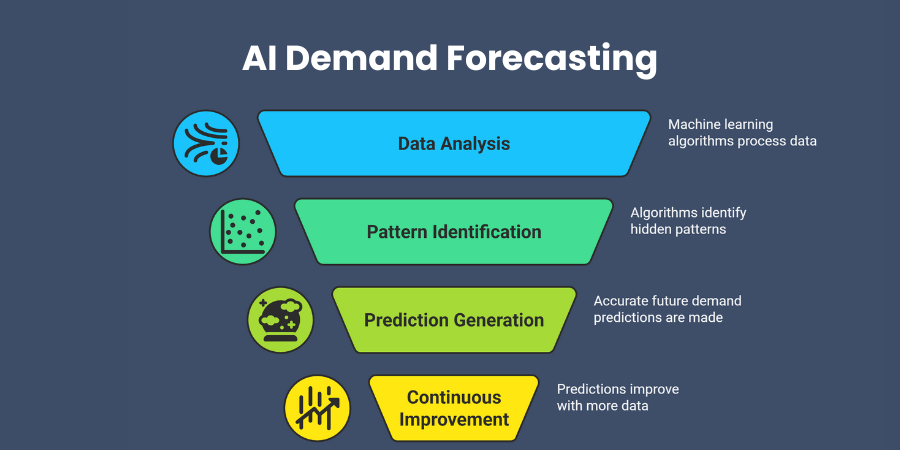
Unlike traditional methods that rely on historical averages, AI demand forecasting processes real-time data from multiple sources. Your sales history, market trends, weather patterns, social media sentiment, and economic indicators all feed into sophisticated algorithms that learn and adapt continuously.
Think of it this way: while traditional forecasting looks backward, AI demand forecasting looks forward, sideways, and all around. The system identifies patterns that human analysts might miss entirely. When you implement AI demand forecasting, you are essentially giving your business a crystal ball that gets clearer over time.
What makes this particularly exciting for your business? The algorithms improve their predictions automatically as they process more data. Every transaction, every market shift, every seasonal change teaches the system to make better forecasts for your specific situation.
Traditional Demand Forecasting vs AI-Based Forecasting
Are you still relying on spreadsheets and gut feelings for your demand planning? Let’s examine why traditional methods might be holding your business back and how AI demand forecasting can revolutionize your approach.
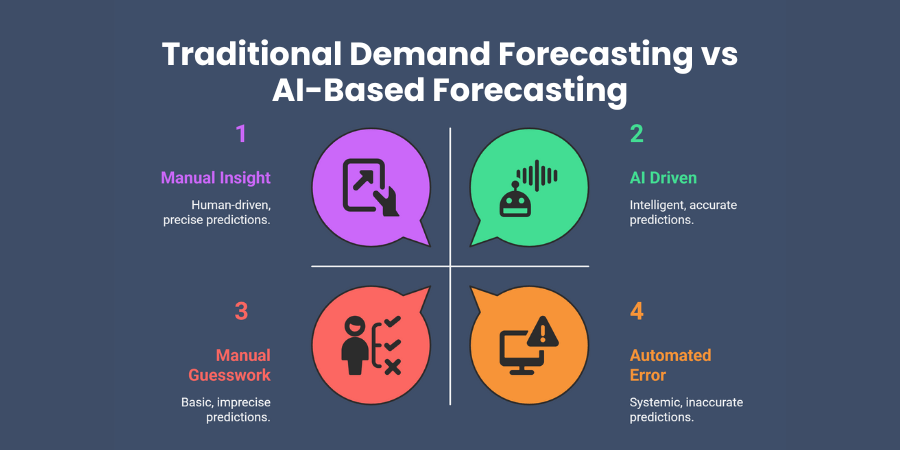
Traditional forecasting typically uses simple statistical models based on historical sales data. You might recognize this approach: looking at last year’s numbers and adjusting for expected growth. While this method seems logical, it cannot adapt quickly to market changes or identify complex patterns.
Here’s where AI demand forecasting transforms your capabilities:
Adaptability: Traditional methods require manual adjustments when market conditions change. AI systems automatically detect and respond to new patterns in your data.
Accuracy: While traditional forecasting achieves 60-70% accuracy rates, AI demand forecasting often reaches 85-95% accuracy for your predictions.
Scalability: Managing forecasts for thousands of products manually becomes overwhelming. AI handles unlimited complexity without breaking a sweat.
Speed: Traditional methods might take weeks to update forecasts. AI systems provide real-time predictions that evolve with your business.
What does this mean for your daily operations? Instead of spending hours analyzing spreadsheets, you receive instant, accurate forecasts that help you make confident decisions. Your team can focus on strategy rather than number-crunching.
How AI Improves Demand Forecasting Accuracy
Wondering how AI actually makes your forecasts more accurate? The secret lies in pattern recognition capabilities that far exceed human analytical capacity.
AI demand forecasting identifies hidden relationships in your data that traditional methods miss completely. For example, the system might discover that rainy weather increases demand for your indoor products by 23%, but only when combined with specific social media trends.
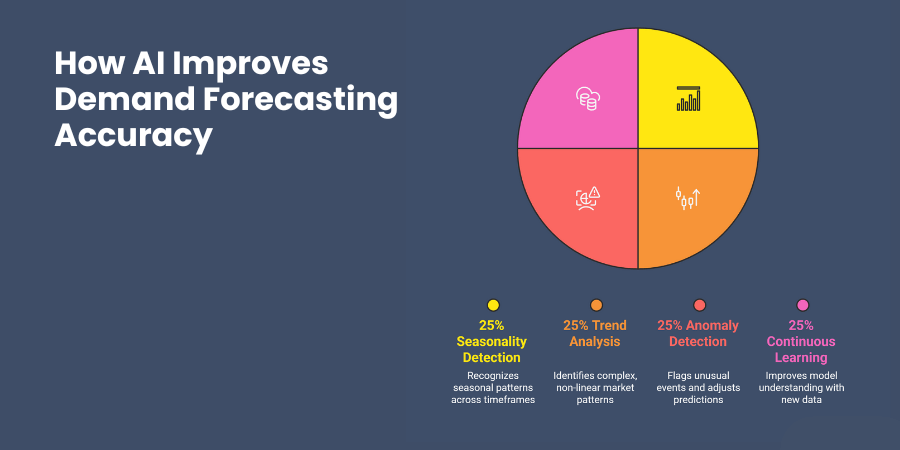
Here’s how the accuracy improvements benefit your business:
Seasonality Detection: The AI recognizes seasonal patterns across multiple timeframes simultaneously. Your system understands daily, weekly, monthly, and yearly cycles affecting your products.
Trend Analysis: Rather than simple linear trends, AI identifies complex, non-linear patterns in your market behavior.
Anomaly Detection: When unusual events occur, the system flags them immediately and adjusts future predictions accordingly.
Continuous Learning: Every new data point improves the model’s understanding of your specific market dynamics.
What makes this particularly powerful for your situation? The system learns your unique business patterns. Your customer behavior, market position, and operational constraints all become part of the forecasting intelligence.
Key Technologies Used in AI Demand Forecasting
Curious about the technological foundation powering your future forecasting success? Let’s explore the core technologies that make AI demand forecasting so effective for businesses like yours.
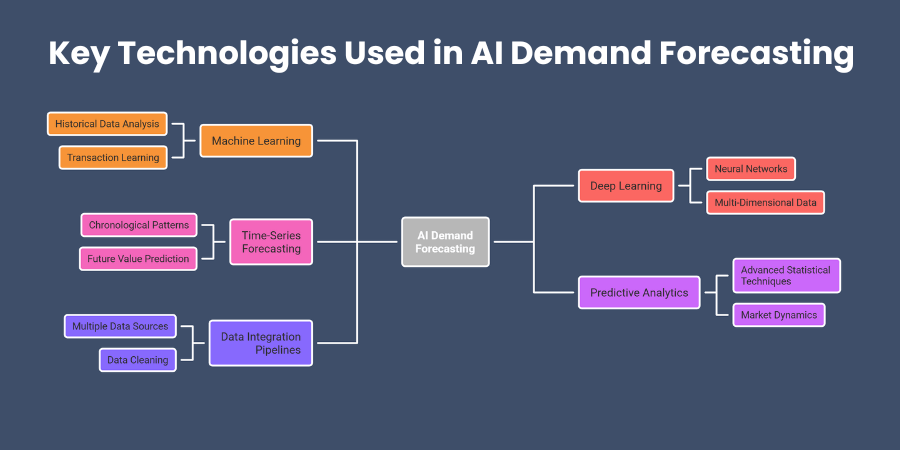
Machine Learning: These algorithms analyze your historical data to identify patterns and relationships. The system learns from every transaction and market event.
Deep Learning: Neural networks process complex, multi-dimensional data relationships. Think of this as the brain that connects seemingly unrelated factors affecting your demand.
Time-Series Forecasting: Specialized algorithms designed specifically for predicting future values based on chronological data patterns.
Predictive Analytics: Advanced statistical techniques that go beyond simple correlation to understand causation in your market dynamics.
Data Integration Pipelines: Systems that automatically collect, clean, and process data from multiple sources feeding your forecasting models.
What does this technology stack mean for your implementation? You do not need to understand the technical details to benefit from these powerful capabilities. The technology works behind the scenes while you focus on business decisions.
The exciting part is how these technologies work together. Your data flows through integrated pipelines, gets processed by machine learning algorithms, and emerges as actionable forecasts tailored to your specific business needs.
Benefits of AI Demand Forecasting
Are you ready to discover how AI demand forecasting can transform your business performance? The benefits extend far beyond simple accuracy improvements.
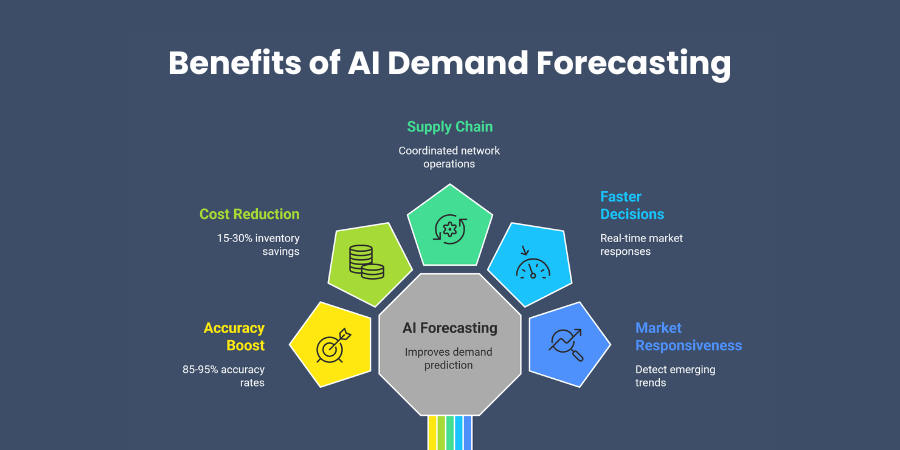
Improved Forecast Accuracy: Achieve 85-95% accuracy rates compared to 60-70% with traditional methods. This means fewer surprises and more predictable operations for your business.
Reduced Inventory Costs: Optimize your stock levels to minimize carrying costs while maintaining service levels. Many businesses see 15-30% reductions in inventory investment.
Optimized Supply Chains: Coordinate your entire supply network based on accurate demand signals. Your suppliers, warehouses, and distribution centers work in perfect harmony.
Faster Decision-Making: Real-time forecasts enable immediate responses to market changes. You can adjust production, procurement, and marketing strategies instantly.
Increased Market Responsiveness: Detect emerging trends before your competitors. Your business stays ahead of market shifts and customer preference changes.
What makes these benefits particularly valuable for your situation? The improvements compound over time. Better forecasts lead to better decisions, which generate better data, which creates even better forecasts.
Consider this: reducing stockouts by just 10% while cutting excess inventory by 20% can improve your profit margins significantly. When you multiply these improvements across your entire product portfolio, the financial impact becomes substantial.
Use Cases of AI Demand Forecasting
Wondering how AI demand forecasting applies to real-world business situations? Let’s explore specific scenarios where this technology delivers measurable value for companies like yours.
Inventory and Stock Level Optimization
Picture yourself managing thousands of products across multiple locations. AI demand forecasting analyzes each item’s unique demand patterns, considering factors like seasonality, promotions, and market trends. Your system automatically calculates optimal stock levels for every product and location.
Production and Capacity Planning
Imagine knowing exactly how much to produce three months in advance. AI demand forecasting helps you align production schedules with predicted demand, reducing waste while ensuring product availability. Your manufacturing operations become lean and responsive.
Supply Chain and Logistics Forecasting
Envision coordinating complex supply networks with confidence. The system predicts demand at every node in your supply chain, enabling optimized transportation, warehousing, and distribution decisions.
Retail and E-commerce Demand Prediction
Consider the challenge of managing online and offline inventory simultaneously. AI demand forecasting integrates data from all channels, providing unified demand predictions that optimize your omnichannel operations.
Sales and Revenue Forecasting
Think about planning your business strategy with accurate revenue predictions. The system translates demand forecasts into financial projections, supporting budgeting, resource allocation, and growth planning.
Seasonal and Promotional Demand Planning
Visualize managing holiday seasons and promotional campaigns without stress. AI identifies complex seasonal patterns and promotional impacts, helping you prepare for demand spikes and valleys.
Healthcare and Pharmaceutical Demand Planning
Consider the critical nature of medical supply availability. AI demand forecasting ensures essential medications and supplies remain available while minimizing waste from expiration.
Energy and Utilities Consumption Forecasting
Imagine predicting energy demand with weather, economic, and social factors. Utility companies use AI demand forecasting to optimize generation, distribution, and pricing strategies.
What makes these use cases particularly relevant to your business? The technology adapts to your specific industry requirements and operational constraints.
Challenges and Limitations of AI Demand Forecasting
Are you concerned about potential obstacles in implementing AI demand forecasting? Let’s address the common challenges you might face and how to overcome them.
Data Quality Issues: Your forecasting accuracy depends entirely on data quality. Incomplete, inconsistent, or inaccurate data will produce unreliable predictions. The solution involves establishing robust data governance processes before implementation.
System Integration Complexity: Connecting AI demand forecasting with your existing systems can be challenging. You need seamless data flow between ERP, CRM, and forecasting platforms.
Model Explainability: Understanding why the AI made specific predictions can be difficult. Your team needs confidence in the system’s recommendations to make important business decisions.
Change Management: Shifting from traditional forecasting methods requires cultural adaptation. Your team must learn to trust and work with AI-generated insights.
Scalability Concerns: As your business grows, the forecasting system must handle increased complexity without performance degradation.
How can you address these challenges effectively? Start with a pilot program focusing on your most critical products or markets. This approach allows you to learn and refine your implementation before scaling across your entire operation.
How to Implement AI Demand Forecasting
Ready to transform your forecasting capabilities? Here’s your step-by-step roadmap for successful AI demand forecasting implementation.
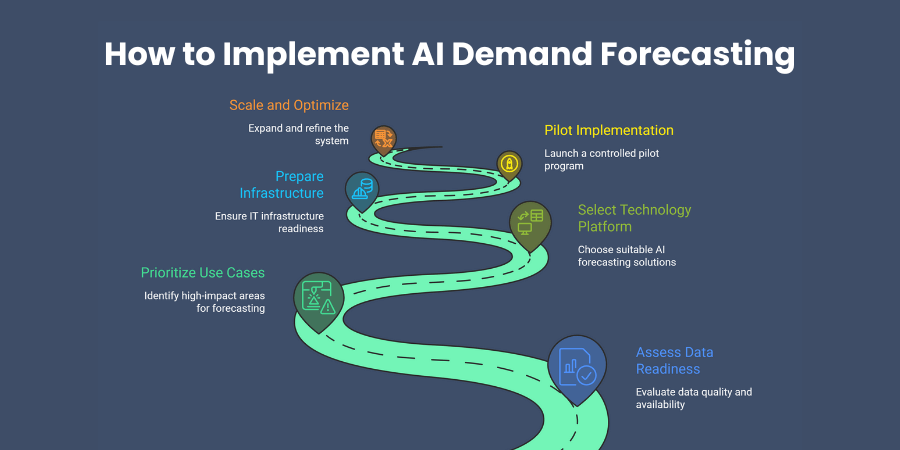
Step 1: Assess Data Readiness: Evaluate your current data quality, availability, and accessibility. You need clean, comprehensive historical data spanning at least two years.
Step 2: Prioritize Use Cases: Identify which products, markets, or business units will benefit most from improved forecasting accuracy. Start with high-impact, manageable scope.
Step 3: Select Technology Platform: Choose AI demand forecasting solutions that integrate with your existing systems and match your technical capabilities.
Step 4: Prepare Infrastructure: Ensure your IT infrastructure can support real-time data processing and model execution requirements.
Step 5: Pilot Implementation: Launch a controlled pilot program with limited scope to test and refine your approach.
Step 6: Scale and Optimize: Gradually expand the system across your organization while continuously monitoring and improving performance.
What should you expect during implementation? The process typically takes 3-6 months for initial deployment, with ongoing optimization continuing indefinitely. Your investment in proper planning and execution will determine long-term success.
Remember, implementation is not just about technology. Your team needs training, processes require updating, and organizational culture must adapt to data-driven decision-making.
Key Metrics to Measure AI Demand Forecasting Performance
How will you know if your AI demand forecasting implementation is successful? These essential metrics will help you track performance and demonstrate ROI.
Forecast Accuracy Metrics:
- Mean Absolute Percentage Error (MAPE): Measures average prediction accuracy
- Mean Absolute Deviation (MAD): Shows average forecast error magnitude
- Tracking Signal: Indicates systematic bias in predictions
Business Impact Metrics:
- Inventory Turnover Improvement: Higher turnover indicates better demand matching
- Service Level Enhancement: Reduced stockouts improve customer satisfaction
- Cost Reduction Indicators: Lower inventory carrying costs and waste reduction
Operational Efficiency Metrics:
- Forecast Generation Time: How quickly you receive updated predictions
- Planning Cycle Reduction: Faster decision-making capabilities
- Exception Management: Fewer manual interventions required
What targets should you set for your organization? Most businesses achieve 15-25% accuracy improvements within six months of implementation. Your specific results will depend on data quality, implementation approach, and organizational commitment.
Regular performance monitoring ensures continuous improvement. Monthly reviews help identify optimization opportunities and validate the system’s ongoing value to your business.
Future Trends in AI Demand Forecasting
Curious about what’s coming next in AI demand forecasting? These emerging trends will shape the future of demand prediction and planning.
Real-Time Forecasting: Systems will provide instant forecast updates as new data arrives. Your predictions will reflect current market conditions continuously.
AI Agents: Autonomous agents will manage entire forecasting workflows, from data collection to decision implementation, with minimal human intervention.
Autonomous Planning Systems: Complete supply chain orchestration based on AI-generated forecasts and automated decision-making.
Multimodal Data Integration: Systems will incorporate images, videos, social media content, and IoT sensor data for comprehensive demand intelligence.
Predictive-to-Prescriptive Evolution: Beyond predicting demand, systems will recommend specific actions to optimize business outcomes.
What do these trends mean for your business strategy? Early adoption of advanced AI demand forecasting capabilities will provide competitive advantages. Companies that embrace these technologies will outperform those relying on traditional methods.
The exciting part is how these trends converge to create intelligent, autonomous demand management systems. Your future forecasting capabilities will be more accurate, responsive, and valuable than ever before.
How Shadhin Lab Helps Businesses Implement AI Demand Forecasting
Looking for expert guidance in your AI demand forecasting journey? Shadhin Lab specializes in transforming businesses through advanced predictive analytics and machine learning solutions.
Our comprehensive approach addresses every aspect of your AI demand forecasting implementation:
Predictive Analytics Expertise: We design custom forecasting models tailored to your specific industry and business requirements.
Machine Learning Solutions: Our team develops and deploys sophisticated algorithms that learn and adapt to your unique demand patterns.
AI Agents Development: We create autonomous systems that manage your forecasting workflows with minimal human intervention.
Enterprise Integration: Our solutions seamlessly connect with your existing ERP, CRM, and supply chain management systems.
Scalable Architecture: We build forecasting platforms that grow with your business and handle increasing complexity effortlessly.
What sets Shadhin Lab apart for your implementation? We combine deep technical expertise with practical business understanding. Your success depends on both technological excellence and strategic implementation.
Our proven methodology ensures rapid deployment and measurable results. You will see forecast accuracy improvements within weeks of implementation, with continuous optimization delivering long-term value.
Conclusion
You now have a comprehensive understanding of how AI demand forecasting can revolutionize your business operations. The question is not whether you should implement this technology, but how quickly you can get started.
Consider the competitive advantage waiting for you: 20-50% reduction in supply chain errors, 65% efficiency improvements, and forecast accuracy rates reaching 95%. Your competitors using traditional methods cannot match these performance levels.
What will you do with this knowledge? The businesses that act quickly will establish market leadership while others struggle with outdated forecasting methods. Your customers expect product availability, your stakeholders demand efficiency, and your bottom line needs optimization.
The future belongs to organizations that embrace AI demand forecasting. You have the roadmap, you understand the benefits, and you know the implementation steps. The only question remaining is: when will you begin your transformation?
Remember, every day you delay implementation is another day of missed opportunities and suboptimal performance. Your journey toward forecasting excellence starts with a single decision to embrace the power of artificial intelligence.
Frequently Asked Questions
How long does it take to see results from AI demand forecasting?
You can expect to see initial improvements in forecast accuracy within 4-6 weeks of implementation. However, the most significant benefits typically emerge after 3-6 months as the system learns your specific business patterns. Your results will depend on data quality and implementation approach.
What data do I need for AI demand forecasting to work effectively?
You need at least 24 months of historical sales data, preferably with additional information like promotions, seasonality, and external factors. The more comprehensive your data, the better your forecasting accuracy will be. Clean, consistent data is more important than volume.
Can AI demand forecasting work for small businesses?
Absolutely! Many cloud-based AI demand forecasting solutions are designed specifically for small and medium businesses. You do not need massive data volumes or complex IT infrastructure to benefit from improved forecasting accuracy.
How much does AI demand forecasting implementation cost?
Implementation costs vary widely based on your business size, complexity, and chosen solution. Cloud-based platforms can start at a few hundred dollars monthly, while enterprise implementations might require significant investment. The ROI typically justifies costs within 6-12 months.
Will AI demand forecasting replace human planners?
No, AI demand forecasting enhances human capabilities rather than replacing planners. Your team will focus on strategic decisions, exception management, and business insights while AI handles routine forecasting tasks. This collaboration produces better results than either approach alone.

Shaif Azad
Shaif Azad Rahi is an AI/ML professional and Solution Engineer at Shadhin Lab, specializing in AI-powered solutions and scalable software systems, with a focus on applying AI to solve real-world business challenges.
Related Post
10 Best AI Sales Agents in 2026: Which One Fits You?
AI sales agents are no longer one clearly defined product category. Some automate outbound prospecting, while...
AI Automation Use Cases to Boost Efficiency
Are you overwhelmed by repetitive tasks that consume hours of your valuable time each day? Businesses...
Generative AI for Startups: Growth & Innovation
Are you struggling to compete with industry giants while operating on a limited budget? You face...
