
AI Workflow Automation: Use Cases & Benefits
Table of Contents
Are you drowning in repetitive tasks that consume hours of your valuable time each day? Picture this: you arrive at work facing the same mundane processes – data entry, email responses, document approvals, and endless team coordination. Modern organizations struggle with these exact challenges that fragment workflows and increase operational complexity.
While you manually process invoices and route customer inquiries, competitors leverage AI Workflow Automation for automatic task handling. Fragmented workflows and increasing operational complexity cost your business more than you realize through reduced productivity and higher operational expenses.
By reading this guide, you will understand how AI Workflow Automation transforms your daily operations completely. You will discover practical solutions combining artificial intelligence with workflow management systems to automate time-consuming tasks. More importantly, you will learn to reduce manual workload while dramatically improving speed and accuracy.
Let us explore how this revolutionary approach helps businesses optimize processes, enable smarter decision-making, and break free from repetitive work cycles.
Key Takeaways
- Readers will be able to understand how AI Workflow Automation transforms repetitive tasks into intelligent, efficient business processes.
- Identify high-impact workflows that can be automated to save time and reduce operational complexity.
- Explore core technologies like machine learning, NLP, and RPA that power intelligent automation systems.
- Discover real-world use cases including customer support, document processing, marketing, HR, and sales automation.
- Evaluate key benefits such as increased efficiency, reduced costs, faster decision-making, and improved accuracy.
- Recognize implementation challenges like system integration, data quality, and change management before starting.
- Apply a practical roadmap to successfully implement, test, and optimize AI-driven workflows in your organization.
- Understand future trends like autonomous AI agents and hyperautomation shaping next-generation business operations.
- See how solutions from Shadhin Lab help businesses deploy scalable and ROI-driven AI workflow automation systems.
Table of Contents
What Is AI Workflow Automation?
Have you wondered what makes AI Workflow Automation different from basic automation tools you currently use? This advanced approach represents intelligent fusion of artificial intelligence with your existing business processes effectively.
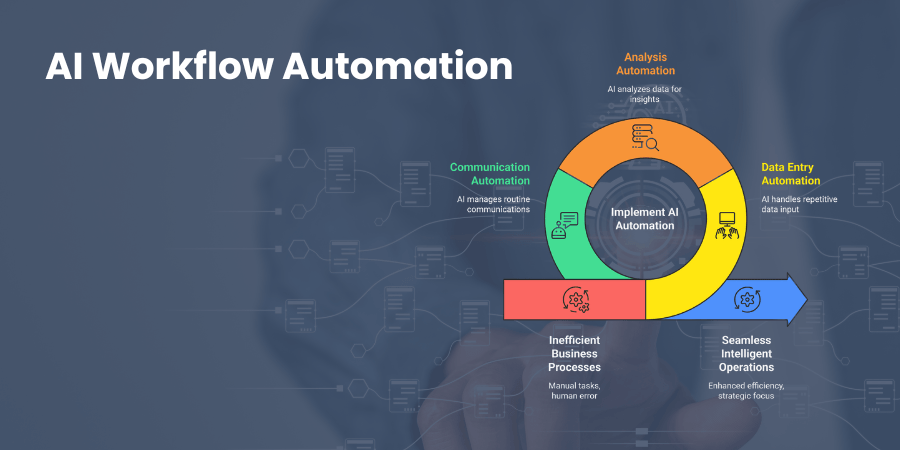
AI Workflow Automation goes beyond traditional automation that simply follows predetermined rules without adaptation. Unlike conventional systems, AI-driven workflows understand context, process unstructured data, make predictions, and trigger intelligent actions based on real-time analysis.
When you implement AI-driven workflows, you create smart assistants handling complex decision-making processes automatically. Picture managing customer support tickets, marketing campaigns, document processing, and internal approvals happening automatically while you focus on strategic initiatives.
This technology adapts to your specific business needs whether processing customer inquiries, managing inventory, or coordinating projects. AI automation learns from your patterns and continuously improves performance over time.
Core Technologies Behind AI Workflow Automation
Wondering how intelligent automation works behind the scenes? Let me explain key technologies making your automated workflows powerful.
Machine learning serves as your automation system brain, recognizing data patterns and making predictions about future outcomes. When you receive customer emails, machine learning algorithms instantly categorize them and predict optimal response strategies.
Natural language processing enables workflows to understand and process text-based communications from various sources. Your automated system reads customer messages, extracts important information, and generates appropriate responses in your voice.
Robotic process automation handles actual task execution within your workflows like updating databases, sending notifications, and moving files. AI agents coordinate and manage your entire workflow ecosystem, ensuring each step happens correctly.
Why Businesses Are Adopting AI Workflow Automation
Are you feeling pressure to accomplish more with fewer resources while maintaining high-quality standards? You are not alone in facing this modern business challenge.
The driving force behind AI automation adoption stems from increasingly complex business environments requiring faster decisions. You deal with more data sources, stricter decision-making timelines, and higher customer expectations than ever.
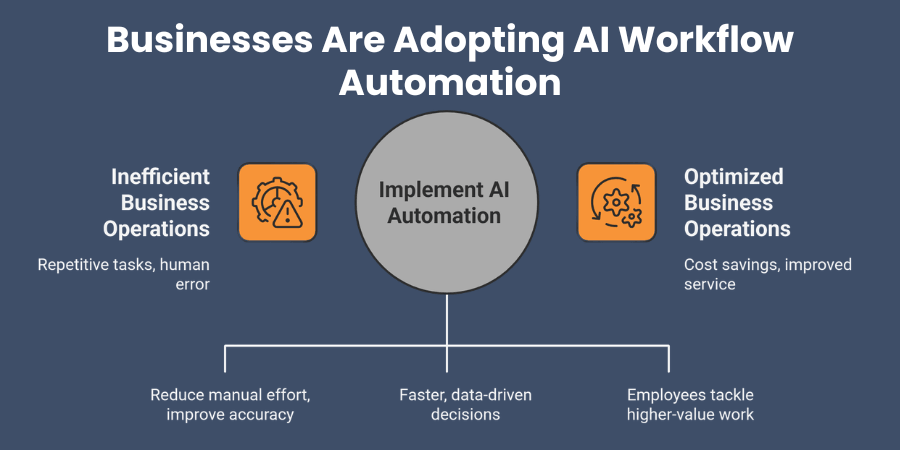
Rising operational complexity means juggling multiple systems, platforms, and processes simultaneously without proper coordination tools. Your team spends valuable time on manual coordination instead of focusing on growth-driving activities.
Customers expect immediate responses and personalized experiences that manual processes simply cannot deliver consistently. Real-time data processing becomes essential for staying competitive in rapidly changing markets.
The strategic advantage comes from viewing AI Workflow Automation as operational improvement rather than technology upgrade. You build more responsive, efficient, and scalable versions of current business operations.
How AI Workflow Automation Works
Curious about actual mechanics of data flowing through your automated systems? Let me explain three essential layers making workflows intelligent and efficient.
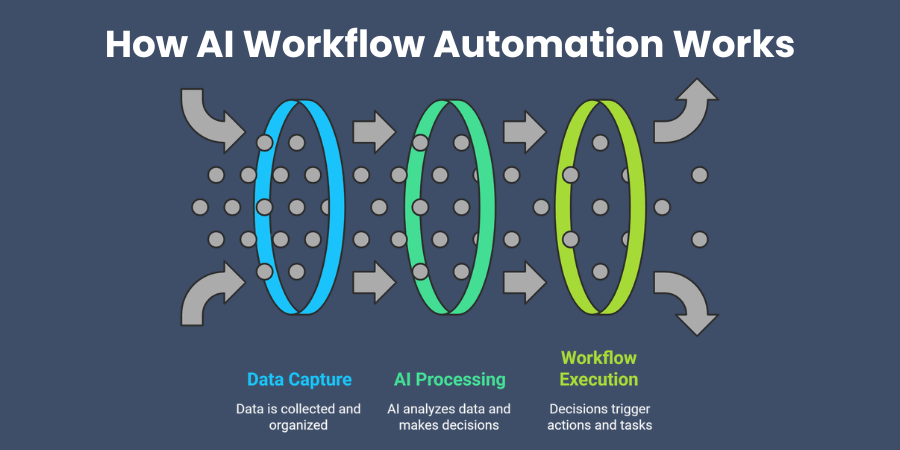
Input and Data Capture Layer
Your automated workflows begin capturing information from multiple sources you already use daily including customer emails. This includes form submissions from websites, CRM system data, uploaded documents, and direct customer interactions.
The beauty lies in not changing how customers or team members interact with your business. The automation layer captures information as it naturally occurs without disrupting existing processes.
AI Processing and Decision Layer
Here AI systems analyze incoming data, identify patterns from historical information, and determine appropriate next actions. When receiving customer support requests, AI evaluates content, checks knowledge bases, considers customer history, and decides responses.
This intelligent processing eliminates manual review bottlenecks while ensuring consistent, accurate decision-making across all workflows.
Workflow Execution Layer
This final layer handles actual task execution that normally requires your manual attention and oversight. The system automatically sends notifications, updates databases, routes tasks to appropriate team members, and generates reports.
You maintain complete visibility and control while eliminating time-consuming manual steps requiring constant attention.
AI Workflow Automation Use Cases
Ready to see how AI automation transforms your specific business operations? Let us explore impactful applications revolutionizing daily workflows.
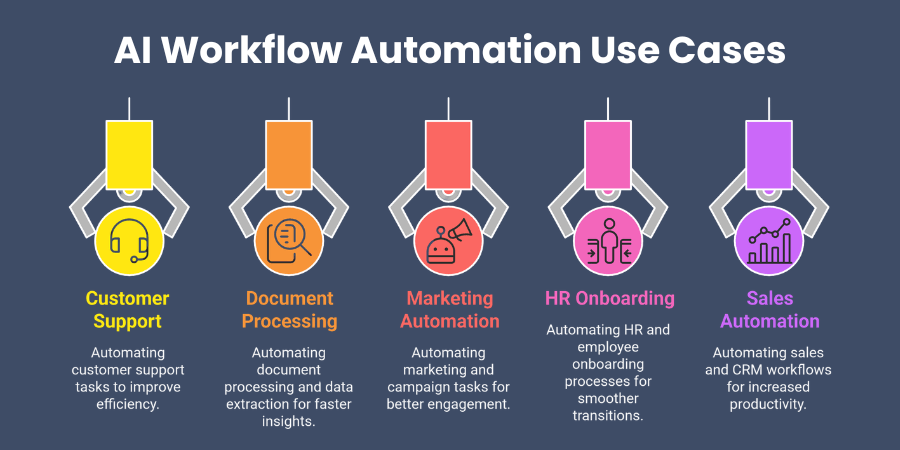
Customer Support Automation
Imagine never manually sorting customer inquiries again while improving response times and satisfaction rates. AI-powered support automation analyzes incoming tickets, categorizes by urgency and topic, and provides immediate responses.
Your customers receive faster responses while support teams focus on high-value interactions requiring human expertise. You gain detailed insights into common customer concerns and resolution patterns for continuous improvement.
Document Processing and Data Extraction
Are you still manually entering data from invoices, contracts, and forms into various systems? AI automation extracts relevant information instantly, populates systems automatically, and flags inconsistencies for review.
This transformation eliminates data entry errors while freeing teams to focus on analysis and decision-making.
Marketing and Campaign Automation
Your marketing efforts become significantly more effective when AI manages campaign triggers and personalizes messaging. The system learns from successful campaigns and automatically applies insights to future marketing initiatives.
Real-time performance optimization ensures consistent improvement in campaign results and customer engagement rates.
HR and Employee Onboarding
New employee onboarding becomes seamless when AI automation handles document processing, system access provisioning, and training coordination. Your HR team focuses on relationship building while ensuring consistent, comprehensive onboarding support.
Progress tracking and automated follow-ups ensure no steps are missed in the onboarding process.
Sales and CRM Workflow Automation
Your sales process becomes more predictable when AI handles lead qualification, follow-up scheduling, and pipeline updates. Sales representatives spend more time building relationships while the system manages administrative tasks.
Predictive insights about deal closure probability help prioritize efforts and improve conversion rates significantly.
Benefits of AI Workflow Automation
Wondering what specific improvements you can expect when implementing AI automation in your business operations? Let me share measurable outcomes organizations experience.
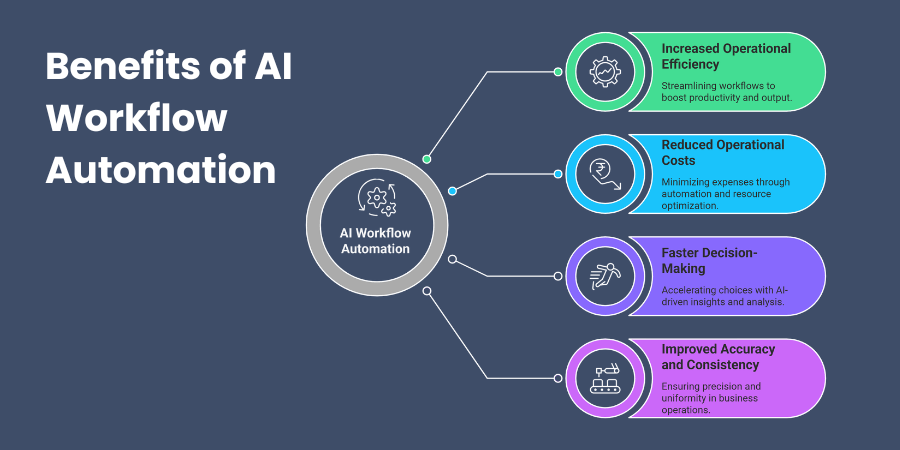
Increased Operational Efficiency
Your team productivity increases dramatically when AI handles repetitive tasks and accelerates process completion times. Tasks requiring hours of manual work now complete in minutes, allowing focus on strategic initiatives.
This efficiency gain translates directly into improved customer service and faster project delivery timelines.
Reduced Operational Costs
Automation reduces reliance on manual labor for routine tasks, leading to significant cost savings over time. You reallocate human resources to higher-value activities while maintaining or improving service quality standards.
Faster Decision-Making
Real-time data analysis enables immediate action triggers, eliminating delays caused by manual review processes completely. Your business becomes more responsive to customer needs and market changes requiring quick adaptation.
Improved Accuracy and Consistency
Automated workflows eliminate human errors and maintain standardized processes across your entire organization effectively. This consistency improves customer experience while reducing costly mistakes that impact profitability.
AI Workflow Automation for Small vs Enterprise Businesses
Are you wondering how your business size affects your automation strategy and implementation approach? The strategy differs significantly based on organizational scale and available resources.
Small businesses typically benefit from ready-made automation tools requiring minimal customization and technical expertise. You can implement solutions quickly, focusing on immediate productivity gains in specific areas.
Enterprise organizations implement sophisticated, integrated AI systems connecting multiple internal platforms and handling complex workflows. Your automation strategy involves custom development, extensive integration requirements, and comprehensive change management.
The key difference lies in workflow complexity, data scale, and integration requirements affecting implementation timelines. Small businesses prioritize quick wins and cost-effective solutions while enterprises focus on comprehensive transformation.
Consider your current technical capabilities, budget constraints, and growth projections when choosing your automation approach.
Challenges and Limitations of AI Workflow Automation
Have you considered potential obstacles you might encounter during your automation journey? Understanding these challenges helps you prepare for successful implementation.
Integration with Existing Systems
Connecting automation tools with legacy software and databases can present significant technical challenges requiring expertise. Your existing systems might require updates or custom integration work to communicate effectively.
Planning for integration complexity early in project timelines prevents delays and ensures smooth deployment.
Data Quality and Availability
Poor data quality significantly reduces effectiveness of AI-driven workflows and system reliability over time. Incomplete, inconsistent, or outdated information leads to incorrect automated decisions requiring manual intervention.
Investing in data cleanup and establishing quality standards before implementing automation ensures better outcomes.
Change Management and Adoption
Your team members need proper training and support to adapt to automated workflows successfully. Resistance to change can undermine even well-designed automation systems requiring careful management.
Developing comprehensive training programs and involving employees in automation design increases adoption rates significantly.
How to Implement AI Workflow Automation
Ready to begin your automation journey with confidence? Here is a practical roadmap guiding you through successful implementation.
Identify High-Impact Processes
Start by analyzing current workflows to identify repetitive, high-volume tasks with clearly defined steps. Focus on processes consuming significant time while providing limited strategic value to your organization.
Document these processes thoroughly, including decision points, data sources, and desired outcomes for automation design.
Select the Right Automation Platform
Choose tools integrating seamlessly with existing systems and supporting AI capabilities you need for success. Consider factors like ease of use, scalability, support quality, and total cost of ownership.
Evaluate platforms based on specific requirements rather than general feature lists for better alignment.
Test, Monitor, and Optimize
Implement automation gradually, starting with pilot projects demonstrating value quickly and building organizational confidence. Use analytics and feedback to refine workflows continuously, ensuring adaptation to changing business needs.
Regular monitoring helps identify optimization opportunities and ensures automated systems continue delivering expected benefits.
Future of AI Workflow Automation
Curious about where automation technology is heading and how it might impact your business strategy? Let us explore emerging developments shaping future operations.
Autonomous AI Agents
The next generation of AI systems will manage complex multi-step workflows with minimal human input. These autonomous agents will coordinate between departments, make strategic decisions, and adapt automatically.
Your business operations will become increasingly self-managing, allowing focus on innovation and strategic planning.
Hyperautomation
This comprehensive approach combines AI, robotic process automation, and advanced analytics to automate entire processes. You will see complete workflow ecosystems operating with minimal human intervention requirements.
Hyperautomation represents evolution from task-level automation to process-level transformation, fundamentally changing organizational operations.
Intelligent Decision Automation
Future AI systems will analyze complex data sets and automatically trigger strategic actions based on insights. Your business will respond to market changes before you recognize patterns manually.
This predictive capability transforms automation from reactive task execution to proactive business strategy implementation.
How Shadhin Lab Enables AI Workflow Automation
Are you looking for expert guidance to implement AI automation successfully in your organization? Shadhin Lab specializes in helping businesses navigate workflow transformation complexities with proven expertise.
Our team brings deep expertise in workflow design, AI agent development, system integrations, and scalable architecture. We understand every business has unique requirements and challenges requiring customized solutions.
We work closely with your team to identify high-impact automation opportunities and design efficient workflows. Our approach focuses on practical solutions delivering measurable results while building internal capabilities.
Whether you need simple task automation or comprehensive workflow transformation, Shadhin Lab provides technical expertise necessary for successful implementation.
Frequently Asked Questions
What is the difference between traditional automation and AI Workflow Automation?
Traditional automation follows predetermined rules and cannot adapt to new situations or changing conditions. AI Workflow Automation understands context, processes unstructured data, learns from patterns, and makes intelligent decisions. You get flexibility and adaptability that traditional systems cannot provide for complex workflows.
How long does it take to implement AI Workflow Automation?
Implementation timelines vary based on complexity and scope of your automation project requirements. Simple workflows can be automated within weeks, while comprehensive systems may require several months. Your timeline depends on existing system integration requirements and the number of processes you want to automate.
Do I need technical expertise to use AI automation tools?
Many modern AI automation platforms offer user-friendly interfaces requiring minimal technical knowledge for basic implementations. However, complex implementations benefit from technical expertise and professional guidance. You can start with simple tools and gradually build more sophisticated workflows as comfort increases.
What is the typical return on investment for AI Workflow Automation?
Most organizations see positive ROI within 6-12 months through reduced labor costs, improved efficiency, and fewer errors. Your specific ROI depends on the processes you automate and implementation scale. Time savings and accuracy improvements often provide immediate value that compounds over time.
Can AI automation integrate with my existing business systems?
Yes, most AI automation platforms offer integration capabilities with popular business systems including CRM, ERP, email platforms, and databases. However, legacy systems may require custom integration work and professional assistance. Proper planning ensures smooth connectivity across your technology stack for optimal performance.
Conclusion
You now have comprehensive understanding of how AI Workflow Automation can transform your business operations completely. The question is not whether automation will impact your industry, but how quickly you embrace these capabilities.
Organizations implementing AI automation today build operational foundations for tomorrow’s success and competitive advantage. You have the opportunity to reduce manual workload, improve accuracy, and scale operations more effectively.
What will you automate first? Which repetitive process in your daily routine could benefit from intelligent automation? The possibilities are endless, and tools for achieving transformation are more accessible than imagined.
Your journey toward operational excellence begins with a single automated workflow that demonstrates value immediately. Take that first step, and discover how AI Workflow Automation revolutionizes not just processes, but your entire approach to business efficiency and sustainable growth.

Shaif Azad
Related Post

Generative AI in eCommerce: Use Cases & Benefits
Are you managing an online store while feeling overwhelmed by constant pressure to scale your product...

Conversational AI for Real Estate: Use Cases & Benefits
Are you overwhelmed by constant property inquiries flooding your inbox? Have you wondered how some real...

How Conversational AI Improves Healthcare
Have you ever waited on hold for healthcare appointments, transferred multiple times before getting simple answers?...
