
How We Stopped Dreading Release Day: Our Journey with AWS CodePipeline
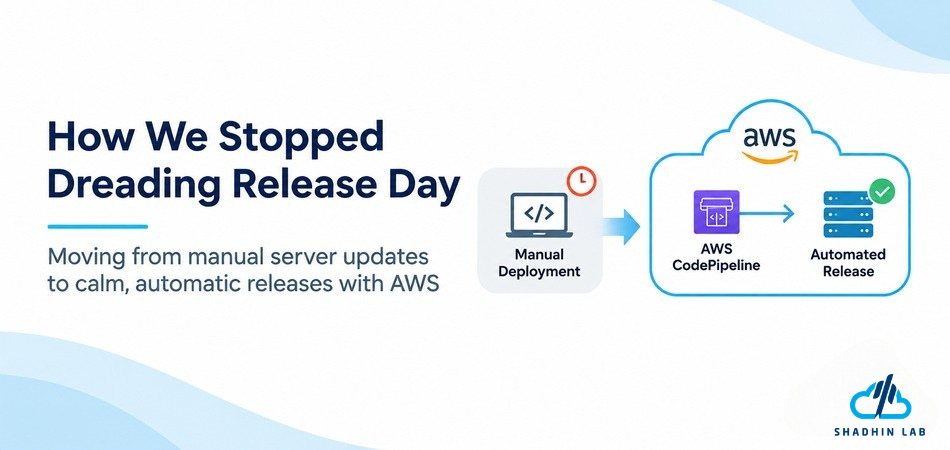
Table of Contents
Release day used to be one of the most stressful parts of our development process. Deploying application updates meant logging into servers, copying code manually, checking configurations, and hoping nothing went wrong. A small typing mistake could break the live application, while simultaneous updates sometimes overwrote each other.
We realized that our deployment process needed a better approach. Instead of depending on manual server updates, we started moving toward automated deployments using AWS CodePipeline.
Table of Contents
Life Before Automation
Our previous deployment process came with several operational challenges.
Manual server updates increased the risk of human error. Development and production environments sometimes behaved differently, making it difficult to identify deployment issues. When multiple developers deployed updates simultaneously, their changes could overwrite one another.
Recovering from a failed update was another challenge. Identifying what changed, locating the problem, and restoring the previous working version often required unnecessary investigation.
These issues made releases unpredictable and consumed valuable development time.
How We Built It Step by Step
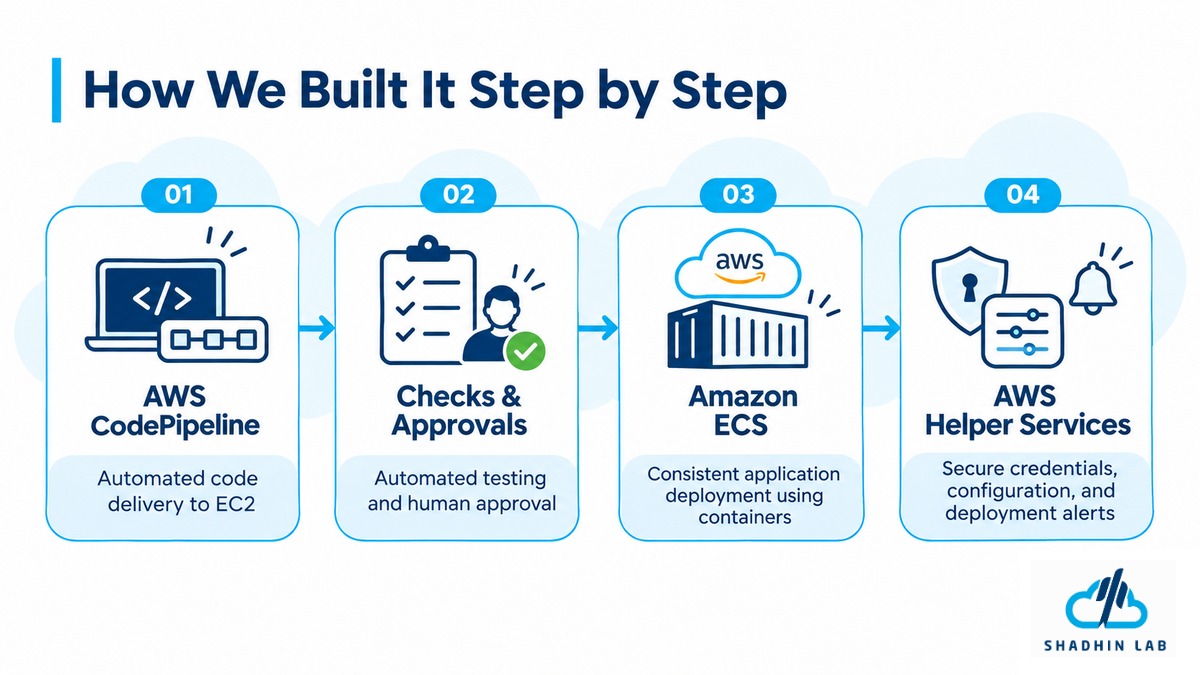
We did not automate everything overnight. Instead, we improved our deployment workflow gradually by introducing AWS services.
Started with AWS CodePipeline
Our first step was introducing AWS CodePipeline to automate application delivery. Instead of manually logging into an EC2 server and copying application code, we established a pipeline to manage code deployment automatically.
This reduced repetitive deployment activities and provided a more consistent release process.
Added Testing and Approvals
Automation alone was not enough. We introduced automated checks and human approval before important releases.
This helped identify potential problems earlier while ensuring engineers remained involved in decisions affecting production applications.
Standardized Applications with Amazon ECS
As our deployment requirements evolved, we introduced Amazon Elastic Container Service (ECS) to package and run applications more consistently.
Containerization helped reduce differences between environments and made application deployment more predictable.
Connected Supporting AWS Services
We added additional AWS services to improve security, configuration management, and operational monitoring.
How AWS Tools Work Together
A reliable deployment environment requires more than a deployment pipeline. Different AWS services support different operational responsibilities.
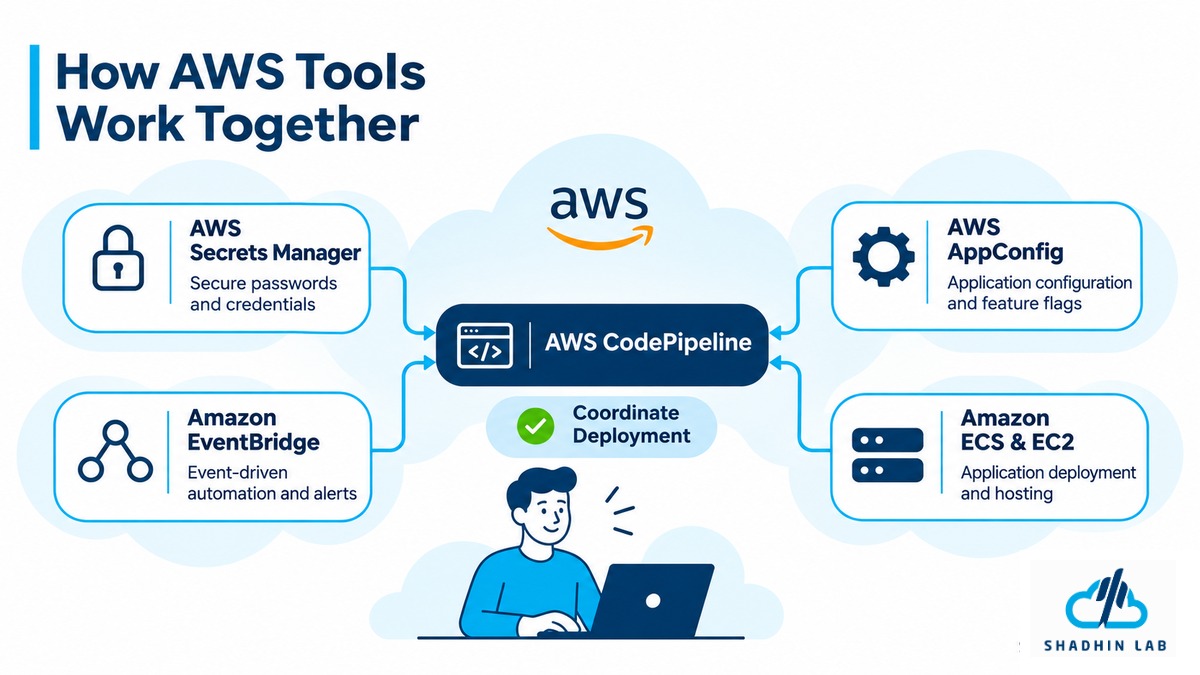
- AWS Secrets Manager: Stores sensitive information, such as passwords and credentials, outside application code.
- AWS AppConfig: Manages application configurations and feature flags without requiring a complete application release.
- Amazon EventBridge: Connects events with automated actions and helps trigger notifications.
- Amazon ECS and EC2: Support containerized applications and traditional server-based workloads.
AWS CodePipeline coordinates application delivery, while these supporting services help maintain security, flexibility, and operational control.
Together, they create a more organized deployment environment where different responsibilities are handled by appropriate services.
The Good vs. The Challenging
Moving toward automated deployments improved several aspects of our workflow.
The biggest advantage was reducing manual server maintenance. Deployment progress became easier to monitor, and integrating with other AWS services became more straightforward.
However, automation introduced new responsibilities.
Managing multiple pipelines across applications required planning. Troubleshooting sometimes involved checking several AWS services, while configuring permissions correctly required additional attention.
The lesson was simple: automation reduces repetitive work, but it does not eliminate the need for good operational practices.
Staying Safe: Our Simple Routine
To maintain a reliable deployment environment, we established a regular maintenance routine.
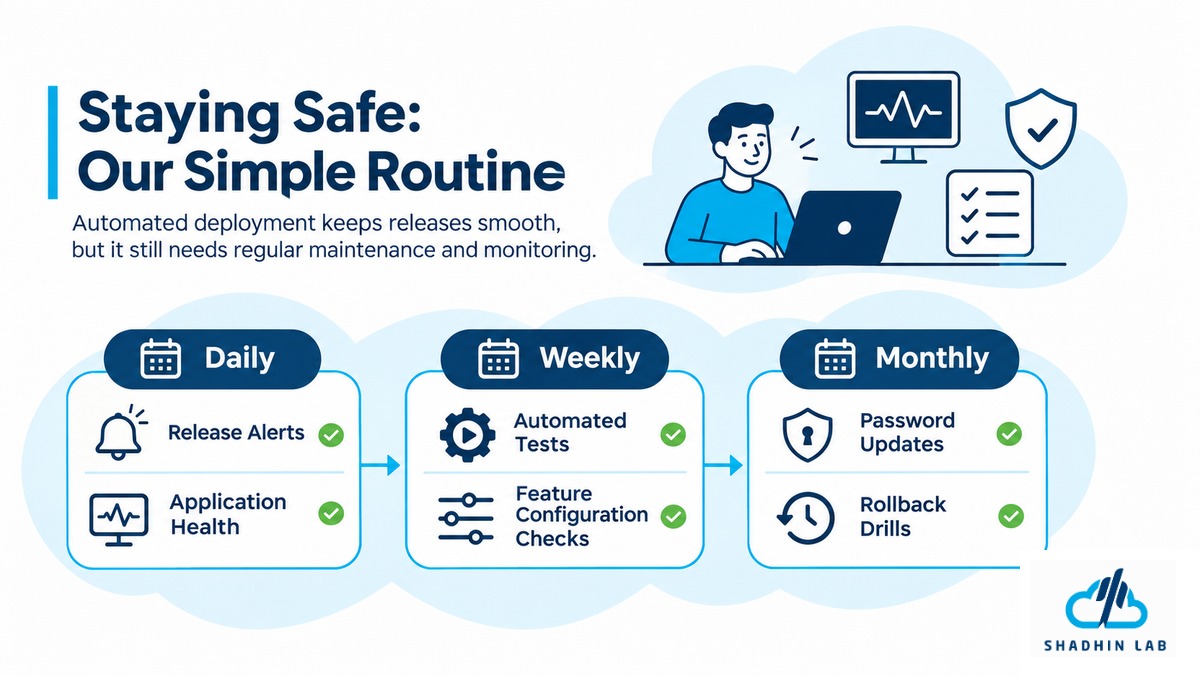
Daily: Review release alerts and live application health to identify failed updates quickly.
Weekly: Check slower automated tests and existing feature configurations to maintain reliable releases.
Monthly: Review passwords, update credentials, and practice rollback procedures to remain prepared for deployment failures.
This routine helps identify potential problems before they become larger operational issues.
Scaling with Teams, Security, and AI
As development workflows grow, teams need to release updates independently without compromising application stability.
We encourage independent teams to deploy their changes without unnecessarily blocking one another. However, engineers remain responsible for approving important production releases.
We also explored AI-assisted error detection. AI tools can analyze error logs and help identify potential problems more quickly, including through MCP-based tool connections.
For example, an AI-powered error detection workflow could examine deployment logs, identify recurring errors, and provide useful troubleshooting insights.
However, AI supports the engineering team rather than replacing its responsibilities. Human approval, restricted access, and security checks remain essential parts of the deployment process.
Conclusion
Our journey with AWS CodePipeline was not simply about introducing automation. It was about making deployments more consistent, predictable, and manageable.
By combining automated delivery, testing, human approvals, secure configuration management, and monitoring, we moved away from stressful manual releases toward a more reliable deployment process.
The best deployment experience is often the one nobody has to worry about. When releases become predictable, engineering teams can spend less time managing deployment problems and more time building better applications.

Md. Ariful Islam
Md. Ariful Islam is a Software Engineer at Shadhin Lab LLC with experience in backend development, API development, and cloud based applications. He works with Python, Django, FastAPI, Laravel, and AWS. He holds a BSc in Computer Science and Engineering and is an AWS Certified Solutions Architect Associate.
Related Post
How to Integrate AI Agents with Salesforce
Sales teams often spend hours retrieving customer information, updating CRM records, summarizing interactions, and managing follow-up...
AI ERP Integration: Use Cases, Benefits, and Implementation
Enterprise resource planning (ERP) systems centralize business operations, from finance and inventory to procurement, sales, and...
MCP vs APIs: Are APIs Becoming Obsolete?
Artificial Intelligence is changing how applications interact with software. AI assistants and autonomous agents can now...
