
How Does AI Reduce Costs? A Guide to Business Cost Optimization
Table of Contents
Are you lying awake wondering how your business can survive rising operational costs? Have you watched labor expenses climb while profit margins shrink relentlessly? You are not alone in this struggle that plagues modern businesses everywhere.
Modern businesses face unprecedented challenges with operational costs, labor expenses, and efficiency bottlenecks that seem impossible to overcome. What if artificial intelligence offers a strategic solution beyond simple job replacement?
How Does AI Reduce Costs is not just about cutting workforce expenses or replacing human workers. Instead, AI serves as a comprehensive cost-reduction enabler that transforms how your organization operates, makes decisions, and serves customers effectively.
By the end of this guide, you will understand exactly how AI can slash operational expenses while improving service quality. Let us explore this transformative journey together and discover how you can harness AI to build a more profitable business.
Key Takeaways
- Readers will be able to understand how AI reduces operational costs while improving efficiency, accuracy, and service quality.
- Identify key business cost areas where AI delivers the highest savings, including labor, operations, and customer support.
- Leverage AI automation and predictive analytics to prevent costly errors, downtime, and inefficiencies.
- Optimize supply chain, inventory, and workflow processes using AI-driven insights and intelligent resource allocation.
- Measure AI-driven cost savings using clear KPIs such as cost-per-task reduction, efficiency gains, and ROI.
- Implement practical AI cost-reduction strategies across departments to achieve long-term profitability and scalability.
Table of Contents
Understanding Business Cost Structures
Have you ever wondered where your business money actually goes each month? Understanding your cost structure is crucial before you can appreciate how AI transforms your financial landscape completely.
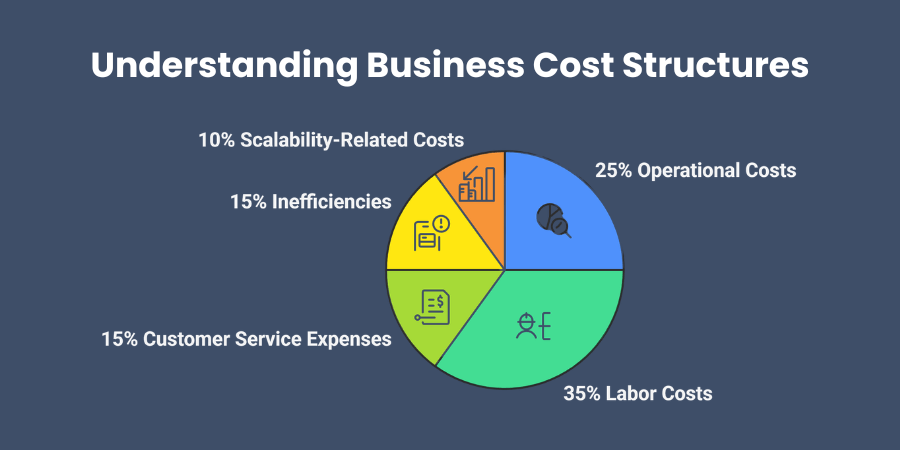
Your organization likely faces five major cost categories that drain resources daily without delivering proportional value. Operational costs include utilities, rent, equipment maintenance, and administrative overhead that keep your business running smoothly.
Labor costs encompass salaries, benefits, training, and productivity-related expenses that often represent your largest expense category. Customer service expenses involve support staff, call center operations, and resolution processes that directly impact your bottom line.
Inefficiencies create hidden costs through errors, delays, rework, and missed opportunities that you might not even track properly. Scalability-related costs emerge when you need additional resources to handle growth or seasonal fluctuations effectively.
These costs interconnect and compound, creating a complex web of financial challenges that traditional solutions cannot adequately address.
How Does AI Reduce Costs?
Wondering how artificial intelligence actually delivers measurable cost savings for your business operations? The answer lies in four core mechanisms that transform how your organization operates and allocates resources strategically.
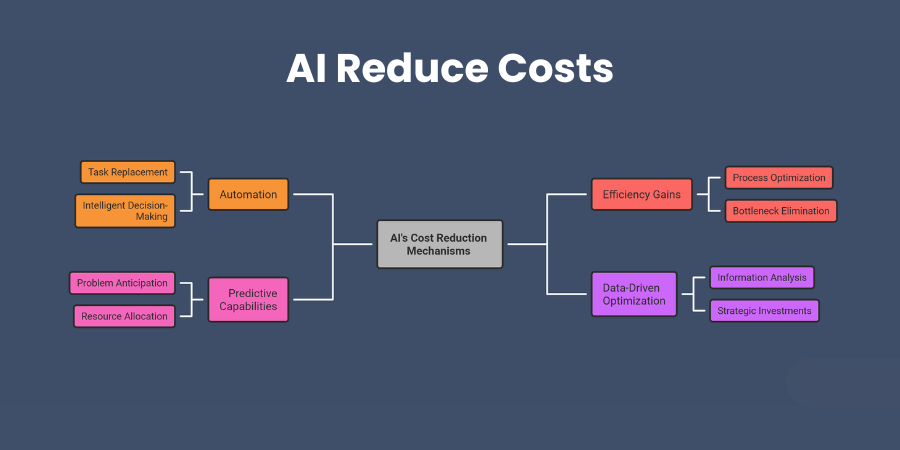
Automation represents the most visible cost-reduction mechanism, where AI handles repetitive tasks that currently require human intervention. However, automation extends beyond simple task replacement to include intelligent decision-making and complex problem-solving capabilities.
Efficiency gains occur when AI optimizes processes, eliminates bottlenecks, and accelerates task completion throughout your organization. Your team can accomplish more work in less time while maintaining higher quality standards than manual processes.
Predictive capabilities enable AI to anticipate problems before they occur, preventing costly issues rather than reacting to them. This proactive approach saves money by avoiding downtime, reducing waste, and optimizing resource allocation based on accurate forecasting.
Data-driven optimization helps AI analyze vast amounts of information to identify cost-saving opportunities that humans might miss. These insights enable smarter decisions about resource allocation, process improvements, and strategic investments that compound savings.
How Does AI Reduce Costs becomes clear when you consider these mechanisms working together to create comprehensive transformation.
AI-Driven Process Automation
Are you tired of watching your team spend hours on repetitive tasks that add little strategic value? AI-driven process automation addresses this frustration by handling routine work more efficiently than human workers ever could.
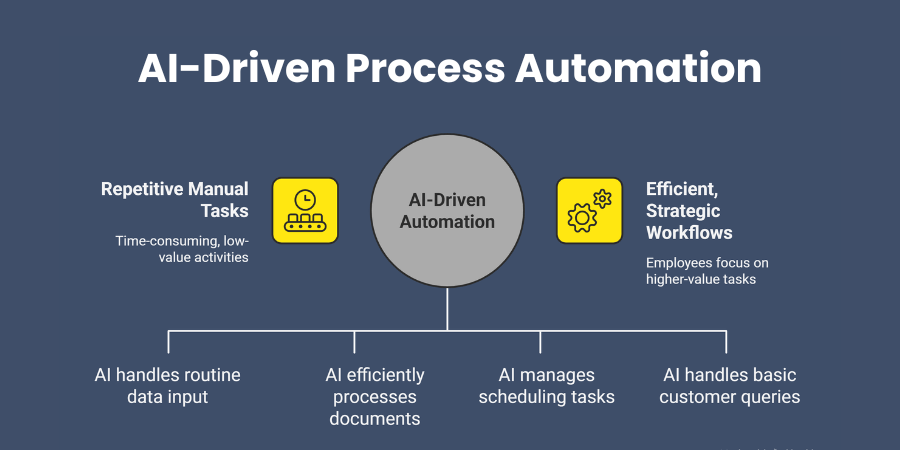
Automation reduces your labor dependency by taking over data entry, document processing, scheduling, and basic customer interactions. Your employees can focus on higher-value activities that require creativity, strategic thinking, and complex problem-solving skills instead.
Faster execution becomes possible when AI processes information and completes tasks without breaks, delays, or human error. You can handle larger volumes of work without proportionally increasing your workforce or operational costs significantly.
Lower error rates result from AI’s consistent performance and ability to follow precise instructions without fatigue or distraction. Fewer errors mean less rework, reduced customer complaints, and lower costs associated with fixing mistakes repeatedly.
Consider how your current manual processes create bottlenecks and consume valuable time that could be better allocated. AI automation can transform these pain points into smooth, efficient workflows that operate continuously without additional labor.
Cost Reduction Through AI in Customer Support
Have you calculated how much your customer support operations cost per interaction with each customer? AI-powered customer support solutions can dramatically reduce these expenses while improving service quality and customer satisfaction simultaneously.
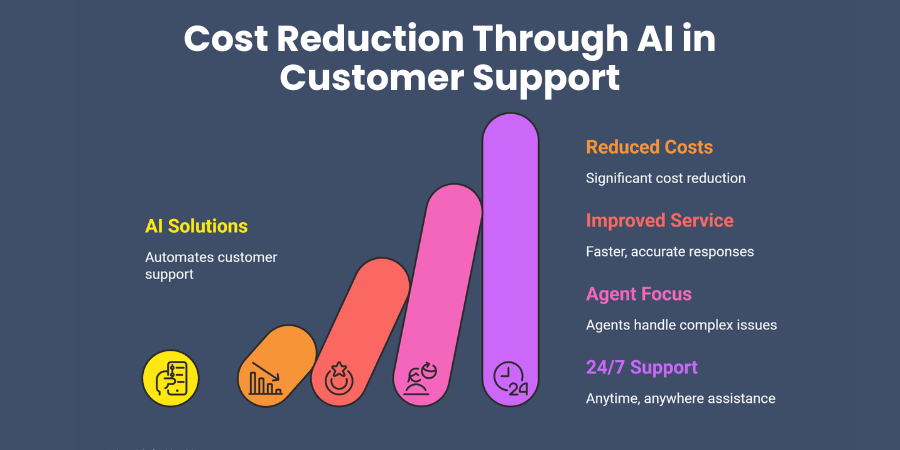
Chatbots and voice bots handle routine inquiries, password resets, order status checks, and basic troubleshooting without human intervention. Your customers receive instant responses while your support costs decrease significantly across all interaction channels.
Reduced call volumes occur when AI resolves common issues through self-service options and intelligent routing systems. Your human agents can focus on complex problems that require empathy and advanced problem-solving skills effectively.
Faster resolution times result from AI’s ability to access information instantly and provide accurate answers without research delays. Your customers experience better service while your operational costs decrease substantially over time.
Twenty-four-seven self-service capabilities mean your customers can get help anytime without requiring additional staffing investments. You can provide excellent support coverage without the expense of round-the-clock human agents working shifts.
Picture your current support costs and imagine reducing them by forty to sixty percent while improving satisfaction. This transformation becomes possible when you implement AI-powered conversational solutions strategically throughout your customer service operations.
AI in Operations and Workflow Optimization
Wondering how AI can streamline your internal operations beyond customer-facing applications and external interactions? Operational AI delivers significant cost savings through intelligent resource management and process optimization across all business functions.
Scheduling optimization helps AI coordinate resources, appointments, and workflows more efficiently than manual planning ever could. Your organization can maximize utilization while minimizing conflicts and downtime that waste valuable resources unnecessarily.
Resource allocation becomes more precise when AI analyzes demand patterns, capacity constraints, and performance data continuously. You can deploy your assets more effectively while reducing waste and idle time significantly.
Process optimization occurs when AI identifies bottlenecks, redundancies, and improvement opportunities within your existing workflows. These insights enable you to eliminate inefficiencies that drain resources without adding measurable value.
Operational intelligence provides real-time visibility into your business performance, enabling faster decision-making and proactive problem resolution.
Predictive Analytics and Cost Prevention
What if you could prevent costly problems before they occur rather than reacting after damage is done? Predictive analytics represents one of the most powerful ways AI reduces costs through prevention rather than correction.
Demand forecasting enables more accurate inventory planning, staffing decisions, and resource allocation across your entire organization. You can avoid overstocking, understaffing, and other costly misalignments between supply and demand patterns effectively.
Predictive maintenance identifies equipment issues before failures occur, reducing downtime and repair costs that disrupt operations. Your maintenance becomes proactive rather than reactive, saving money and preventing disruptions that affect customer service.
Fraud detection catches suspicious activities early, preventing losses and reducing investigation costs that drain security budgets. AI can identify patterns that humans might miss while processing transactions in real-time without delays.
Risk mitigation helps you identify potential problems across your operations and take preventive action before issues escalate. This proactive approach saves money by avoiding issues rather than fixing them after they occur.
Consider how much your organization spends on emergency repairs, rush orders, and crisis management annually. Predictive analytics can transform these reactive expenses into proactive investments that cost significantly less overall.
AI Cost Reduction in Supply Chain and Inventory Management
Are you struggling with inventory costs that seem impossible to optimize despite your best efforts? Supply chain AI addresses these challenges by improving forecasting accuracy and operational efficiency throughout your distribution network.
Minimizing overstocking reduces carrying costs, storage expenses, and obsolescence risks that eat into profit margins. AI analyzes demand patterns, seasonal trends, and market conditions to optimize inventory levels precisely without guesswork.
Preventing stockouts eliminates lost sales, rush shipping costs, and customer dissatisfaction that damages your reputation. Your inventory management becomes more responsive to actual demand rather than relying on historical guesswork alone.
Logistics optimization reduces transportation costs through route planning, load optimization, and carrier selection based on data. AI can identify the most cost-effective shipping options while maintaining service quality standards consistently.
Forecasting accuracy improvements enable better planning across your entire supply chain from suppliers to customers. You can coordinate with suppliers, manage cash flow, and optimize operations based on reliable predictions.
AI-Powered Decision-Making and Strategic Cost Control
How confident are you in your current decision-making processes when significant costs are at stake? AI enhances executive and managerial decisions by providing data-driven insights that reduce expensive mistakes and improve outcomes.
Scenario analysis helps you evaluate different options and their potential costs before making major commitments. AI can model various scenarios and predict outcomes more accurately than traditional planning methods allow.
Cost modeling provides detailed analysis of how different decisions impact your financial performance across multiple variables. You can understand the true cost implications of strategic choices before implementation begins.
Budget allocation optimization ensures your resources go toward the highest-impact activities that generate measurable returns. AI analyzes performance data to recommend where investments will generate the best returns consistently.
Strategic insights emerge from AI’s ability to process vast amounts of data and identify patterns. Your leadership team can make more informed choices that reduce costs and improve outcomes.
Hidden and Indirect Cost Savings Enabled by AI
Have you considered the indirect ways AI saves money beyond obvious automation benefits and direct replacements? These hidden savings often exceed the direct cost reductions you initially expect from implementation.
Reduced errors across your operations eliminate rework, customer complaints, and reputation damage that costs money. AI’s consistency prevents costly mistakes that require time and resources to correct after they occur.
Improved compliance reduces regulatory risks, fines, and audit costs that can devastate your budget unexpectedly. AI can monitor compliance requirements continuously and flag potential issues before they become expensive problems.
Lower training costs result from AI handling routine tasks that require extensive human training and certification. Your onboarding becomes faster and less expensive when AI manages standardized processes automatically.
Faster onboarding enables new employees to become productive quickly with AI assistance and automated guidance. You can reduce the time and cost associated with bringing new team members up to speed.
Productivity gains occur when your team can focus on high-value activities while AI handles routine work. This shift improves overall output without increasing labor costs proportionally across your organization.
Challenges and Considerations When Using AI for Cost Reduction
Worried about the challenges you might face when implementing AI for cost reduction in your organization? Understanding these considerations helps you plan more effectively and avoid common pitfalls that derail projects.
Implementation costs require upfront investment in technology, training, and integration that can strain budgets initially. However, you should view these as investments that generate returns rather than pure expenses without value.
Data readiness challenges emerge when your information systems are not prepared for AI implementation and analysis. You might need to clean, organize, and standardize data before AI can deliver optimal results.
Integration complexity can create temporary disruptions as AI systems connect with existing processes and legacy systems. Careful planning and phased implementation help minimize these challenges while maintaining operational continuity throughout transitions.
Change management becomes crucial when your team needs to adapt to new AI-powered workflows and processes. You must invest in training and communication to ensure successful adoption across all organizational levels.
ROI measurement challenges arise when benefits are difficult to quantify or take time to materialize fully. You need clear metrics and patience to accurately assess AI’s cost reduction impact over time.
How to Measure Cost Savings from AI
How will you know if your AI investment is actually reducing costs as promised by vendors? Measuring AI-driven cost reduction requires systematic tracking and analysis of multiple metrics across different operational areas.
Key performance indicators should include cost-per-task reduction, processing time improvements, error rate decreases, and resource utilization optimization. These metrics provide concrete evidence of AI’s financial impact on your organization’s bottom line.
Cost-per-task reduction measures how much less it costs to complete specific activities with AI assistance. You can compare before and after costs to quantify direct savings from automation implementations.
Efficiency metrics track how AI improves speed, accuracy, and throughput across your operations and workflows. These improvements translate directly into cost savings through better resource utilization and reduced waste.
ROI models help you calculate the return on your AI investment by comparing costs and benefits. You should include both direct and indirect savings in these calculations for accurate assessment.
Industries Where AI Delivers the Highest Cost Savings
Wondering if your industry is particularly well-suited for AI cost reduction compared to other sectors? Certain sectors experience more dramatic savings due to their operational characteristics and existing cost structures.
Customer-service-heavy industries like telecommunications, banking, and retail see substantial savings from AI-powered support automation systems. These sectors handle high volumes of routine inquiries that AI can manage efficiently without human intervention.
Logistics-driven businesses including shipping, manufacturing, and distribution benefit significantly from AI optimization of routes, inventory, and allocation. The complexity of these operations creates numerous opportunities for AI-driven improvements and cost reductions.
Data-intensive industries such as healthcare, finance, and insurance can leverage AI for analysis, prediction, and decision-making. These sectors generate vast amounts of information that AI can process more efficiently than human analysts.
Large-scale operations across any industry tend to see greater cost savings because AI’s benefits multiply with volume. Your organization’s size and transaction volume influence the potential return on AI investment significantly.
Real-Life Examples and Use Cases of AI Cost Reduction
Curious about how businesses actually achieve measurable cost savings with AI in real-world scenarios? These examples demonstrate practical applications across different industries and use cases that deliver concrete results.
A manufacturing company implemented predictive maintenance AI that reduced equipment downtime by sixty percent and maintenance costs. The system identified potential failures weeks in advance, enabling proactive repairs that cost significantly less.
A retail organization deployed inventory optimization AI that reduced carrying costs by thirty percent while improving availability. The system analyzed sales patterns, seasonal trends, and external factors to maintain optimal stock levels automatically.
A healthcare provider used AI-powered scheduling that increased patient throughput by twenty-five percent without additional staff. The system optimized appointment scheduling, resource allocation, and workflow coordination to maximize efficiency throughout facilities.
How Shadhin Lab Helps Businesses Reduce Costs with AI
Looking for a partner who understands how to implement AI cost reduction strategies effectively for businesses? Shadhin Lab specializes in helping businesses achieve measurable cost savings through strategic AI implementation and deployment.
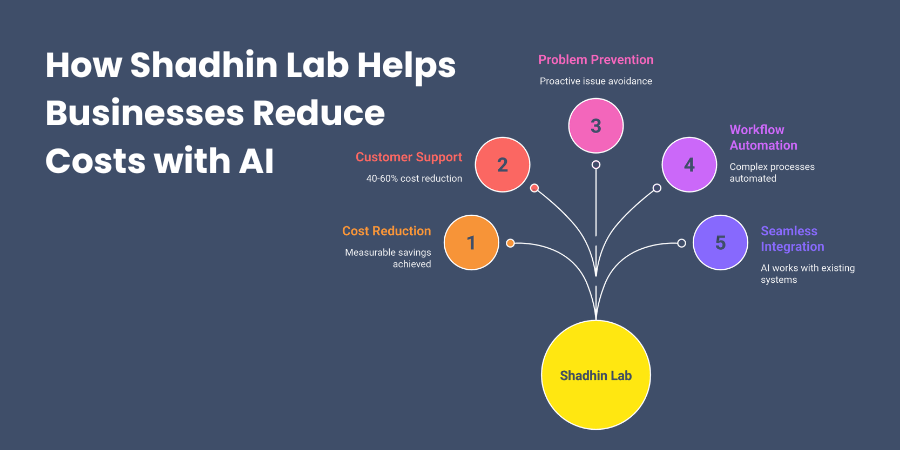
Our expertise in AI automation focuses on identifying and implementing the highest-impact opportunities for cost reduction. We help you prioritize initiatives that deliver the fastest return on investment within your budget.
Conversational AI solutions from Shadhin Lab can reduce your customer support costs by forty to sixty percent. Our chatbots and voice assistants handle routine inquiries efficiently while seamlessly escalating complex issues to agents.
Predictive analytics capabilities help you prevent costly problems before they occur through demand forecasting and scheduling. These proactive approaches save money by avoiding issues rather than reacting to them after occurrence.
AI agents developed by our team can automate complex workflows that currently require significant human intervention. These intelligent systems handle multi-step processes while maintaining quality and compliance standards throughout execution.
Enterprise integration expertise ensures your AI solutions work seamlessly with existing systems and established processes. We minimize disruption while maximizing the cost-reduction benefits of AI implementation across your organization.
Frequently Asked Questions
How quickly can I expect to see cost savings from AI implementation?
You can typically see initial cost savings within three to six months of implementing AI solutions effectively. Simple automation projects often deliver immediate results, while more complex predictive analytics may take longer to show full benefits and return on investment.
What is the typical return on investment for AI cost reduction projects?
Most businesses see ROI of two hundred to four hundred percent within the first year of implementation. However, your specific return depends on factors like implementation costs, operational complexity, and how well you execute the deployment process.
Do I need to replace employees when implementing AI for cost reduction?
Not necessarily at all. Many successful AI implementations focus on augmenting human capabilities rather than replacing workers entirely. You can often redeploy employees to higher-value activities while AI handles routine tasks and administrative work efficiently.
What are the biggest risks when using AI to reduce costs?
The main risks include inadequate data quality, poor integration with existing systems, and insufficient change management planning. You can mitigate these risks through careful planning, phased implementation, and working with experienced AI partners who understand requirements.
How do I choose the right AI applications for maximum cost reduction?
Start by identifying your highest-cost processes and most time-consuming manual tasks across your organization. Focus on areas with high volume, repetitive work, and clear success metrics that you can measure and track effectively over time.
Conclusion
You now have a comprehensive understanding of how AI can transform your business costs from burden into advantage. The question is not whether AI can reduce your costs, but rather which applications will deliver impact.
Remember that successful AI cost reduction requires a strategic approach rather than random technology adoption without planning. Start with your biggest cost pain points, choose solutions that align with operational needs, and measure results.
The businesses that embrace AI cost reduction today will have significant advantages over competitors who wait. Your journey toward more efficient, profitable operations can begin immediately with the right planning and approach.
What will you do first to start reducing your costs with AI in your organization? The opportunities are waiting for you to seize them, and the potential savings could transform your financial future.

Shaif Azad
Related Post
How Conversational AI Improves Healthcare
Have you ever waited on hold for healthcare appointments, transferred multiple times before getting simple answers?...
Conversational AI Use Cases That Drive Revenue
Are you frequently considering how technology could revolutionize your business operations? Conversational AI use cases are...
How AI Improves Demand Forecasting Accuracy and Decision-Making
Are you tired of watching your inventory costs spiral out of control while customers walk away...
