
How Conversational AI Delivers Measurable ROI for Businesses
Table of Contents
Are you considering conversational AI for your business but questioning whether the investment will deliver real returns? Organizations implementing conversational AI strategically are seeing returns of 200-400% within the first year. The pressure on businesses to justify AI investments with measurable returns has never been higher.
You are not alone in wondering whether conversational AI delivers genuine value or creates another expense line. Conversational AI represents one of the highest-impact technologies capable of delivering both significant cost savings and revenue growth when implemented strategically. By the end of this guide, you will understand exactly how to measure, calculate, and maximize the ROI of conversational AI for your specific situation.
Key Takeaways
- Readers will be able to understand how to measure, calculate, and maximize ROI from conversational AI investments using clear business metrics.
- Identify the primary cost components and hidden expenses involved in conversational AI implementation.
- Evaluate how conversational AI drives ROI through automation, scalability, consistency, and data-driven insights.
- Analyze direct cost savings and revenue growth opportunities enabled by conversational AI across customer support, sales, and operations.
- Measure conversational AI performance using essential ROI metrics such as cost per interaction, resolution rate, and conversion impact.
- Apply proven strategies to maximize conversational AI ROI through use case prioritization, continuous optimization, and system integration.
Table of Contents
What Is Conversational AI?
Have you ever wondered what makes conversational AI different from traditional chatbots? Your customers can engage with your business through natural conversations that feel genuinely helpful rather than frustratingly robotic. Conversational AI represents advanced technology that enables machines to understand, process, and respond to human language contextually.
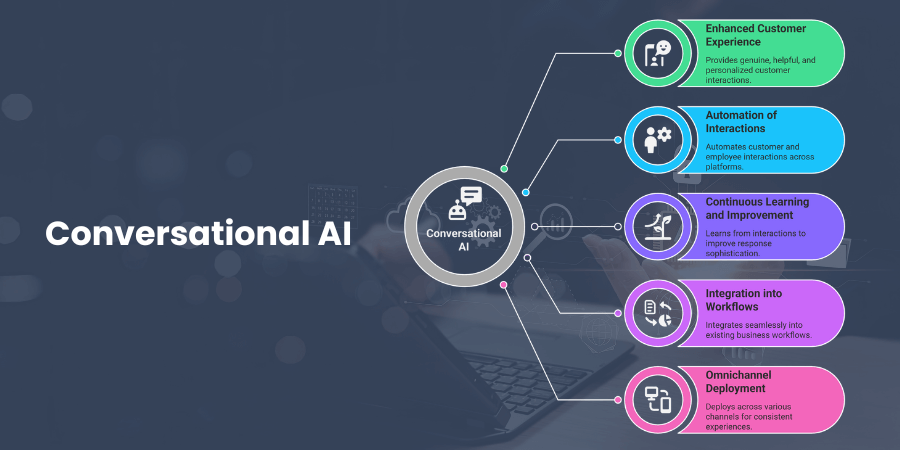
In your business context, conversational AI serves as an intelligent layer that automates customer and employee interactions across chat, voice, and omnichannel platforms. Unlike simple rule-based systems, this technology learns from each interaction to provide increasingly sophisticated responses. When you implement conversational AI, you create digital assistants that handle complex queries, understand intent, and deliver personalized experiences at scale.
Conversational AI integrates seamlessly into your existing workflows. Whether you need customer support automation, sales assistance, or internal process optimization, this technology adapts to your specific requirements. You can deploy it across websites, mobile apps, voice systems, and messaging platforms to create consistent experiences wherever customers prefer to engage.
Why ROI Matters in Conversational AI Investments
Why should you focus intensely on ROI when evaluating conversational AI solutions? The answer directly impacts your ability to secure budget, gain stakeholder support, and scale AI initiatives successfully. Without clear ROI measurement, you risk implementing technology that consumes resources without delivering measurable business value.
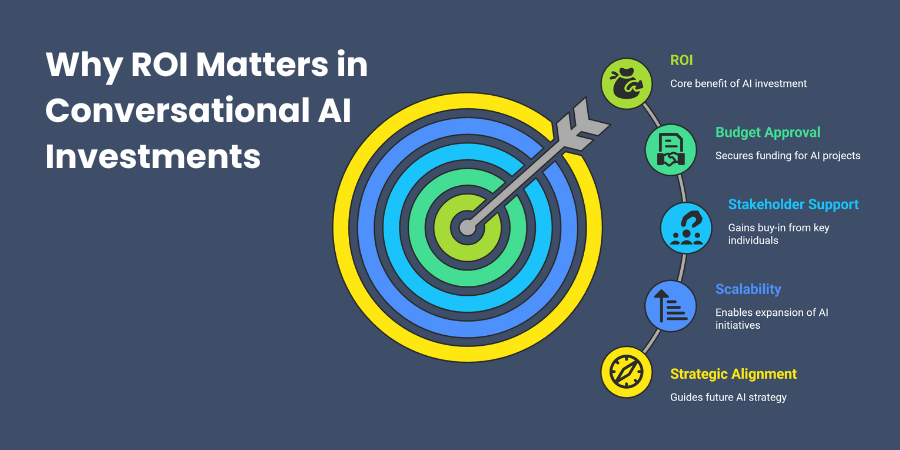
Your organization likely faces increasing scrutiny around technology investments. Stakeholders want concrete evidence that conversational AI will generate returns justifying the initial investment and ongoing costs. When you demonstrate clear ROI, you position yourself to secure additional funding for expanded AI initiatives.
ROI measurement connects directly to your long-term AI strategy. Organizations that track ROI effectively can identify which use cases deliver the highest returns, allowing strategic prioritization of future implementations. This data-driven approach ensures your conversational AI program evolves based on actual performance rather than assumptions.
Without ROI focus, conversational AI remains experimental technology rather than a strategic business tool. When you establish clear measurement frameworks from the beginning, you create accountability that drives better implementation decisions and optimization efforts.
Key Cost Components of Conversational AI
What costs should you expect when implementing conversational AI in your organization? Understanding the complete cost structure helps you budget accurately and identify areas where you can optimize spending.
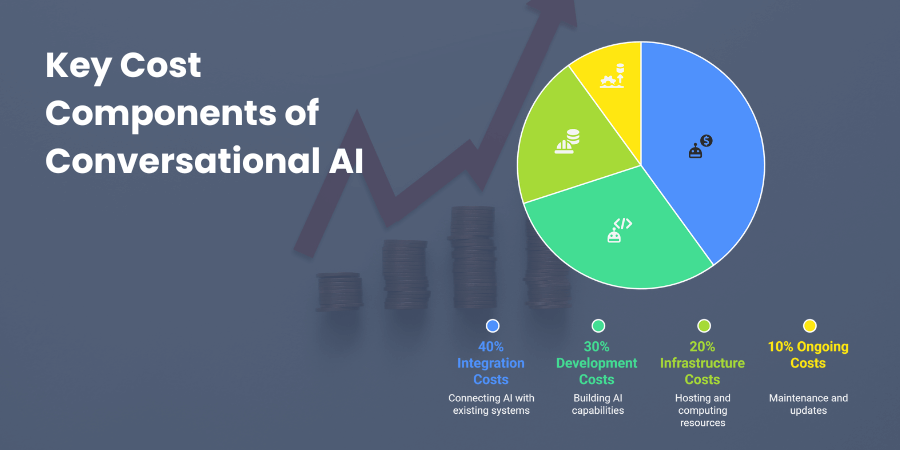
Development costs represent your initial investment in building conversational AI capabilities. These include platform licensing, custom development work, integration with existing systems, and initial training data preparation. You might spend anywhere from $10,000 for basic implementations to $500,000+ for enterprise-grade solutions.
Integration costs often surprise organizations because they extend beyond the AI platform itself. You need to connect conversational AI with your CRM, knowledge bases, payment systems, and other business applications. This integration work typically requires specialized expertise and can represent 30-50% of your total implementation cost.
Infrastructure costs include hosting, computing resources, and security requirements. Cloud-based solutions offer more predictable pricing, but you still need to account for usage-based scaling as your conversational AI handles more interactions.
Ongoing costs encompass maintenance, updates, training data refinement, and performance optimization. Plan to allocate 15-25% of your initial investment annually for these operational expenses.
How Conversational AI Generates ROI
How does conversational AI actually create measurable returns for your business? Value generation happens through multiple channels that compound over time to deliver substantial ROI. Understanding these value drivers helps you optimize your implementation for maximum returns.
Automation represents the most immediate ROI driver. When conversational AI handles routine inquiries, you reduce the workload on human agents, allowing them to focus on complex, high-value interactions. This efficiency gain translates directly into cost savings and improved productivity.
Scalability provides another significant value source. Unlike human agents who have capacity limitations, conversational AI can handle unlimited simultaneous conversations. During peak periods or business growth phases, you can serve more customers without proportional increases in staffing costs.
Consistency improvements also generate measurable value. Conversational AI delivers uniform responses based on your best practices and current information. This consistency reduces errors, improves customer satisfaction, and minimizes costs associated with inconsistent service delivery.
Data collection and insights represent often-overlooked ROI sources. Every conversation generates valuable data about customer preferences, common issues, and optimization opportunities. You can use these insights to improve products, services, and processes across your organization.
Cost Savings Enabled by Conversational AI
Where will you see the most significant cost reductions from conversational AI implementation? Direct cost savings typically provide the clearest ROI demonstration, making them essential for building your business case.
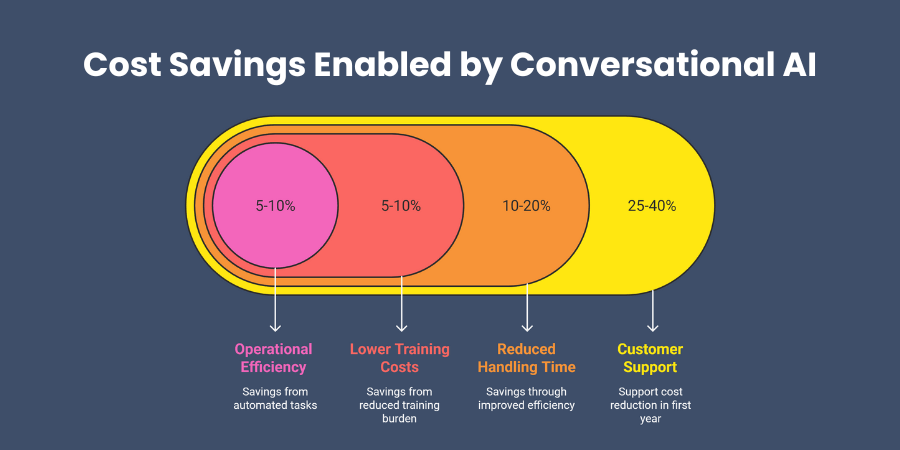
Customer support cost reduction represents the largest savings opportunity for most organizations. When conversational AI resolves 60-80% of routine inquiries automatically, you can reduce support staffing requirements or reallocate agents to higher-value activities. Organizations typically see 25-40% reductions in support costs within the first year.
Reduced handling time creates additional savings through improved efficiency. Conversational AI can instantly access relevant information and provide accurate responses without the research time human agents require. This efficiency improvement allows you to serve more customers with existing resources.
Lower training and onboarding costs emerge as your conversational AI handles more interactions. New human agents require extensive training on products, policies, and procedures. Conversational AI eliminates much of this training burden while ensuring consistent knowledge application.
Operational efficiency gains extend beyond direct customer interactions. When conversational AI automates appointment scheduling, order processing, and information gathering, you reduce manual effort across multiple departments.
Revenue Growth and Conversion Impact
How can conversational AI directly contribute to your revenue growth? Beyond cost savings, well-implemented conversational AI creates multiple revenue enhancement opportunities that significantly impact your bottom line.
| Revenue Driver | Impact Mechanism | Typical Improvement |
| Lead Qualification | Automated screening and routing | 25-35% increase in qualified leads |
| Upselling/Cross-selling | Intelligent product recommendations | 15-25% revenue per customer increase |
| Conversion Rate | Instant responses and assistance | 20-30% improvement in conversion |
| Customer Retention | Proactive support and engagement | 10-20% reduction in churn |
| Sales Cycle Speed | Immediate information and scheduling | 15-25% faster deal closure |
Lead qualification improvements happen when conversational AI engages website visitors immediately, captures their information, and routes qualified prospects to your sales team. This instant engagement prevents lead loss and improves conversion rates significantly.
Upselling and cross-selling opportunities increase because conversational AI can analyze customer history and preferences to suggest relevant additional products or services. These recommendations happen at optimal moments during customer interactions, improving acceptance rates.
Faster response times directly impact conversion rates. When potential customers receive immediate assistance, they are more likely to complete purchases rather than abandoning their journey to seek alternatives.
Productivity and Efficiency Gains
What productivity improvements can you expect from conversational AI implementation? Internal efficiency gains often provide substantial ROI that extends far beyond customer-facing interactions.
Agent assistance capabilities transform how your human staff operates. Conversational AI can provide real-time suggestions, access relevant information instantly, and guide agents through complex procedures. This support reduces training time and improves performance consistency across your team.
Workflow automation eliminates repetitive tasks that consume significant staff time. When conversational AI handles appointment scheduling, information updates, and routine processing, your employees can focus on strategic activities that drive business growth.
Reduced manual effort in data entry and information gathering creates measurable time savings. Conversational AI can collect, organize, and route information automatically, eliminating hours of manual work daily.
Faster resolution times benefit both customers and your organization. When issues resolve quickly, you reduce the total effort required per case while improving customer satisfaction scores.
Customer Experience and Long-Term ROI
Why should you consider customer experience improvements as part of your ROI calculation? Enhanced customer satisfaction drives long-term financial returns that often exceed immediate cost savings and efficiency gains.
Improved customer satisfaction scores translate directly into retention improvements. When customers receive faster, more accurate assistance through conversational AI, they develop stronger loyalty to your brand. This loyalty reduces churn and increases lifetime value significantly.
Brand reputation enhancement occurs when customers consistently receive excellent service. Positive experiences lead to referrals, online reviews, and word-of-mouth marketing that drives new customer acquisition at lower costs.
Reduced customer effort creates lasting competitive advantages. When your conversational AI makes interactions effortless, customers prefer your business over competitors who require more effort to engage with.
Long-term value tracking reveals that customer experience improvements compound over time. Initial satisfaction gains lead to increased purchase frequency, higher order values, and stronger brand advocacy.
Key Metrics to Measure Conversational AI ROI
Which specific metrics should you track to demonstrate conversational AI ROI effectively? Establishing the right measurement framework ensures you can prove value and identify optimization opportunities continuously.
Cost per interaction provides a fundamental efficiency metric. Calculate the total cost of your conversational AI system divided by the number of interactions handled. Compare this to your previous cost per human-handled interaction to demonstrate savings.
Resolution rate measures how effectively your conversational AI solves customer issues without human intervention. Higher resolution rates indicate better ROI through reduced escalation costs and improved efficiency.
Average handling time tracks how quickly conversational AI resolves customer inquiries. Faster resolution times indicate improved efficiency and better customer experience.
Customer satisfaction scores reveal the quality impact of your conversational AI implementation. Maintaining or improving satisfaction while reducing costs demonstrates successful ROI achievement.
Conversion rate improvements show revenue impact. Track how conversational AI affects your sales funnel performance and customer acquisition costs.
Revenue per interaction measures the direct financial impact of conversational AI on your business. This metric helps justify continued investment and expansion.
Challenges in Measuring Conversational AI ROI
What obstacles might you encounter when measuring conversational AI ROI? Understanding these challenges helps you prepare appropriate solutions and set realistic expectations for your measurement efforts.
Attribution challenges arise when conversational AI impacts multiple touchpoints in your customer journey. Determining which improvements result directly from conversational AI versus other factors requires careful analysis and baseline establishment.
Data silos can prevent comprehensive ROI measurement. When conversational AI data exists separately from your CRM, analytics, and financial systems, you cannot easily calculate complete ROI pictures.
Qualitative benefits often resist easy quantification. Improved employee satisfaction, brand reputation enhancement, and customer loyalty provide real value that traditional ROI calculations might miss.
Long-term value tracking requires patience and consistent measurement over extended periods. Some conversational AI benefits emerge gradually, making immediate ROI demonstration challenging.
How to Maximize ROI from Conversational AI
How can you ensure your conversational AI implementation delivers maximum possible returns? Strategic approaches to deployment and optimization significantly impact your ultimate ROI achievement.

Use case prioritization helps you focus on high-impact opportunities first. Start with interactions that are high-volume, routine, and clearly defined. These scenarios typically deliver the fastest and most measurable ROI.
Continuous optimization ensures your conversational AI improves over time. Regular analysis of conversation logs, performance metrics, and user feedback reveals opportunities for enhancement that increase ROI progressively.
Training data quality directly impacts performance and ROI. Invest in comprehensive, accurate training data that reflects your actual customer interactions and business scenarios.
System integration maximizes efficiency gains by connecting conversational AI with your existing business processes. Seamless integration reduces manual effort and improves overall workflow efficiency.
Governance frameworks ensure consistent performance and continuous improvement. Establish clear processes for monitoring, updating, and optimizing your conversational AI systems.
Conversational AI ROI Across Industries
How does conversational AI ROI vary across different industries? Understanding industry-specific factors helps you set appropriate expectations and identify the most relevant success metrics for your sector.
Customer support-heavy industries like telecommunications and software typically see the highest immediate ROI through cost reduction. These sectors can automate 70-80% of routine inquiries, creating substantial savings.
Sales-driven industries such as retail and real estate benefit significantly from lead qualification and conversion improvements. Conversational AI can engage prospects immediately and guide them through purchase processes effectively.
Regulated industries like healthcare and finance require specialized compliance considerations that can impact ROI timelines. However, these sectors often achieve strong returns through improved accuracy and consistency in customer interactions.
Enterprise environments with complex internal processes can realize substantial productivity gains through employee-facing conversational AI that automates routine tasks and provides instant access to information.
How Shadhin Lab Helps Maximize Conversational AI ROI
Are you looking for a partner who understands how to deliver measurable conversational AI returns? Shadhin Lab specializes in ROI-driven conversational AI implementations that transform your investment into demonstrable business value.
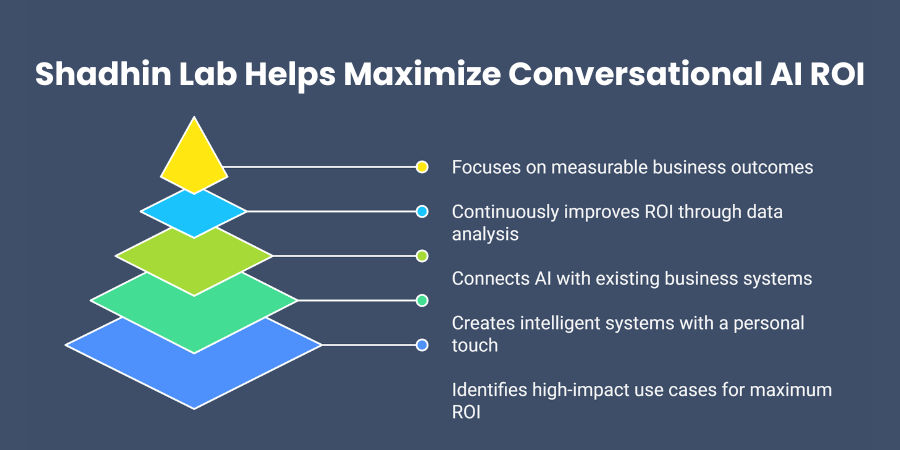
Our conversational AI strategy expertise helps you identify the highest-impact use cases for your specific situation. We analyze your current processes, customer interactions, and business objectives to prioritize implementations that deliver maximum ROI.
AI agent development at Shadhin Lab focuses on creating intelligent systems that integrate seamlessly with your existing workflows. Our agents are designed to handle complex interactions while maintaining the personal touch your customers expect.
Automation integration ensures your conversational AI connects effectively with your CRM, knowledge bases, and business systems. This integration maximizes efficiency gains and reduces the manual effort required to maintain your AI systems.
Performance optimization services help you continuously improve your conversational AI ROI through data analysis, conversation refinement, and strategic enhancements based on real usage patterns.
ROI-driven implementation methodology ensures every aspect of your conversational AI deployment focuses on measurable business outcomes rather than just technical functionality.
Conclusion
You now have a comprehensive understanding of how conversational AI can deliver measurable ROI for your organization. The key to success lies in approaching conversational AI as a strategic business investment rather than an experimental technology.
Start by identifying your highest-volume, most routine customer interactions. These represent your greatest opportunities for immediate ROI through automation and efficiency gains. Remember that successful conversational AI ROI requires continuous measurement, optimization, and strategic focus on business outcomes.
The organizations achieving the highest returns from conversational AI share common characteristics: they measure ROI from day one, optimize continuously based on data, and maintain focus on customer value creation. You can achieve similar results by following the frameworks and strategies outlined in this guide.
Your journey toward conversational AI ROI begins with a single step. Choose one high-impact use case, establish clear measurement criteria, and implement with a focus on demonstrable business value. The possibilities ahead of you are endless when you approach conversational AI strategically.
Frequently Asked Questions
How long does it take to see ROI from conversational AI?
You can typically expect to see initial ROI within 3-6 months of implementation. Cost savings from automation often appear immediately, while revenue improvements may take 6-12 months to fully materialize. The timeline depends on your implementation complexity and use case selection.
What is a realistic ROI percentage for conversational AI?
Most organizations achieve 200-400% ROI within the first year of strategic conversational AI implementation. However, your specific returns depend on factors like use case selection, implementation quality, and optimization efforts. Start with conservative estimates and track actual performance.
How do I calculate the ROI of conversational AI accurately?
Calculate ROI using this formula: (Benefits – Costs) / Costs × 100. Include all implementation and operational costs, then measure benefits through cost savings, productivity gains, and revenue improvements. Track metrics like cost per interaction, resolution rates, and customer satisfaction scores.
Can small businesses achieve good ROI from conversational AI?
Yes, small businesses often see excellent ROI from conversational AI because they can automate significant portions of customer interactions with relatively small investments. Cloud-based solutions make conversational AI accessible to businesses of all sizes.
What are the biggest ROI risks with conversational AI?
The primary risks include poor use case selection, inadequate training data, and lack of integration with existing systems. You can mitigate these risks through careful planning, pilot testing, and working with experienced implementation partners who understand ROI optimization.

Shaif Azad
Related Post

Enterprise Generative AI: Applications, Challenges, and Best Practices
Are you wondering how your organization can stay competitive in today’s rapidly evolving business landscape? The...
How Chatbots Help Businesses Reduce Costs and Scale Faster
Are you lying awake wondering how your business can cut operational costs without sacrificing quality? Have...
Call Center Automation Solutions: Improving Support with AI
Are you struggling with rising customer support costs while your call volumes continue climbing? Have you...
