
Generative AI in eCommerce: Use Cases & Benefits
Table of Contents
Are you managing an online store while feeling overwhelmed by constant pressure to scale your product catalog? Have you wondered how to create personalized experiences for thousands of customers without hiring countless content creators? What if generative AI in e-commerce could transform your entire business approach, automating content creation while delivering hyper-personalized experiences?
Picture this scenario: you run an e-commerce business with hundreds of SKUs, struggling with manual product descriptions and generic customer interactions. You know customers expect personalized experiences, but your current systems cannot deliver at scale. Here is where generative AI in e-commerce becomes your strategic advantage.
Modern e-commerce businesses face unprecedented challenges. You deal with complex product catalogs, demanding customers expecting instant personalization, and profit margins squeezed by rising costs. Traditional approaches simply cannot keep pace with these demands. By this guide’s end, you will understand exactly how generative AI can revolutionize your operations.
Wondering what makes generative AI different from traditional AI tools you might already know? Here is the key distinction that will change how you think about business operations.
Generative AI in e-commerce refers to artificial intelligence systems that create original content specifically for online retail environments. Unlike traditional AI that predicts customer behavior or classifies products, generative AI produces new product descriptions, personalized marketing copy, dynamic recommendations, and intelligent chatbot responses.
Think about your current content creation process. You probably spend hours writing product descriptions, crafting email campaigns, and personalizing customer interactions. Generative AI transforms this entire workflow by creating content dynamically based on product data, customer behavior, and business objectives.
The exciting part is how this technology integrates directly into your existing e-commerce workflows. Instead of replacing your systems, generative AI enhances them, working behind scenes to deliver personalized, scalable experiences.
Core Technologies Behind Generative AI
Curious about the technology powering these remarkable capabilities? Let me break down the core systems that make generative AI powerful for your e-commerce business.
Large language models form the foundation of text generation in your store. These systems understand product attributes, customer preferences, and brand voice to create compelling descriptions and marketing copy.
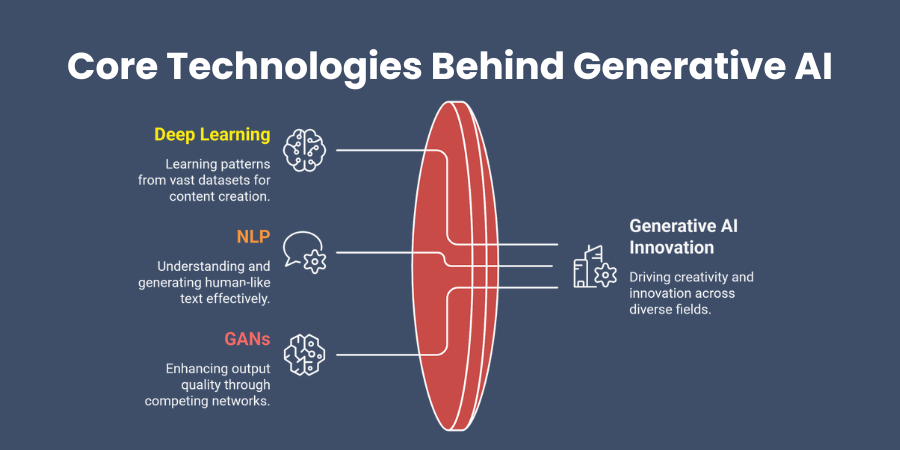
Diffusion models handle visual content creation, generating product images, lifestyle photos, and marketing visuals that align with your brand aesthetic. You can create consistent visual experiences across your entire catalog without expensive photo shoots.
Natural language processing enables intelligent customer interactions through chatbots and voice interfaces. Your customers receive human-like responses that understand context, intent, and emotional nuance.
Machine learning recommendation engines analyze customer behavior patterns to suggest products that genuinely match individual preferences, increasing average order value and satisfaction.
Why the eCommerce Industry Is Adopting Generative AI
Have you noticed how customer expectations have evolved dramatically in recent years? Your customers now expect experiences that feel personally crafted for them, available instantly around the clock.
The demand for hyper-personalization has become non-negotiable. Your customers want product recommendations that understand their unique preferences, content that speaks directly to their needs, and interactions that feel genuinely helpful.
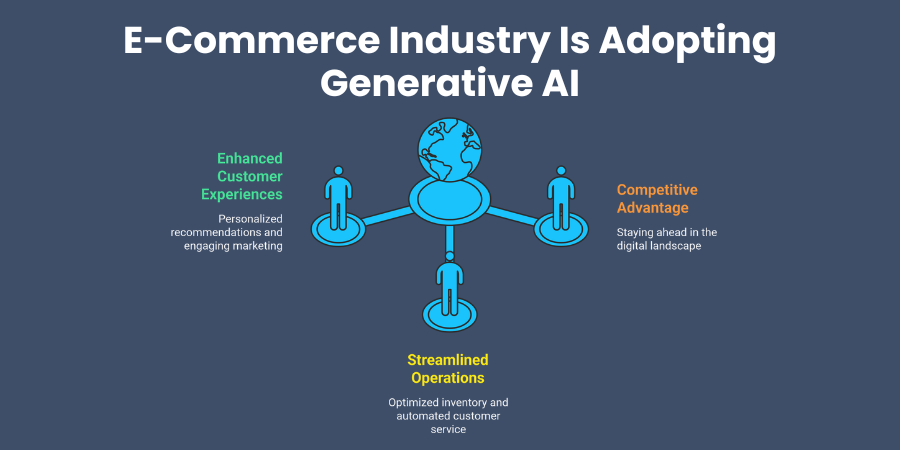
You also face the challenge of providing automated engagement around the clock. Your customers shop at all hours across multiple time zones, expecting immediate responses to their questions.
Faster content production has become critical for competitive advantage. You need to launch new products quickly, update descriptions regularly, and create marketing campaigns that respond to market trends.
Rising labor costs make manual content creation increasingly unsustainable. You cannot hire enough writers, designers, and customer service representatives to handle personalized experiences at scale.
The pressure to increase conversion rates drives every decision you make. Generative AI offers measurable improvements in engagement, customer satisfaction, and revenue performance.
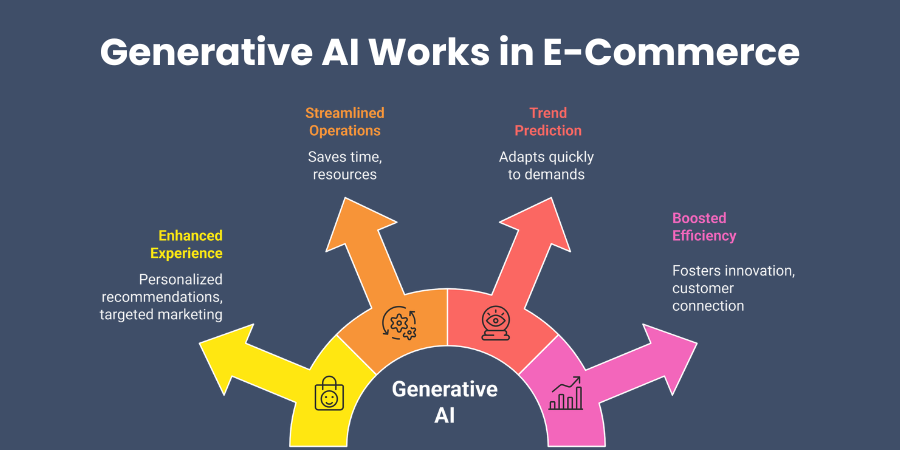
How Generative AI Works in eCommerce
Wondering how all these AI capabilities actually integrate with your existing e-commerce infrastructure? Let me walk you through the three-layer architecture that makes generative AI effective.
Customer Interaction Layer
This is where your customers directly experience the power of generative AI. They interact through your website, mobile app, chatbots, email campaigns, and personalized landing pages capturing valuable preference data.
Your customers might not realize they are interacting with AI-generated content. They simply experience more relevant product descriptions, helpful chatbot conversations, and email campaigns that feel personally crafted.
AI Processing and Intelligence Layer
Here is where the magic happens behind the scenes. The AI systems analyze customer intent, understand contextual information, and generate dynamic content in real-time for personalized experiences.
Your AI systems continuously learn from customer interactions, improving their ability to generate relevant content and recommendations. This creates a feedback loop that enhances performance over time.
Integration with eCommerce Systems
The integration layer connects AI capabilities with your existing CRM systems, e-commerce platforms, inventory management tools, and marketing automation software through APIs.
This seamless integration means you can implement generative AI without disrupting your existing workflows. The technology enhances your current systems rather than replacing them entirely.
Generative AI Use Cases in eCommerce
Ready to explore the specific ways generative AI can transform your business operations? Let us examine the most impactful applications that deliver measurable results.
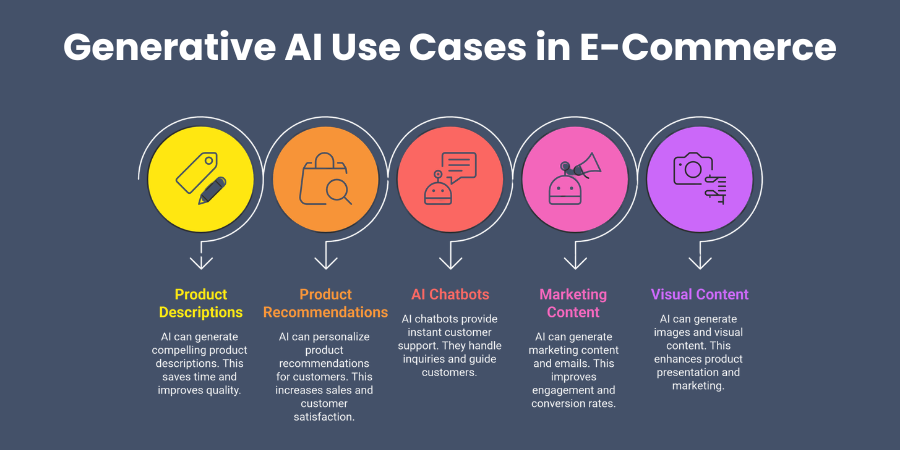
AI-Generated Product Descriptions
Are you tired of writing hundreds of product descriptions that need to be unique, engaging, and optimized? AI-generated product descriptions solve this challenge by automatically creating compelling copy based on product attributes.
Your AI system analyzes product specifications, customer reviews, and competitive information to generate descriptions that highlight the most relevant features for each customer segment.
Multilingual support becomes effortless when AI generates descriptions in multiple languages simultaneously, helping you expand into new markets without hiring specialized translators.
Personalized Product Recommendations
Have you wondered why some customers browse extensively but rarely purchase? Personalized product recommendations powered by generative AI analyze individual behavior patterns, purchase history, and contextual factors.
These systems go beyond simple collaborative filtering logic. They understand seasonal preferences, style evolution, budget considerations, and life stage changes to recommend products perfectly.
The result is higher average order values, increased customer retention, and shopping experiences that feel genuinely helpful rather than pushy.
AI Chatbots and Conversational Commerce
Picture your customers receiving instant, helpful responses to their questions at any time of day. AI chatbots powered by generative technology provide human-like conversations that understand context and emotion.
These systems handle everything from basic product questions to complex troubleshooting, cart recovery conversations, and guided product discovery sessions for natural assistance.
The conversational commerce capabilities enable customers to complete purchases directly through chat interfaces, reducing friction and improving conversion rates significantly.
Marketing Content and Email Generation
Struggling to create fresh marketing content that resonates with different customer segments? Generative AI creates personalized email campaigns, social media content, and advertising copy.
Your marketing campaigns become truly dynamic, adapting messaging, offers, and creative elements based on recipient behavior, purchase history, and engagement patterns for unprecedented personalization.
AI Image and Visual Content Generation
Visual content creation becomes scalable with AI systems that generate product images, lifestyle photos, and marketing visuals that align with your brand aesthetic.
These systems understand your brand guidelines, color schemes, and visual style to produce images that feel authentically part of your brand identity.
Benefits of Generative AI for eCommerce
What specific outcomes can you expect when implementing generative AI in your e-commerce operations? Let us examine the measurable benefits that directly impact business performance.
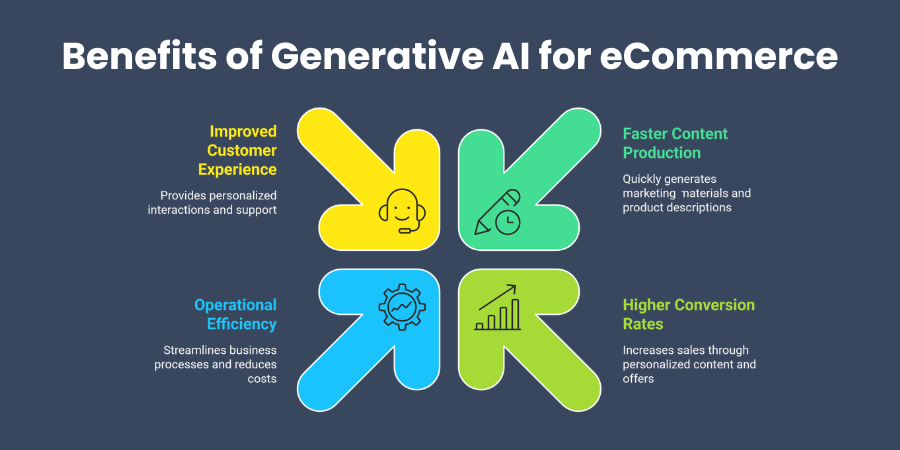
Faster Content Production
Automation removes the bottlenecks that slow down your product launches and marketing campaigns. You can generate hundreds of product descriptions and marketing materials quickly.
This speed advantage allows you to respond quickly to market trends, seasonal demands, and competitive pressures. Your time-to-market improves dramatically across all content types.
Higher Conversion Rates
Personalized interactions significantly increase the likelihood that browsers become buyers. When your content, recommendations, and customer service feel tailored to individual needs, customers respond positively.
Studies show that personalized product recommendations can increase conversion rates significantly, while personalized email campaigns often see higher open rates compared to alternatives.
Operational Efficiency
Your team can focus on strategic activities while AI handles routine content creation and customer interactions. This shift reduces manual workload while maintaining scalability.
The cost savings become substantial as you scale, allowing you to serve more customers with the same team size and resources.
Improved Customer Experience
Always-on, personalized communication across all channels creates customer experiences that feel premium and attentive. Your customers receive consistent, helpful interactions across all touchpoints.
This consistency builds trust and loyalty, leading to higher customer lifetime value and positive word-of-mouth referrals that drive organic growth.
Generative AI in Small vs Enterprise eCommerce
Wondering how implementation differs based on your business size? The approach to generative AI varies significantly between small stores and enterprise operations.
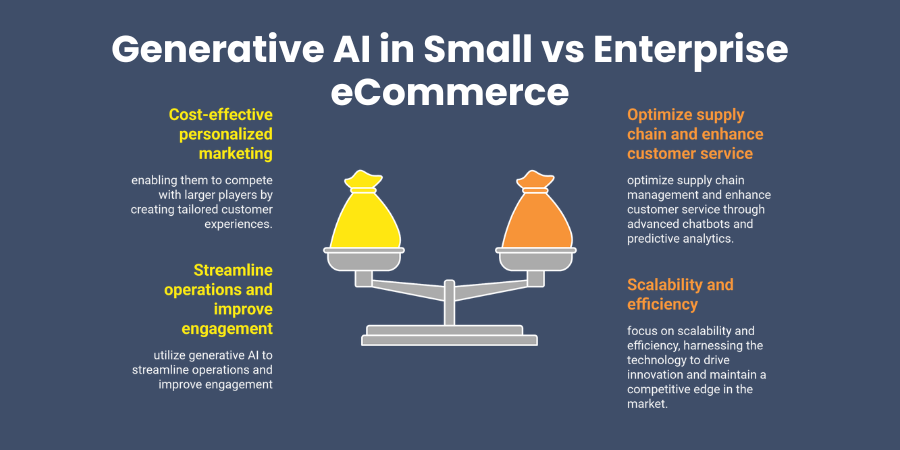
Small e-commerce businesses often benefit from plug-and-play AI tools that integrate easily with popular platforms like Shopify, WooCommerce, or BigCommerce for immediate value.
Your small business can implement AI chatbots, automated product descriptions, and basic personalization features quickly and affordably. The focus is on solving immediate pain points.
Enterprise e-commerce operations typically implement deeply integrated, custom AI systems that connect with complex existing infrastructure. These implementations handle massive product catalogs and sophisticated personalization.
Enterprise systems leverage extensive customer data, purchase history, and behavioral analytics to deliver highly sophisticated personalization that small businesses cannot match.
The key difference lies in data availability, integration complexity, and customization requirements. However, both approaches can deliver significant ROI when properly implemented.
Challenges and Limitations of Generative AI
Before you dive into implementation, what potential challenges should you prepare for? Understanding these limitations helps you plan more effectively and set expectations.
Content Accuracy
AI systems can occasionally generate inaccurate information or make claims about products that are not supported by actual specifications. This requires human oversight.
You need systems for reviewing AI-generated content before publication, especially for technical products or regulated industries where accuracy is critical for compliance.
Data Privacy
Personalization requires customer data, which brings compliance responsibilities under regulations like GDPR, CCPA, and other privacy laws. You must ensure secure handling.
Implementing proper data governance, consent management, and security protocols becomes essential for legal compliance and customer trust in your brand.
Brand Voice Control
Maintaining consistent brand voice across AI-generated content requires careful training and ongoing refinement. Your AI systems need clear guidelines and regular updates.
Human review and governance processes help maintain quality standards while allowing AI to handle volume production efficiently and effectively.
How to Implement Generative AI in eCommerce
Ready to get started with your own implementation? Here is a strategic roadmap that minimizes risk while maximizing early wins for success.
Identify High-Impact Use Cases
Start by analyzing your current workflows to identify the biggest bottlenecks and inefficiencies. Where does your team spend the most time on tasks?
Prioritize use cases based on potential ROI, implementation complexity, and alignment with your business objectives. Quick wins build momentum for ambitious projects.
Select and Integrate Platforms
Choose AI platforms that integrate seamlessly with your existing e-commerce infrastructure. Compatibility with your current CRM, inventory management, and marketing automation systems matters.
Evaluate platforms based on ease of integration, scalability, support quality, and alignment with your specific use cases and business requirements.
Train, Test, and Optimize
Implement AI systems gradually, starting with pilot programs that allow you to test performance and refine approaches. Use testing to compare performance.
Continuous optimization based on performance analytics ensures your AI systems improve over time and deliver increasing value to your business operations.
Future of Generative AI in eCommerce
What exciting developments are coming that could further transform your business? The future of generative AI in e-commerce promises even more capabilities.
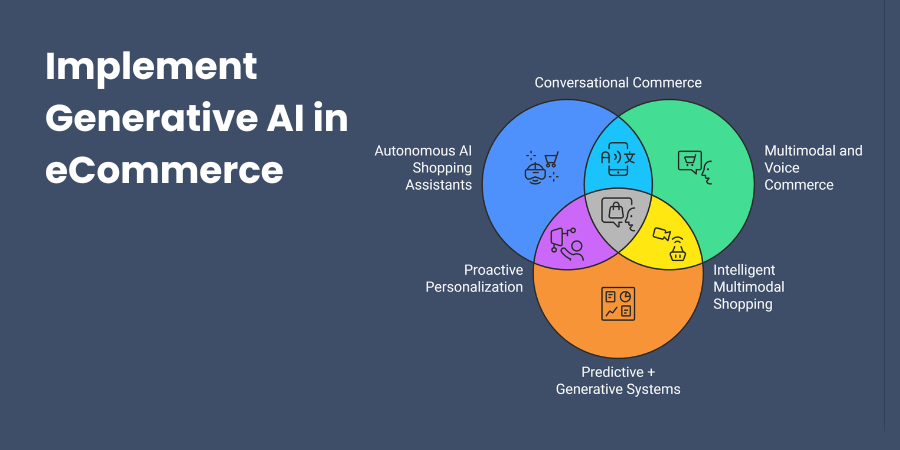
Autonomous AI Shopping Assistants
Imagine AI assistants that guide customers through complete buying journeys, from initial product discovery to purchase completion and post-sale support with understanding.
Multimodal and Voice Commerce
Integration of voice, visual, and text AI will create seamless shopping experiences across all interaction modes. Your customers will search by voice and images.
Predictive + Generative Systems
Combining forecasting capabilities with dynamic content creation will enable AI systems that anticipate customer needs and proactively generate relevant content and recommendations.
How Shadhin Lab Enables Generative AI for eCommerce
Are you looking for a strategic partner to help implement generative AI in your e-commerce operations? Shadhin Lab specializes in developing custom solutions.
Our expertise spans generative AI implementation, intelligent agent development, CRM integrations, and automation systems designed specifically for e-commerce environments with ROI focus.
Our approach combines technical excellence with deep understanding of e-commerce operations, ensuring your AI implementation enhances rather than disrupts existing workflows.
Final Thoughts
You now have a comprehensive understanding of how generative AI can transform your e-commerce operations. From automated content creation to personalized experiences, these technologies offer solutions.
The question is not whether generative AI will become essential for e-commerce success, but how quickly you can implement these capabilities for advantage. Your customers already expect personalized experiences.
What will you implement first? Which of your current bottlenecks could benefit most from AI automation? The possibilities ahead of you are endless today.
The businesses that embrace generative AI now will set the standard for customer experience in the years ahead. Your journey toward efficient operations begins immediately.
Frequently Asked Questions
How much does implementing generative AI in e-commerce typically cost?
Implementation costs vary significantly based on your business size and requirements. Small businesses can start with affordable solutions for under one hundred dollars monthly, while enterprise implementations may require larger initial investments. The ROI typically justifies costs within six to twelve months through improved efficiency.
Can generative AI work with my existing e-commerce platform?
Yes, most modern generative AI solutions integrate with popular platforms like Shopify, WooCommerce, Magento, and BigCommerce through APIs. The key is choosing AI tools that offer pre-built integrations or robust API capabilities for your specific platform and requirements.
How do I ensure AI-generated content maintains my brand voice?
You can train AI systems using your existing content as examples, provide detailed brand guidelines, and implement review processes for quality control. Most platforms allow you to fine-tune AI models to match your specific tone, style, and messaging preferences accurately.
What kind of results can I expect from AI-powered personalization?
Typical results include fifteen to thirty percent increases in conversion rates, twenty to forty percent improvements in email engagement, and twenty-five to fifty percent increases in average order value. However, results depend on your current baseline performance and implementation quality.
Is my customer data safe with generative AI systems?
Reputable AI platforms implement enterprise-grade security measures, including data encryption, compliance with privacy regulations, and secure data processing. Always verify that your chosen platform meets your industry’s specific compliance requirements and offers transparent data handling policies for protection.

Shaif Azad
Related Post
AI Automation Use Cases to Boost Efficiency
Are you overwhelmed by repetitive tasks that consume hours of your valuable time each day? Businesses...
Generative AI for Startups: Growth & Innovation
Are you struggling to compete with industry giants while operating on a limited budget? You face...
How to Implement AI in Business Implementation
Are you wondering how your business can stay competitive in today’s rapidly evolving marketplace? Your competitors...
