
How Entrepreneurs Can Use AI to Grow Their Business
Table of Contents
Entrepreneurs rarely have enough time, money, people, or specialized expertise to do everything a growing business requires. AI can help close some of those gaps by giving founders access to capabilities that once required larger teams or specialized departments.
Generative AI can help with research, writing, analysis, and ideation. AI automation can connect tools and reduce repetitive manual work. More advanced AI agents can take action across defined business workflows instead of simply generating a response.
That makes AI useful across almost every stage of entrepreneurship, from validating an idea and building a product to marketing, sales, and customer support.
But AI is not a replacement for entrepreneurial judgment. Founders still need to understand customers, make strategic decisions, manage risk, build relationships, and decide what the business should become.
The real opportunity is leverage: use AI to remove bottlenecks so a small team can accomplish more without sacrificing judgment or quality.
Table of Contents
Key Takeaways
- AI can help entrepreneurs analyze data, build products, market businesses, improve sales processes, and support customers.
- AI is particularly useful when a business has limited time, people, or specialized expertise.
- Generative AI supports knowledge and creative work, while automation and AI agents can take AI deeper into business workflows.
- The best AI use cases start with a real business problem rather than a desire to use the newest tool.
- Entrepreneurs should keep human oversight over important decisions, customer relationships, and sensitive processes.
- A practical path is AI tool → AI-assisted workflow → AI automation → AI agent → custom AI system.
AI and Entrepreneurship
AI is changing entrepreneurship by lowering the amount of specialized work required to test ideas, create products, analyze information, and operate a business.
A founder can now use AI to research a market, organize customer feedback, generate a prototype, write marketing material, analyze sales information, and prepare customer responses without building a large team for every task.
This does not mean one person can suddenly replace an entire organization. It means entrepreneurs can use technology as a force multiplier.
How AI Is Changing the Entrepreneurial Landscape
One of AI’s biggest advantages for entrepreneurs is faster experimentation.
A founder considering a new product can use AI to organize market research, compare competitors, brainstorm positioning, analyze customer interviews, and identify questions that still need validation.
AI can also help bridge skill gaps. A non-technical founder can ask an AI assistant to explain technical concepts. A marketer can use AI to explore unfamiliar data. A developer can use AI to understand an unfamiliar codebase. A sales professional can use AI to research accounts and prepare for meetings.
The result is not necessarily fewer people. It can mean that a small team has access to a broader range of capabilities.
AI as an Entrepreneur’s Copilot
Entrepreneurs can use AI as a thinking partner for:
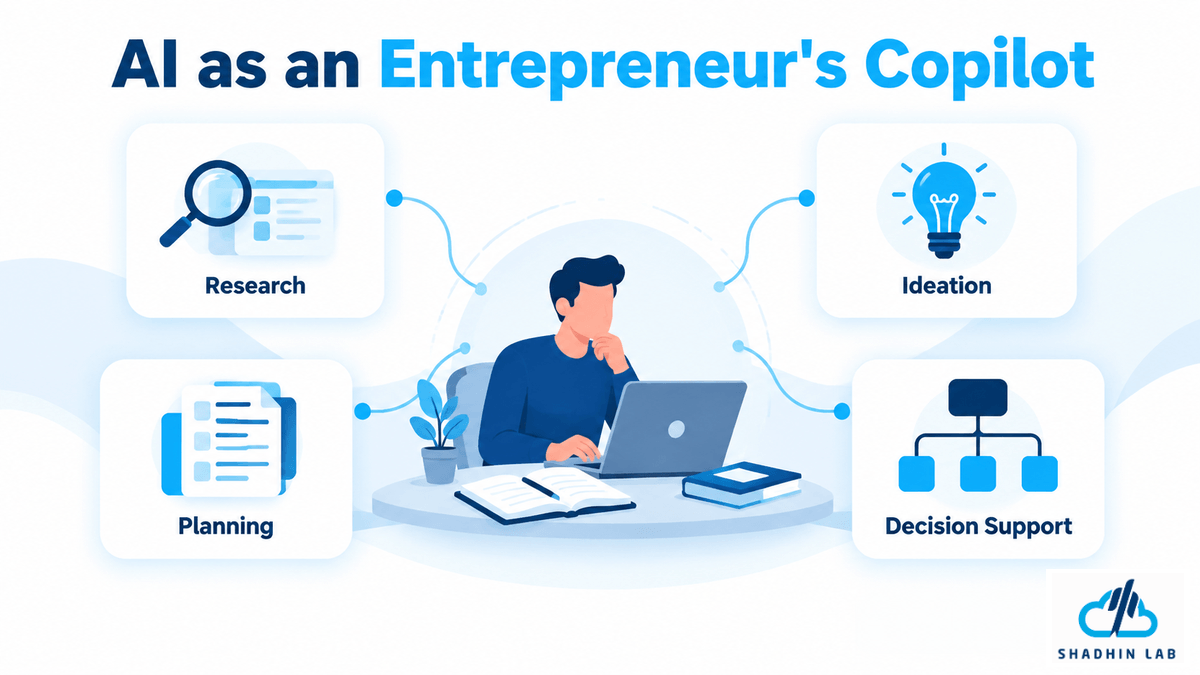
- Brainstorming ideas
- Researching unfamiliar topics
- Writing and editing
- Structuring business plans
- Analyzing customer feedback
- Exploring strategic options
- Challenging assumptions
- Learning new concepts
The most useful approach is often conversational. Instead of asking AI for a final answer immediately, use it to explore alternatives, identify weaknesses, and ask better questions.
For example:
“I’m considering a subscription-based service for small retailers. Challenge this business idea. Identify the strongest assumptions, possible customer objections, competitors I should research, and five questions I should answer before investing.”
This is more valuable than simply asking AI whether the idea is good.
AI Isn’t a Replacement for Entrepreneurial Judgment
AI can generate possibilities, but the entrepreneur decides which possibilities matter.
Vision, creativity, customer understanding, empathy, strategic thinking, risk assessment, and final decision-making remain human responsibilities.
A useful principle is:
AI expands the entrepreneur’s capacity; it does not replace the entrepreneur’s responsibility.
1. Use AI to Add Insight to Data Analysis and Interpretation
Entrepreneurs often have useful business data scattered across CRM systems, email, website analytics, sales platforms, customer support software, surveys, and financial systems.
The challenge is not always collecting more data. It is understanding what the existing data is saying.
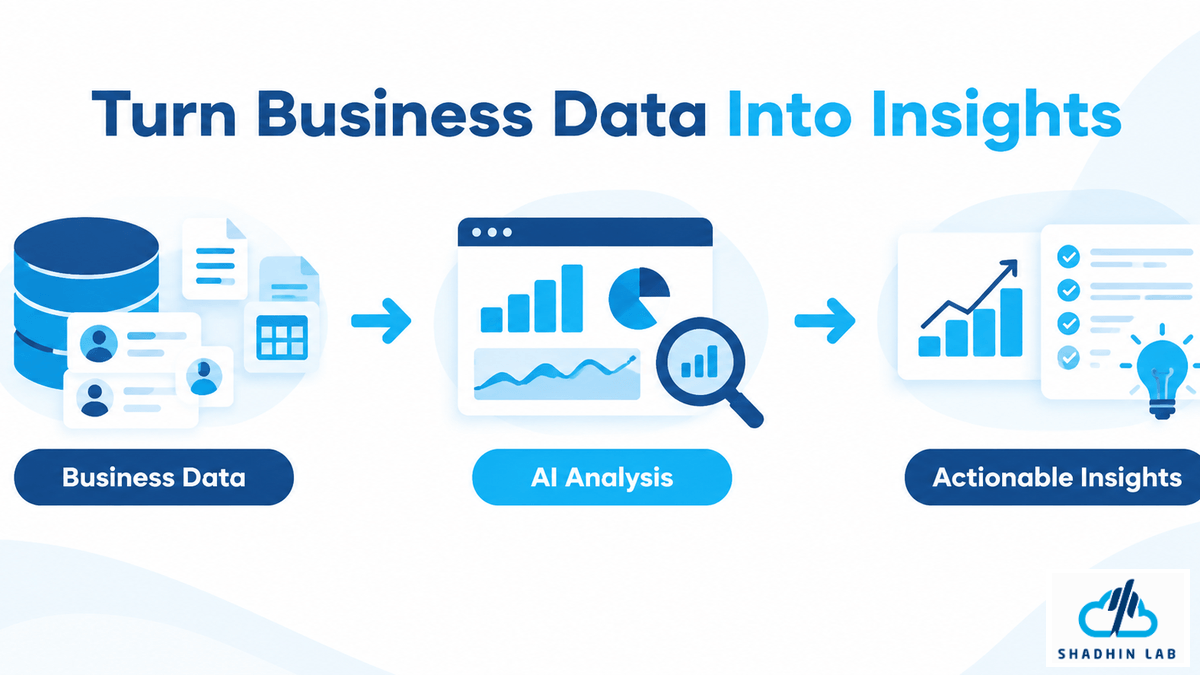
AI can help move the process from:
Data collection → interpretation → decision-making
For example, instead of manually reviewing hundreds of customer records, an entrepreneur could use an AI-enabled analysis workflow to identify recurring complaints, common customer characteristics, high-value segments, changes in purchasing behavior, or unusual sales patterns.
AI can also help turn questions written in plain language into useful analytical tasks:
“Which customer segment generated the highest revenue last quarter?”
“What are the three most common reasons customers cancel?”
“Which products are growing fastest?”
“What changed in our conversion rate compared with the previous period?”
This can make business analysis more accessible to founders who do not have dedicated data analysts.
However, AI-generated analysis should not automatically be treated as fact. The underlying data, calculations, assumptions, and definitions still need to be checked.
A useful workflow is:
Connect reliable data → ask a focused question → review the analysis → verify against source data → make the decision.
AI is most valuable here when it reduces the time between having information and understanding what that information means.
2. Use AI to Streamline and Democratize Software Development
Building software has traditionally required technical expertise, developers, designers, testing, infrastructure, and ongoing maintenance. AI coding assistants are changing how some of this work is performed.
Entrepreneurs can use AI to generate code, explain unfamiliar code, identify errors, create tests, develop prototypes, write documentation, and turn business requirements into technical specifications.
This can be particularly useful during the early stages of a startup.
What Non-Technical Entrepreneurs Can Build With AI
With appropriate technical review, AI can help founders prototype:
- Simple websites
- Internal tools
- Calculators
- Data dashboards
- MVPs
- Basic SaaS concepts
- Workflow automations
For example, a founder might describe a customer-facing calculator in plain English and ask an AI coding assistant to turn the requirements into a working prototype.
The founder can then test the prototype with potential users before committing significant resources to full development.
This changes the economics of experimentation. Instead of spending weeks deciding whether an idea is technically possible, a business can sometimes create an early version and learn from real users sooner.
Where Human Developers Still Matter
AI-generated code still needs engineering judgment.
Architecture, security, scalability, production deployment, data protection, complex debugging, code review, and system reliability are not problems that should simply be handed to an AI without oversight.
A prototype that works for ten users may fail completely at a much larger scale.
AI is therefore best viewed as a development accelerator rather than a replacement for software engineering.
The strongest workflow is often:
Business idea → AI-assisted prototype → technical review → user testing → production engineering.
3. Use AI to Transform Your Marketing
Marketing is one of the most accessible areas for entrepreneurs to apply AI because much of the work involves research, writing, analysis, personalization, and repetitive content production.
AI can help accelerate these activities while leaving positioning and strategic decisions with the entrepreneur.
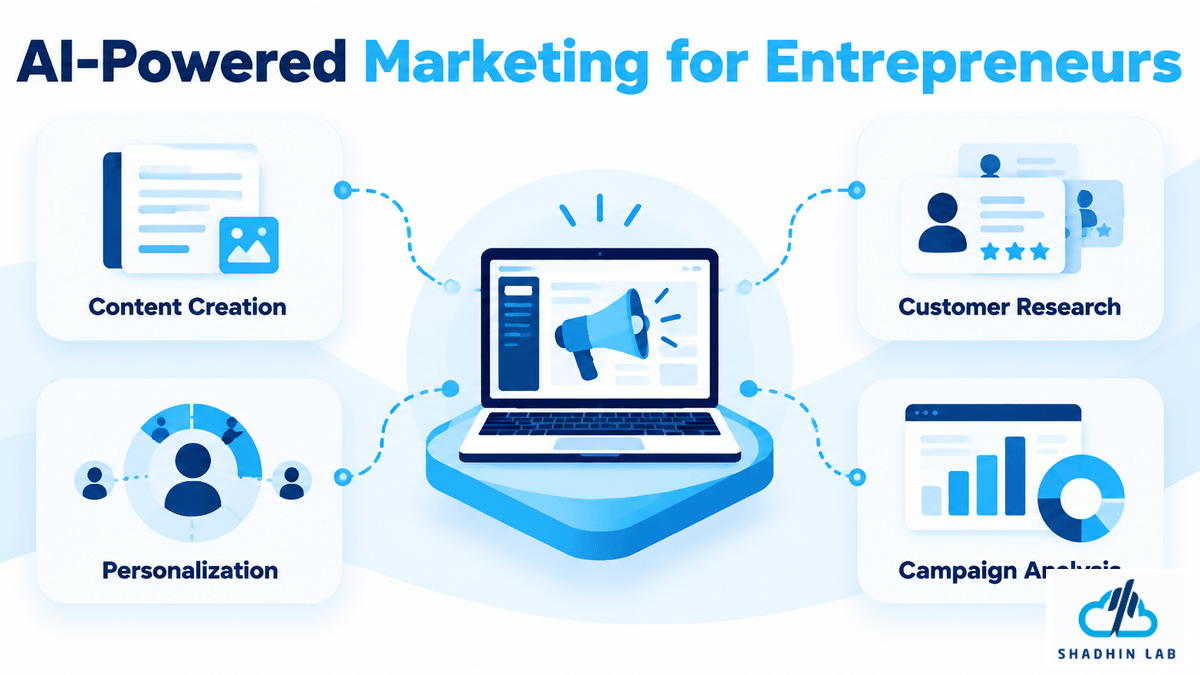
Content Creation
Entrepreneurs can use AI to assist with:
- Blog research
- Content outlines
- Social media posts
- Email campaigns
- Product descriptions
- Advertising copy
- Content repurposing
For example, a founder could provide a webinar transcript and ask AI to turn it into a blog outline, several social posts, an email newsletter, and a list of questions for a follow-up article.
The entrepreneur still needs to review the material for accuracy, brand voice, originality, and relevance.
Marketing Strategy
AI can also help with the research behind marketing decisions.
You can use it to organize competitor information, analyze customer feedback, identify recurring pain points, brainstorm positioning options, or challenge an existing marketing strategy.
For example:
“Here are 30 customer interview responses. Identify the five most common problems customers mention, group similar responses, and suggest which problems appear most urgent.”
That can help an entrepreneur see patterns that might otherwise remain buried in unstructured feedback.
Marketing Optimization
Once campaigns are running, AI can assist with analyzing performance, identifying audience segments, improving content, and generating personalization ideas.
But there is an important distinction between AI-assisted marketing and AI-designed marketing strategy.
AI can accelerate research, analysis, ideation, production, and optimization.
The entrepreneur still needs to decide:
- Who the business serves
- What problem it solves
- How it is positioned
- Why customers should choose it
- What brand voice it should use
- Which opportunities are worth pursuing
AI can produce many options. It cannot determine which option is strategically right without meaningful business context and human judgment.
4. Use AI to Assist and Refine Sales Processes
Sales involves research, personalization, timing, follow-up, qualification, and large amounts of customer information. That makes it another strong area for AI adoption.
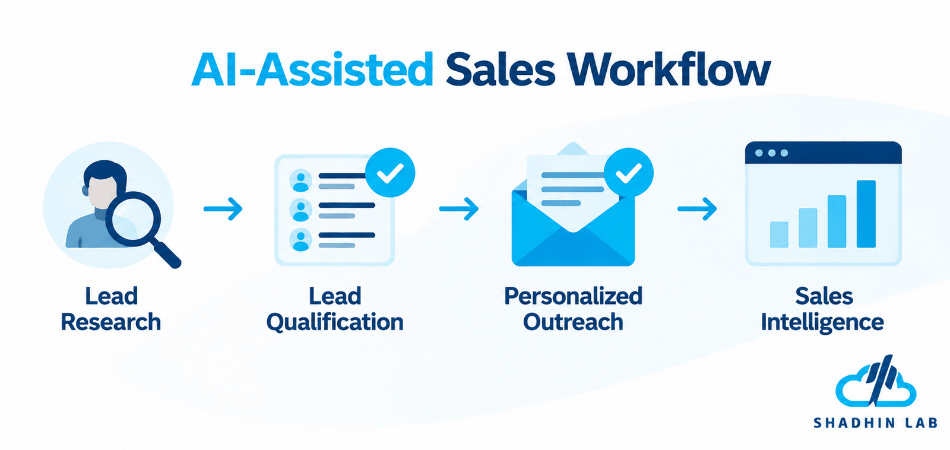
Entrepreneurs can use AI to reduce repetitive sales work while giving salespeople more time for conversations and relationship-building.
Lead Research and Qualification
AI can help sales teams research prospects, identify potential buyers, organize account information, prioritize opportunities, and analyze buying signals.
For example, instead of manually reviewing every prospect before a sales call, a founder could use an AI workflow to prepare a short account brief containing the prospect’s company information, relevant business context, previous interactions, and questions worth asking.
Sales Outreach
AI can also assist with personalized outreach and follow-ups.
Rather than:
“Write a sales email.”
A better instruction might be:
“Using the prospect information below, draft a short introduction explaining how our service could address the problem they mentioned. Avoid generic claims and keep the email below 100 words.”
The goal is not to automate communication for its own sake. The goal is to make relevant communication easier to produce.
Sales Intelligence
AI can analyze information from sales calls, CRM records, customer interactions, and pipeline data to help identify patterns and next steps.
For example, a sales team might ask:
“Which objections appear most frequently in our lost opportunities?”
That insight could lead to changes in sales messaging, product positioning, onboarding, or pricing.
AI Sales Agents
AI is also moving beyond sales assistance into agentic workflows.
An AI sales agent can be designed to execute defined parts of prospecting, qualification, outreach, follow-up, or meeting-booking workflows rather than simply suggesting what a salesperson should do.
This creates a progression:
AI assistant → AI-assisted sales workflow → automated sales process → AI sales agent
The right level depends on the business, data quality, sales process, risk tolerance, and required human involvement.
5. Use AI to Boost Efficiency and Satisfaction in Customer Support
Customer support is another area where AI can reduce repetitive work while helping human teams focus on more difficult conversations.
A business can use AI for common questions, knowledge retrieval, ticket classification, routing, and basic customer interactions.
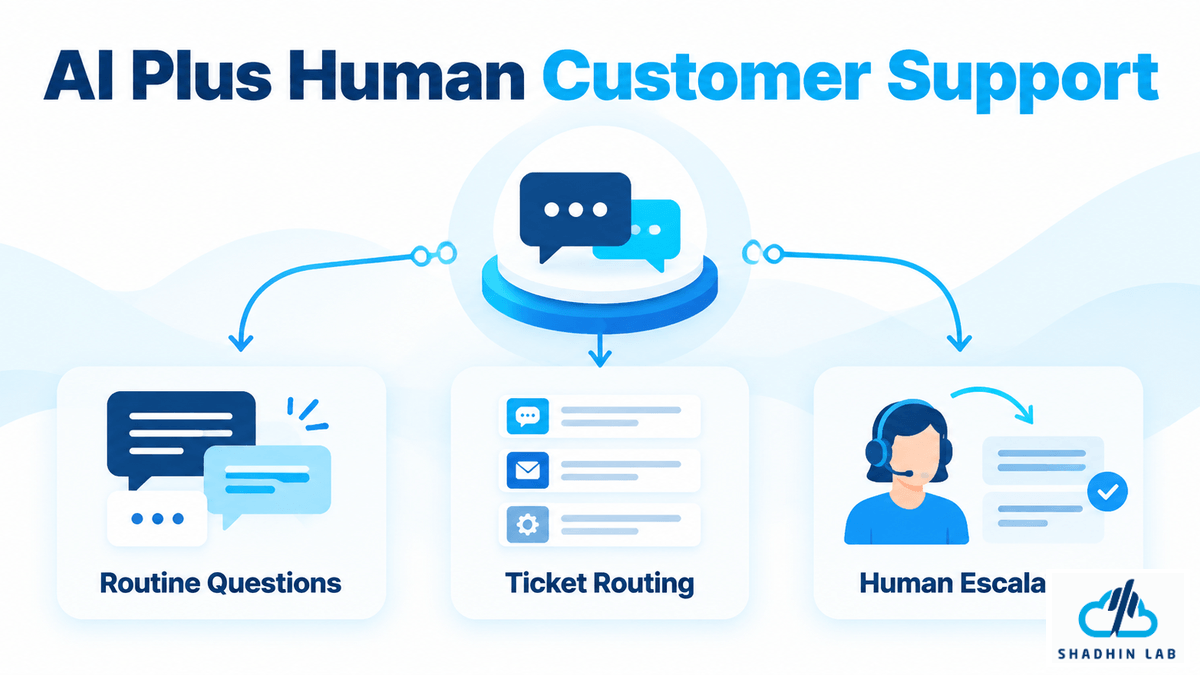
AI-Powered Customer Support
Common applications include:
- Frequently asked questions
- Chatbots
- Virtual assistants
- Basic customer inquiries
- Ticket classification
- Support routing
- Knowledge-base assistance
For example, a customer asking how to reset a password may not require a support employee to manually write a response every time.
AI can handle the routine interaction while making a human available for cases that require judgment.
AI for Support Teams
AI does not have to communicate directly with customers to be useful.
It can work behind the scenes by helping support agents:
- Retrieve customer context
- Summarize previous conversations
- Find relevant knowledge
- Recommend response options
- Draft support replies
- Create or update documentation
This can reduce the amount of time agents spend searching for information.
Where Humans Should Take Over
Some situations require more than a correct answer.
Angry customers, complex complaints, refund disputes, sensitive situations, escalations, and high-value accounts may require empathy, negotiation, or business judgment.
The best support model is therefore often AI plus human support, rather than AI instead of human support.
AI Tools Entrepreneurs Can Start With
Entrepreneurs do not need dozens of AI subscriptions to begin.
Start with the category that matches the problem you are trying to solve.
| Business need | AI category |
| Research and reasoning | General AI assistants |
| Content and copy | Generative AI |
| Software development | AI coding assistants |
| Marketing | AI marketing tools |
| Sales | AI sales tools and agents |
| Customer support | AI support platforms |
| Data analysis | AI analytics tools |
| Workflow automation | AI automation platforms |
| Design | AI design tools |
Tools such as ChatGPT, Claude, Gemini, GitHub Copilot, Canva, HubSpot, Salesforce, and automation platforms can serve different parts of this ecosystem.
But the tool should come after the business problem.
Choosing a tool because it is popular does not guarantee that it solves your bottleneck.
The Risks of Relying Too Much on AI
AI can increase entrepreneurial leverage, but over-reliance introduces new risks.
AI-generated information can be incorrect. An AI system can misunderstand business context, produce convincing but unsupported statements, or make recommendations based on incomplete information.
There are also operational risks.
Heavy automation can make customer communication feel impersonal. Poorly configured systems can create errors at scale. Connecting AI to business data introduces privacy and security considerations. Dependence on third-party AI services can also create operational risk if pricing, capabilities, access, or integrations change.
There is a strategic risk as well: letting AI make decisions that the entrepreneur should own.
The objective should not be to automate everything.
It should be to automate the right things.
AI should increase entrepreneurial leverage, not replace entrepreneurial judgment.
How to Get Started With AI as an Entrepreneur
You do not need a complete AI transformation strategy to start.
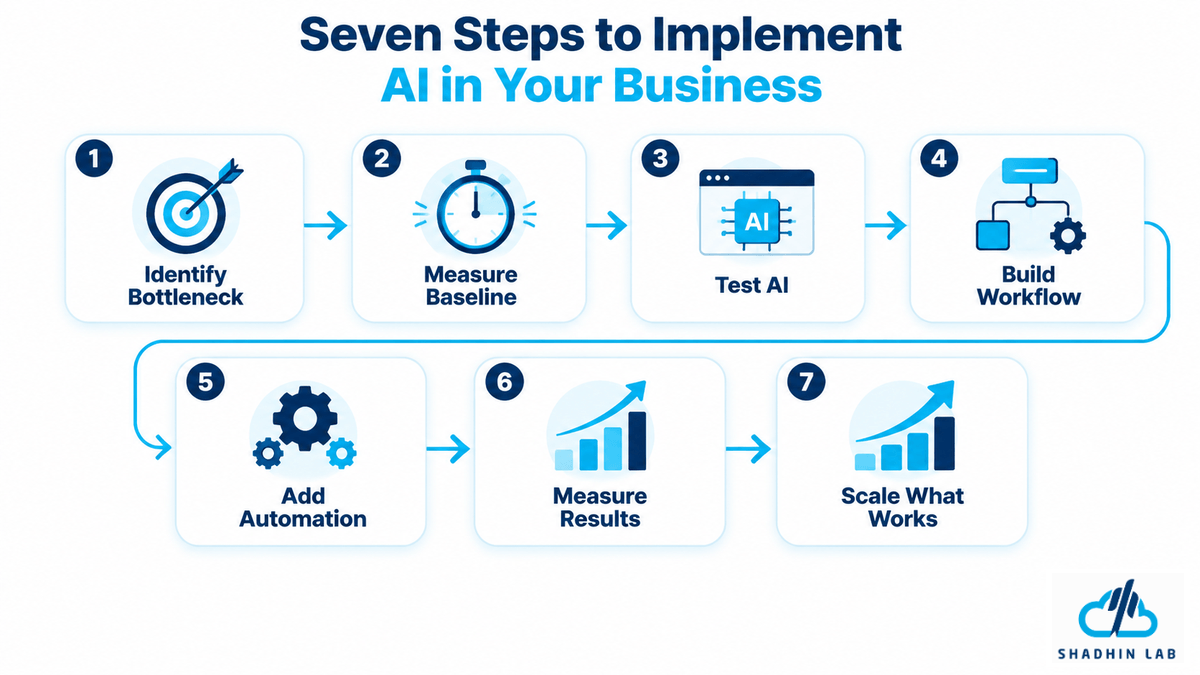
Begin with one bottleneck.
Step 1: Identify one bottleneck
Choose a task that repeatedly consumes time or creates unnecessary manual work.
Step 2: Measure the current process
Understand how much time it takes, how frequently it happens, what it costs, how many errors occur, and what business impact it has.
Step 3: Test AI assistance
Start with a simple AI tool before investing in complex automation.
For example, if employees spend hours summarizing customer feedback, first test whether an AI assistant can reliably organize and classify that feedback.
Step 4: Create a repeatable workflow
Document the process, inputs, prompts, expected outputs, and review steps.
Step 5: Add automation when appropriate
Once the AI-assisted process works consistently, connect it to the systems involved.
Step 6: Measure the outcome
Track meaningful results such as:
- Time saved
- Output quality
- Operating cost
- Revenue impact
- Conversion rate
- Customer satisfaction
Step 7: Scale what works
Once one workflow proves valuable, move to the next business bottleneck.
This approach is safer and more useful than trying to introduce AI everywhere at once.
When Entrepreneurs Should Consider Custom AI Solutions
Off-the-shelf AI tools are often enough for common tasks such as writing, research, brainstorming, and basic analysis.
Custom AI becomes more relevant when your business has workflows that standard tools cannot handle effectively.
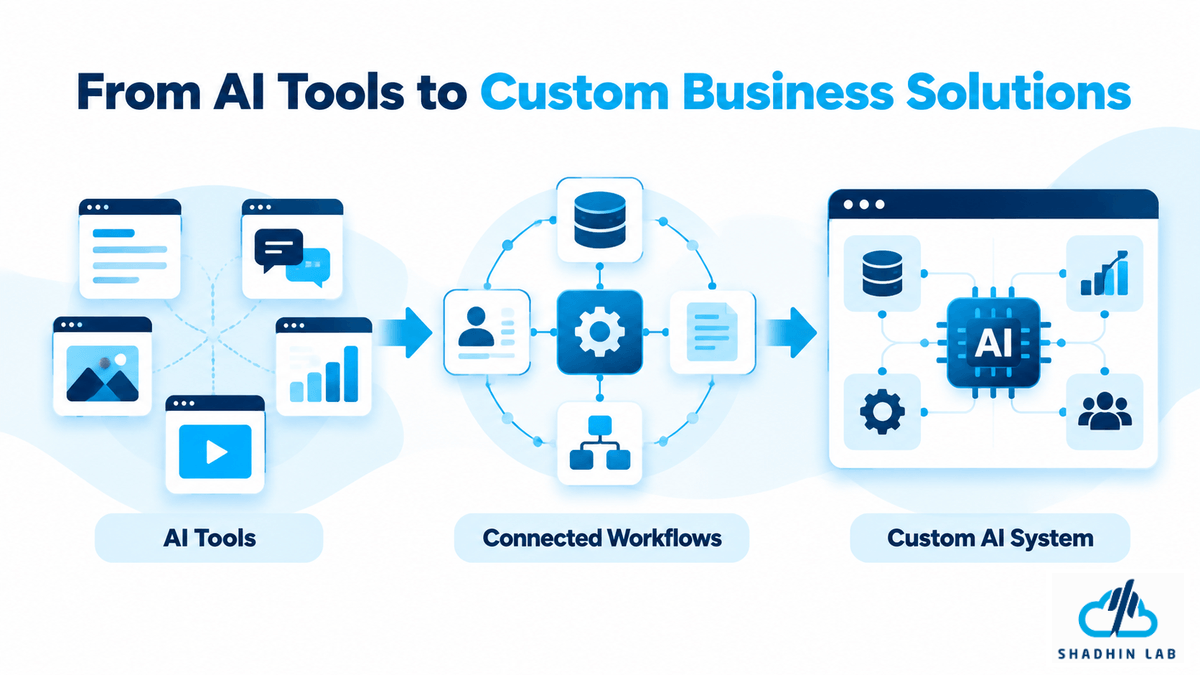
Consider a custom solution when:
- Your workflows are unique
- Multiple business systems need to connect
- AI needs access to proprietary information
- Business-specific rules are important
- Existing tools do not fit your process
- Multiple AI capabilities need to work together
This is where AI shifts from being a productivity tool to becoming part of the business infrastructure.
ShadhinLab works with organizations to build intelligent products, automate operations, and connect AI with business workflows. Its approach includes identifying suitable use cases, developing AI-powered systems, and integrating them into existing technical environments.
If your business has moved beyond experimenting with individual AI tools and you need AI agents, workflow automation, or a custom AI system built around your processes, ShadhinLab can help turn that requirement into an implementable solution.
FAQ
What are the best AI tools for entrepreneurs?
There is no single best AI tool for every entrepreneur. The right tool depends on the problem being solved. General AI assistants are useful for research and knowledge work, while specialized tools can support coding, marketing, sales, analytics, support, or automation.
How can AI help small-business owners?
AI can help small businesses reduce repetitive work, improve customer communication, analyze information, create marketing content, support sales, and connect business processes through automation.
Can AI replace employees in a small business?
AI can automate some tasks that employees currently perform, but that does not mean it should replace entire roles. Many businesses will get more value by using AI to help employees work faster and focus on higher-value activities.
How can entrepreneurs use AI for marketing?
Entrepreneurs can use AI for content research, writing, audience analysis, campaign ideation, personalization, performance analysis, and content repurposing. Strategic positioning and brand decisions should remain under human control.
How much does AI cost for entrepreneurs?
The cost depends on the tools, usage, number of users, integrations, and level of customization required. Entrepreneurs can start with low-cost or existing AI tools before investing in automation or custom AI development.
Conclusion
AI does not make entrepreneurship effortless. It gives entrepreneurs more leverage.
A founder can use AI to turn data into insight, ideas into software prototypes, information into marketing, prospects into more organized sales workflows, and repetitive support tasks into scalable processes.
Start small. Solve one meaningful problem. Measure the result. Automate what works. Then scale.
If you are ready to move beyond experimenting with individual AI tools and build AI into your actual business workflows, ShadhinLab can help design AI solutions, automation, and AI agents around your business needs. Explore ShadhinLab’s AI solutions

Shaif Azad
Shaif Azad Rahi is an AI/ML professional and Solution Engineer at Shadhin Lab, specializing in AI-powered solutions and scalable software systems, with a focus on applying AI to solve real-world business challenges.
Related Post
AI for Lead Generation: Strategies, Tools, and Workflows
Generating leads is not just about finding more potential customers. Businesses need to identify the right...
AI Email Assistant Guide: Write, Reply, and Save Time
Email can quietly consume hours of your workweek. Reading long threads, drafting replies, rewriting awkward messages,...
AI Risk Management: Frameworks, Challenges & Best Practices
Are you someone who lies awake wondering if your AI systems might suddenly make catastrophic decisions?...
