
AI for Lead Generation: Strategies, Tools, and Workflows
Table of Contents
Generating leads is not just about finding more potential customers. Businesses need to identify the right buyers, understand their needs, start relevant conversations, and turn genuine interest into sales opportunities. When these activities depend on manual research and disconnected tools, sales and marketing teams can spend hours working on prospects who are unlikely to convert.
AI for lead generation can help businesses improve this process. It can research target accounts, enrich prospect data, identify buying signals, personalize outreach, qualify incoming inquiries, and automate repetitive CRM tasks.
But AI alone does not create an effective lead-generation strategy. Results still depend on a clear ideal customer profile (ICP), a relevant offer, reliable data, and a sales process that converts qualified interest into business.
This guide explains how to use AI across inbound and outbound lead generation, select the right tools, connect workflows, and measure success based on qualified leads and sales opportunities rather than contact volume alone.
Table of Contents
Key Takeaways
- AI can support the entire lead-generation process, from prospect discovery to qualification, nurturing, and conversion.
- Effective AI prospecting begins with a clearly defined ideal customer profile and verified data.
- Research-informed personalization is more useful than simply inserting a prospect’s name into a generic message.
- AI chatbots, lead scoring, and workflow automation can improve how businesses handle incoming inquiries and follow-ups.
- The best AI lead generation tools depend on your existing systems, data sources, workflow requirements, and budget.
- Qualified leads, sales opportunities, and pipeline contribution are more meaningful measures of success than the number of contacts generated.
What Is AI for Lead Generation?
AI for lead generation is the use of artificial intelligence to identify, attract, research, qualify, and nurture potential customers.
It combines several technologies. Generative AI can summarize company research and draft personalized messages. Predictive models can estimate which leads are more likely to convert. Conversational AI can engage website visitors, while workflow automation connects these activities to CRM systems and sales processes.
AI agents can also perform multi-step tasks, such as researching an account, collecting information from approved sources, preparing a lead summary, and recommending a next action.
AI Lead Generation vs. Traditional Lead Generation
Traditional lead generation often relies on manual research, predefined audience segments, standard outreach templates, and salespeople deciding which leads to contact first. AI-assisted processes can make these activities more data-informed and reduce repetitive work.
| Traditional approach | AI-assisted approach |
| Manual prospect research | Automated research and data enrichment |
| Broad audience segmentation | More detailed, data-informed targeting |
| Standard outreach templates | Contextual message personalization |
| Manual lead prioritization | Rule-based or predictive lead scoring |
| Repetitive CRM updates | Automated data synchronization |
| Manual inquiry handling | AI-assisted engagement and qualification |
These approaches can work together. Traditional methods remain valuable for customer relationships, strategy, and judgment. AI is most useful when it improves specific tasks without removing necessary human oversight.
Where AI Fits in the Lead-Generation Funnel
AI can support three connected stages:
- Discover: Identify target accounts, relevant contacts, and potential buying signals.
- Engage: Attract prospects through useful content, contextual outreach, and conversations.
- Convert: Qualify interest, schedule meetings, nurture opportunities, and support sales follow-up.
The objective is to connect these stages so that prospect research informs outreach, engagement informs qualification, and qualification determines the next sales action.
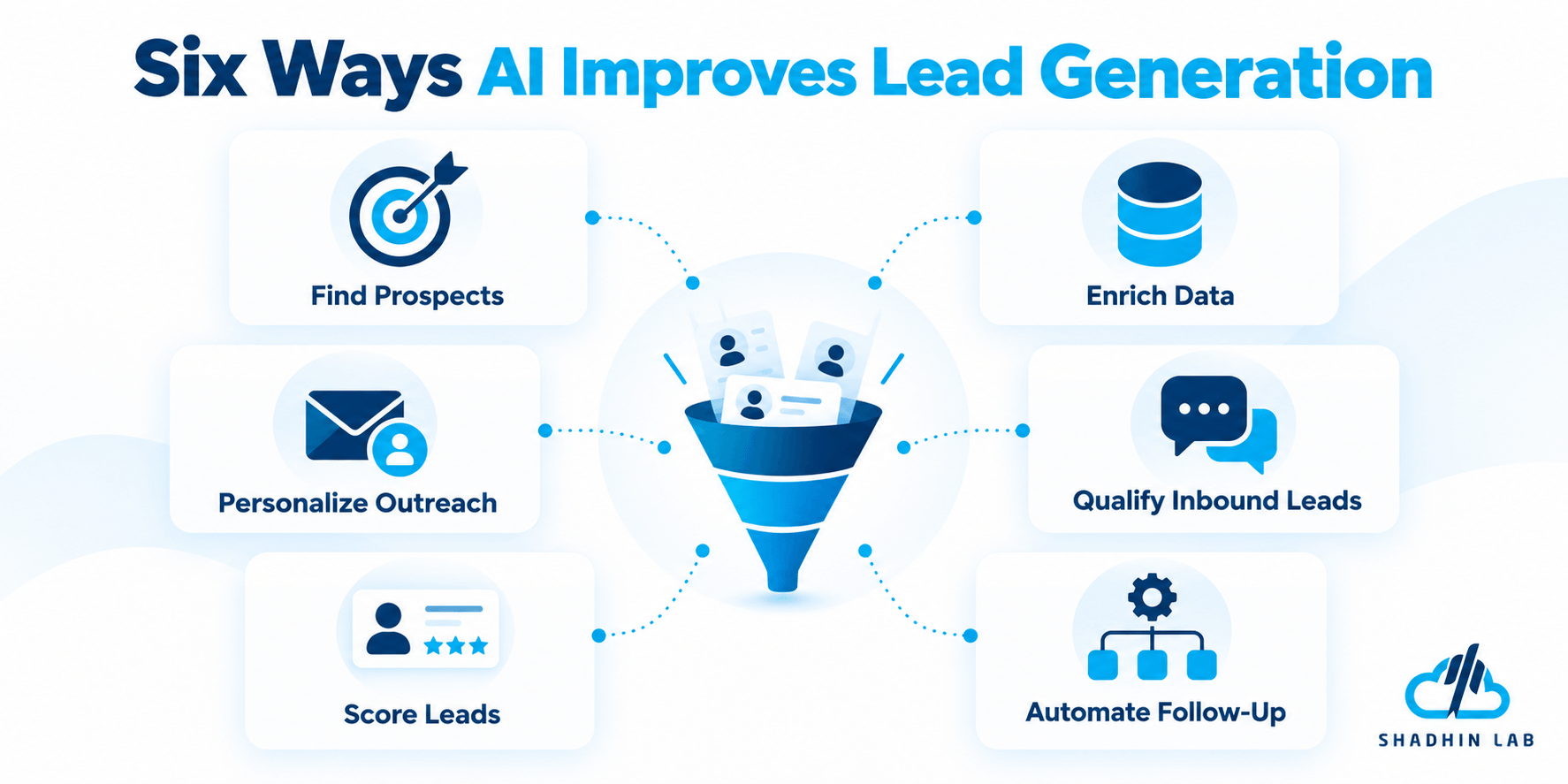
Six Practical Ways to Use AI for Lead Generation
1. Find and Prioritize the Right Prospects
A common lead-generation problem is spending time on companies that do not need the product or service being offered.
AI-assisted prospecting can help teams build target lists based on an ideal customer profile. An ICP describes the types of companies most likely to benefit from a business’s offering. It can include industry, company size, business model, technical requirements, geography, and other relevant characteristics.
AI research and data tools can help identify matching companies, find likely decision-makers, filter prospects by firmographic or technographic attributes, and discover similar accounts.
For example, a B2B AI development company might target mid-sized software businesses with complex manual workflows, growing engineering teams, or a need to integrate AI into existing applications. AI-assisted research can help identify relevant companies and potential technology or operations leaders to contact.
However, the targeting criteria should come from actual customer knowledge. AI-generated assumptions about which companies are ready to buy should be treated as hypotheses, not facts.
Start by analyzing existing customers, successful projects, and lost opportunities. Use those insights to define qualification criteria before building a prospect list.
2. Enrich Prospect Data and Identify Buying Signals
A company name and contact record rarely provide enough information for effective outreach. Sales teams often need additional context about a prospect’s business, technology, priorities, and possible challenges.
AI-assisted data enrichment can help add company descriptions, technology information, leadership details, hiring activity, funding announcements, product launches, and relevant business news.
It is useful to distinguish between static attributes and buying signals. Static attributes describe a company, such as its industry or approximate size. Buying signals are events or behaviors that may indicate a current need.
For example, a software company hiring AI engineers might be worth researching for AI infrastructure or development services. But hiring alone does not prove that the company intends to purchase external services.
A practical workflow should collect only relevant information, verify important facts against reliable sources, and distinguish confirmed details from inferred intent. Data freshness matters because employee roles, technologies, and company priorities change.
Enrichment also has a cost. Teams should compare the value of additional data with its price and usefulness rather than enriching every available field by default.
3. Personalize Outreach at Scale
AI can help sales teams turn prospect research into more relevant emails, professional-network messages, and follow-ups.
The important part is not personalization by itself. It is the connection between a verified business signal, a likely problem, and a relevant offer.
Consider the difference:
Generic outreach
“Hi Alex, I noticed your company is growing. We help businesses improve efficiency with AI. Would you be available for a call?”
Research-informed outreach
“Hi Alex, I noticed your team is expanding its support operation. If your team is reviewing ways to handle repetitive customer inquiries without adding more manual work, it may be worth exploring whether an AI assistant connected to your existing knowledge base could help.”
The second example connects a business observation to a specific potential problem. It is still a hypothesis that needs to be relevant to the recipient, but it gives the conversation a clearer reason to exist.
An AI-assisted outreach workflow can research the account, identify a relevant signal, draft a message using approved information, and prepare follow-up variations. A salesperson should review messages when claims need verification or the communication is sensitive.
Avoid generating large volumes of superficially personalized emails. Inaccurate claims, irrelevant offers, poor contact data, and indiscriminate messaging can damage trust and email deliverability.
Businesses must also follow applicable outreach laws and platform rules. In the United States, for example, the FTC’s CAN-SPAM guidance applies to commercial email, including business-to-business messages.
4. Capture and Qualify Inbound Leads
Outbound prospecting is only one part of lead generation. Businesses can also use AI to improve how they handle visitors who arrive through search, content, advertising, referrals, or existing campaigns.
Conversational AI can answer common questions, recommend relevant services, collect qualification details, assist with forms, and direct visitors toward an appropriate next step.
Imagine a visitor exploring an AI automation service. The visitor describes a repetitive business process that requires manual data entry. An AI assistant asks about the systems involved, the frequency of the task, and the desired outcome. Based on the answers, it can summarize the requirement and offer to schedule a consultation.
This approach can help sales teams receive more useful context before the first conversation.
However, the experience should remain helpful rather than turning every interaction into an aggressive sales pitch. Visitors should be able to request human assistance, and the system should not invent service capabilities, prices, or guarantees.
Define which questions the AI can answer, which information it may collect, and when it should route a visitor to a person. Monitor whether the resulting inquiries are genuinely qualified rather than simply counting chatbot conversations.
5. Score Leads and Prioritize Sales Follow-Up
Not every lead deserves the same level of attention. AI-assisted lead scoring can help sales teams prioritize contacts based on their fit, engagement, and potential readiness to buy.
There are two common approaches.
Rule-based scoring assigns points according to predefined conditions. A company matching the ICP might receive points for fit, while a relevant demo request may indicate stronger buying interest.
Predictive scoring uses historical data to estimate which leads are more likely to achieve a defined outcome, such as becoming a customer. Its usefulness depends on the quality and relevance of the underlying data.
Marketing-qualified leads (MQLs) are leads that meet agreed marketing qualification criteria. Sales-qualified leads (SQLs) have been assessed as appropriate for direct sales engagement under the organization’s qualification process.
AI can help identify patterns, but a high score should support rather than replace sales judgment. A model trained on incomplete data may favor the wrong characteristics or fail when customer behavior changes.
Define qualification criteria with the sales team, validate scoring against actual outcomes, and review whether high-scoring leads become meaningful opportunities.
6. Automate Lead Nurturing and CRM Workflows
Lead generation becomes more efficient when research, qualification, engagement, and follow-up work together.
AI and conventional automation can connect these activities by creating CRM records, updating fields, assigning leads, creating follow-up tasks, preparing meeting summaries, and triggering relevant nurture sequences.
For example, when an inbound lead submits a consultation request, an automated workflow can create or update the CRM record, check for duplicates, assign an owner, and create a follow-up task. AI can summarize the inquiry and suggest relevant discovery questions.
When a prospect shows a meaningful buying signal, the system might notify the assigned salesperson rather than automatically sending another email.
Not every step needs AI. Rules-based automation is often more reliable for predictable tasks, such as assigning a lead by region or notifying an owner when a form is submitted. AI is better suited to tasks involving unstructured information, contextual research, classification, or message drafting.
The strongest workflow combines the two, with clear rules for when a person must review or approve an action.
How to Build an AI-Powered Lead-Generation Workflow
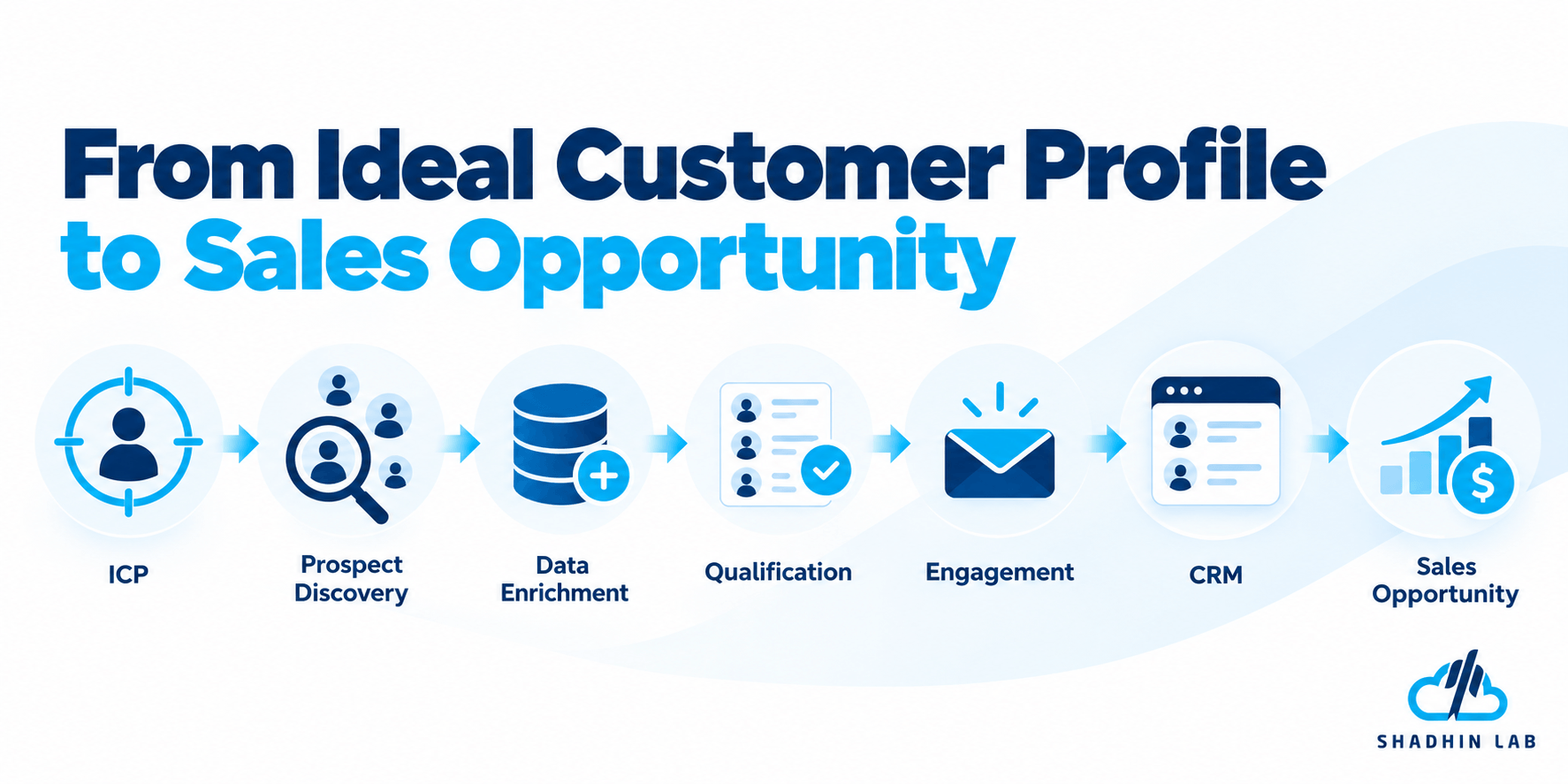
A practical workflow connects prospect discovery to sales opportunities. Follow these steps to implement one without adding unnecessary tools or complexity.
Step 1: Define the Ideal Customer Profile
Specify the companies and buyers most likely to benefit from your product or service. Include industry, company size, business model, relevant business needs, buyer roles, and disqualifying characteristics.
Use existing customer data and sales feedback to refine the ICP. Avoid relying entirely on AI-generated personas.
Step 2: Choose the Lead Source
Identify appropriate sources for prospect data. These might include website inquiries, existing CRM records, business directories, professional networks, company websites, or licensed data providers.
Before automating collection, review data access, accuracy, licensing, permitted use, and applicable privacy requirements.
Step 3: Enrich and Validate the Data
Add the information needed to understand fit and potential need. Verify important details, check contact information, and remove duplicate records where possible.
Do not assume that AI-generated company summaries or inferred buying signals are correct without verification.
Step 4: Define Qualification and Prioritization Rules
Specify which attributes make a prospect suitable, which signals require more research, and which characteristics should disqualify a lead.
Agree on these criteria with sales and marketing so that both teams understand what qualifies as a useful opportunity.
Step 5: Generate Relevant Outreach or Inbound Experiences
Use AI to prepare account-specific messages, support conversational website experiences, or develop nurture content for different segments.
Require human review where factual claims, sensitive information, or consequential communications are involved. Test messages with a small, relevant audience before expanding the workflow.
Step 6: Connect the Workflow to the CRM
Record lead source, qualification status, relevant activity, owner, and next action consistently. Integrations should prevent unnecessary duplicate records and make it clear how information entered the system.
Limit automated write access to the actions the workflow actually needs.
Step 7: Measure Results and Improve
Review which sources, segments, buying signals, and messages produce qualified opportunities. Update the ICP, scoring rules, and workflow based on actual results.
The process can be summarized as:
ICP → Prospect Discovery → Enrichment → Qualification → Engagement → CRM → Sales Opportunity
The sequence may differ for inbound and outbound leads, but both should connect to the same qualification and measurement process.
Best AI Lead Generation Tools: What Should Businesses Look For?
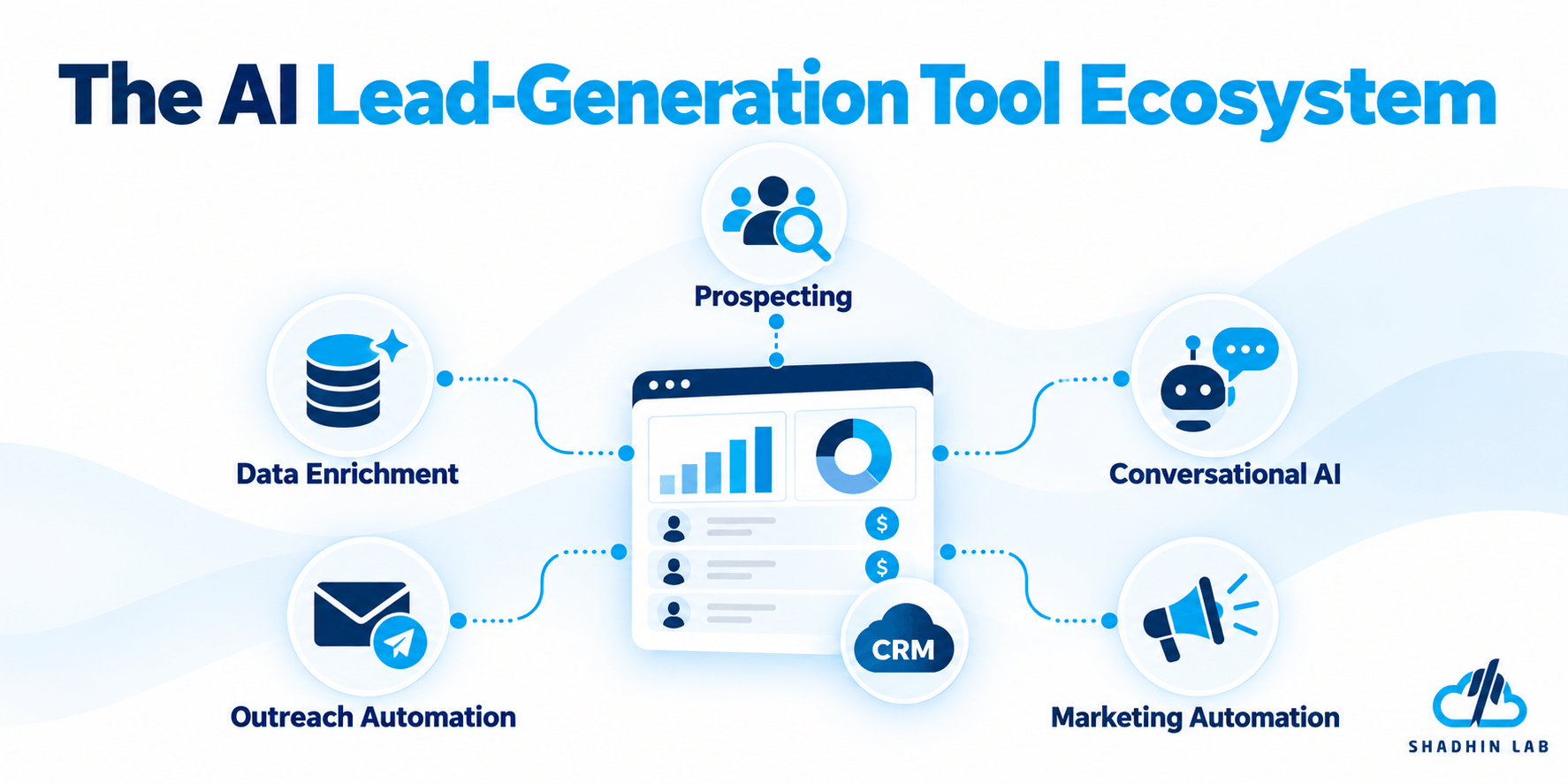
The best tools depend on the problem you need to solve. Instead of choosing software based on popularity alone, map the workflow and identify where your team loses the most time or opportunities.
| Tool category | Primary purpose | Examples to evaluate |
| Prospecting and data enrichment | Find companies, contacts, and relevant data | Clay, Apollo |
| CRM and lead management | Track contacts, opportunities, and follow-ups | HubSpot, Salesforce |
| Conversational AI | Engage and qualify inbound prospects | Intercom and comparable platforms |
| Outreach automation | Manage sales sequences and follow-up | Outreach, Salesloft |
| Marketing automation | Segment, nurture, and convert leads | HubSpot and comparable platforms |
| AI workflow automation | Connect research, qualification, and business systems | Automation platforms suited to your stack |
These are examples of tools to evaluate, not endorsements. Capabilities, integrations, product plans, and prices can change, so verify current details directly with vendors.
How to Choose the Right Tools
Evaluate each tool against the actual workflow it must support.
Consider data accuracy and source transparency, enrichment coverage, personalization controls, CRM and email integrations, security, privacy, usage limits, and total cost. Also consider the maintenance required to keep the workflow reliable.
If your team already has a CRM with useful lead-scoring or automation features, test those capabilities before buying another platform. A collection of overlapping tools can create inconsistent data, duplicated costs, and more integration work.
Off-the-shelf tools are often sufficient for standard prospecting and nurture workflows. Custom development becomes more relevant when qualification logic, internal data, integrations, or approval requirements are too specific for existing products.
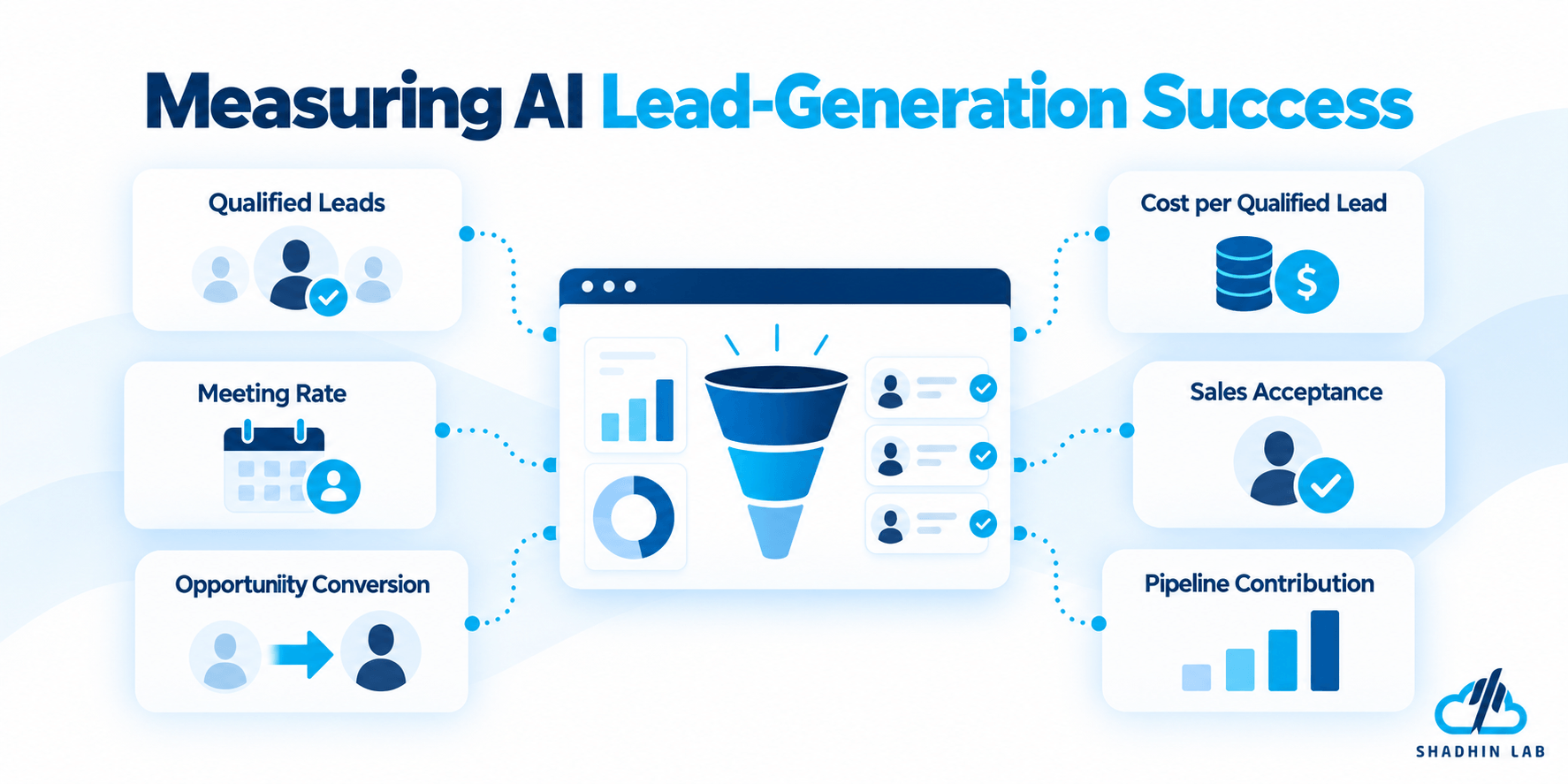
How to Measure AI Lead Generation Performance
AI lead generation should be measured by its contribution to the sales process, not by the number of tasks it automates.
| Metric | What it measures |
| Lead-to-qualified-lead rate | Proportion of leads that meet qualification criteria |
| Cost per qualified lead | Cost of generating a qualified prospect |
| Meeting-booking rate | Proportion of relevant leads that schedule a meeting |
| Sales acceptance rate | How often sales accepts marketing-generated leads |
| Opportunity conversion rate | How often leads become real sales opportunities |
| Pipeline contribution | Opportunity value associated with lead-generation efforts |
| Time to follow-up | How quickly a lead receives the appropriate next action |
| Customer acquisition cost | Cost of acquiring a customer, where attribution is reliable |
Open rates, clicks, and chatbot conversations can help diagnose a workflow, but they do not prove business success on their own.
Establish a baseline before introducing AI. Then compare results across comparable segments and time periods. Consider lead quality, conversion, costs, and sales feedback together rather than attributing every improvement to AI.
Common AI Lead Generation Mistakes
Targeting too broadly. AI can generate more contacts without producing more suitable prospects. Refine the ICP before scaling research.
Using inaccurate or outdated data. Incorrect job titles, company information, or contact details lead to irrelevant outreach and wasted sales effort.
Personalizing without a relevant reason. Mentioning a recent company announcement is not enough if the message does not connect it to a plausible need and a useful offer.
Automating before defining the process. Automation can scale existing problems. Define qualification, ownership, and follow-up rules before connecting tools.
Ignoring human review. AI-generated claims, lead qualification decisions, and sensitive communications may require validation.
Measuring leads instead of opportunities. A larger contact list does not necessarily mean more qualified pipeline or revenue.
Ignoring privacy and outreach requirements. Review data provenance, applicable consent requirements, marketing laws, opt-out processes, and platform rules. Automated outreach does not remove the sender’s responsibilities.
AI Lead Generation vs. AI Agents: What’s the Difference?
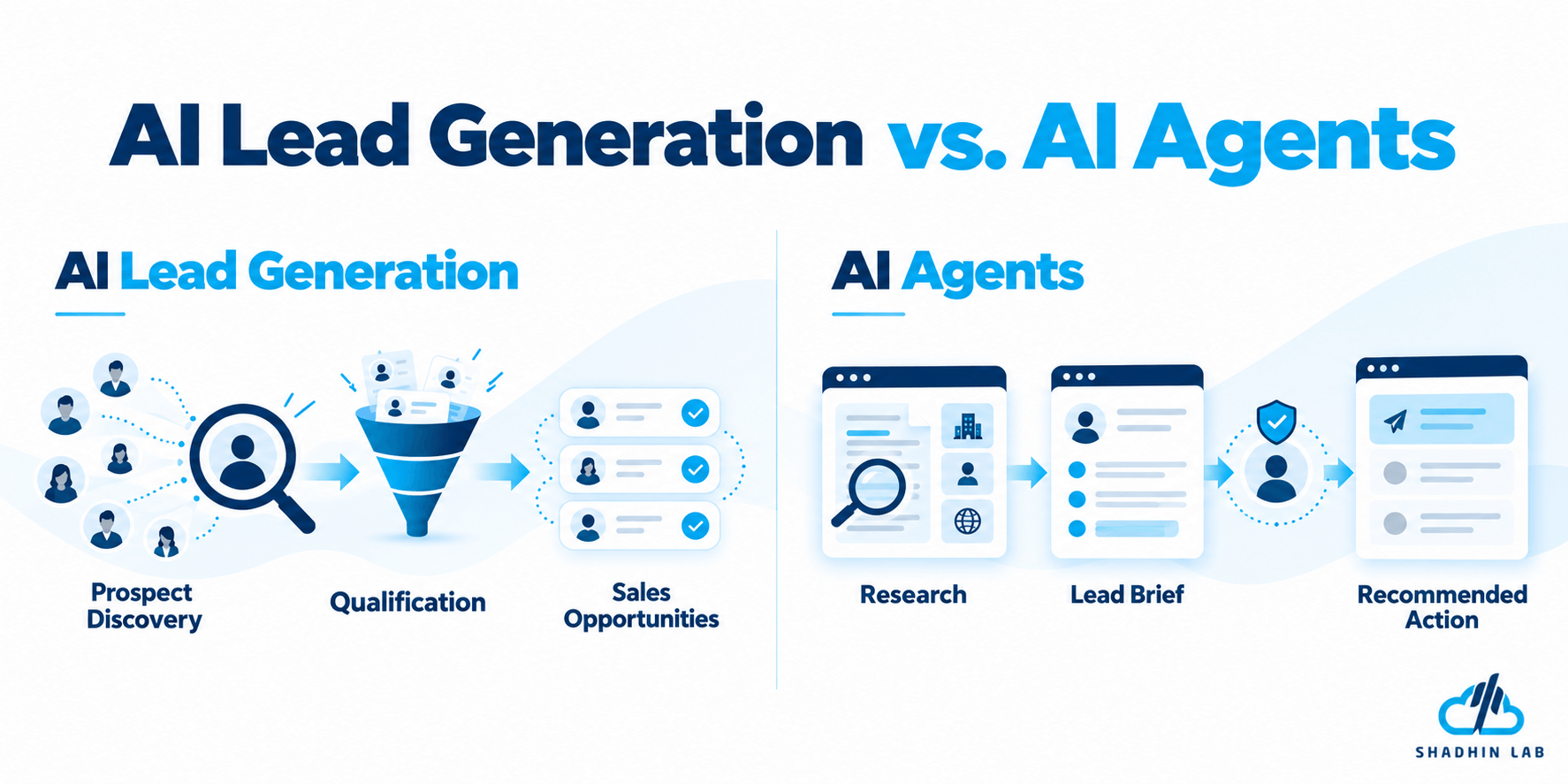
AI lead generation is the broader business use case. AI agents are one possible way to execute parts of it.
| Approach | Role in lead generation |
| Generative AI assistant | Helps researchers or salespeople analyze information and create content |
| Rules-based automation | Executes predictable actions when predefined conditions are met |
| Predictive AI | Estimates outcomes, such as the likelihood of conversion |
| AI agent | Performs multi-step tasks within defined permissions and objectives |
For example, an AI agent could research a target account using approved sources, summarize relevant business signals, prepare a lead brief, and recommend an outreach angle.
A more autonomous workflow might update a CRM record or prepare a message for a sales sequence. These actions should follow defined permissions, validation rules, and approval requirements.
Start with a narrow workflow and evaluate its reliability before expanding its responsibilities. An agent does not need unrestricted access to a CRM, email account, or external data source to be useful.
When Should a Business Build Custom AI Lead Generation Workflows?
Custom AI development is worth considering when existing tools cannot support a business’s specific requirements.
It may be useful when prospect research spans several disconnected systems, qualification depends on company-specific rules, lead routing involves complex conditions, or AI needs access to proprietary knowledge and internal applications.
Custom workflows can connect research, enrichment, qualification, conversational AI, CRM updates, and follow-up into a coordinated process. They can also include business-specific validation, monitoring, and approval controls.
However, custom development brings implementation, integration, testing, and maintenance responsibilities. If a standard tool already solves the problem reliably, building a replacement may not be justified.
Businesses looking to connect separate lead-generation activities can explore ShadhinLab’s AI solutions for AI automation, AI agents, and custom AI application development. The right approach starts with the existing sales process, its bottlenecks, and the systems that need to work together.
Frequently Asked Questions
What are the best AI lead generation tools?
The best tools depend on the workflow. Clay and Apollo are examples to evaluate for prospecting and enrichment, while HubSpot and Salesforce support CRM and lead management. Compare current capabilities, data quality, integrations, security, pricing, and maintenance requirements before choosing.
Can AI find potential customers?
Yes. AI-assisted prospecting can identify companies and decision-makers that match defined criteria and help surface relevant business signals. The resulting prospects still need validation because available data may be incomplete, outdated, or unrelated to actual purchase intent.
How does AI improve lead qualification?
AI can analyze company attributes, engagement, inquiry content, and historical outcomes to help prioritize leads. Qualification rules should reflect actual customer needs, and predictive scores should be validated against sales outcomes rather than accepted automatically.
How can AI personalize sales outreach?
AI can use verified company research, buyer roles, and relevant business events to help draft contextual messages. Effective personalization connects a credible observation to a plausible problem and a relevant offer instead of merely inserting a name or company.
Is AI lead generation suitable for small businesses?
Yes. Small businesses can begin with one practical use case, such as improving prospect research, drafting outreach, qualifying website inquiries, or automating CRM follow-up. They do not need a complex custom AI system to get started.
Can AI automate the entire lead-generation process?
AI and automation can support many stages, but full automation is not appropriate for every business or interaction. Human review remains important for complex qualification, sensitive communications, uncertain data, and decisions that require judgment. Automated actions should have clear permissions, monitoring, and escalation rules.
Conclusion
AI works best for lead generation when it strengthens a well-defined process rather than simply increasing activity.
Start with a clear ideal customer profile, identify one workflow that creates a measurable bottleneck, validate your data, and apply the appropriate AI assistance. Connect the workflow to your CRM, establish clear qualification rules, and measure results through qualified leads and real sales opportunities.
As your process matures, you can connect prospect research, inbound qualification, outreach, and follow-up into a more coordinated system. The objective is not to automate every interaction. It is to help your team spend more time on relevant prospects and meaningful sales conversations.
If your business is ready to move beyond isolated AI tools and connect lead research, qualification, and CRM workflows, explore ShadhinLab’s AI solutions to discuss a practical approach to AI automation, AI agents, and custom AI development.

Shaif Azad
Shaif Azad Rahi is an AI/ML professional and Solution Engineer at Shadhin Lab, specializing in AI-powered solutions and scalable software systems, with a focus on applying AI to solve real-world business challenges.
Related Post
AI Email Assistant Guide: Write, Reply, and Save Time
Email can quietly consume hours of your workweek. Reading long threads, drafting replies, rewriting awkward messages,...
AI Risk Management: Frameworks, Challenges & Best Practices
Are you someone who lies awake wondering if your AI systems might suddenly make catastrophic decisions?...
AI Infrastructure for LLMs: Components, Costs, and Deployment
Large language models (LLMs) need more than a powerful GPU to operate reliably in production. They...
