
AI Tokens Explained: How They Work and Why They Matter
Table of Contents
When you ask an AI chatbot a question, summarize a document, or build an AI-powered application, you may encounter token limits, usage quotas, or unexpected API costs. Understanding AI tokens helps explain why these issues occur.
AI models process information using tokens rather than treating every word as a single unit. A token can represent a complete word, part of a word, punctuation, or another text element, depending on the model’s tokenizer.
Tokens influence how AI models process information, how much content they can handle within a context window, and how usage is measured or billed. This guide explains how AI tokens work, what affects token consumption, and how businesses can optimize AI applications without sacrificing accuracy or performance.
Table of Contents
Key Takeaways
- AI language models process text as tokens, which can represent words, word fragments, or punctuation.
- Token counts vary by tokenizer, language, and input format.
- An AI context window determines how much tokenized information a model can handle in a particular context.
- Many AI APIs charge separately for input and output tokens, although pricing models vary.
- AI agents can consume more tokens when they perform multiple model calls or process additional information.
- Efficient AI applications reduce unnecessary token consumption while maintaining accuracy, reliability, and task performance.
What Are AI Tokens?
AI tokens are units of information that artificial intelligence models process when reading or generating content. In large language models (LLMs), tokens are produced by a process called tokenization, which converts text into smaller units that the model can process.
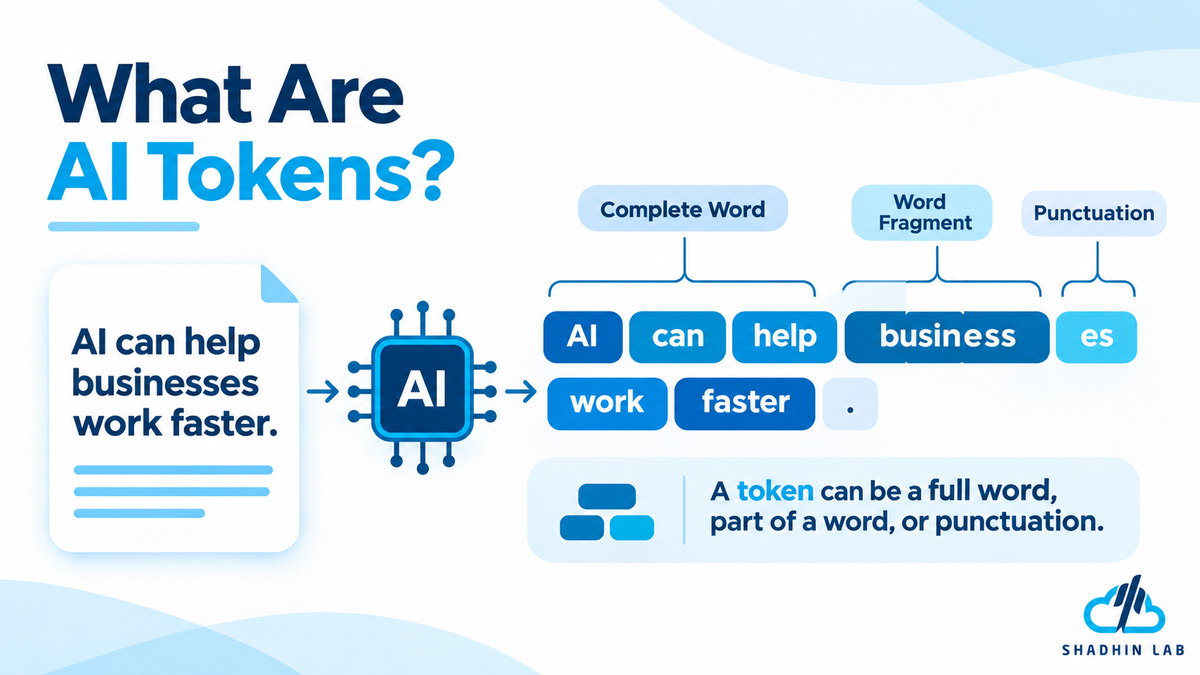
A token may represent:
- A complete word, such as cat
- Part of a word, such as a prefix or suffix
- Punctuation, such as a comma or period
- Other text elements, depending on the tokenizer
Consider this sentence:
AI can help businesses work faster.
A tokenizer divides this sentence into tokens. Common words might each become individual tokens, while other text elements could be split differently. The exact boundaries depend on the tokenizer used by the model.
After tokenization, the text is represented as a sequence of token IDs, which the model uses during processing.
Are AI Tokens the Same as Words?
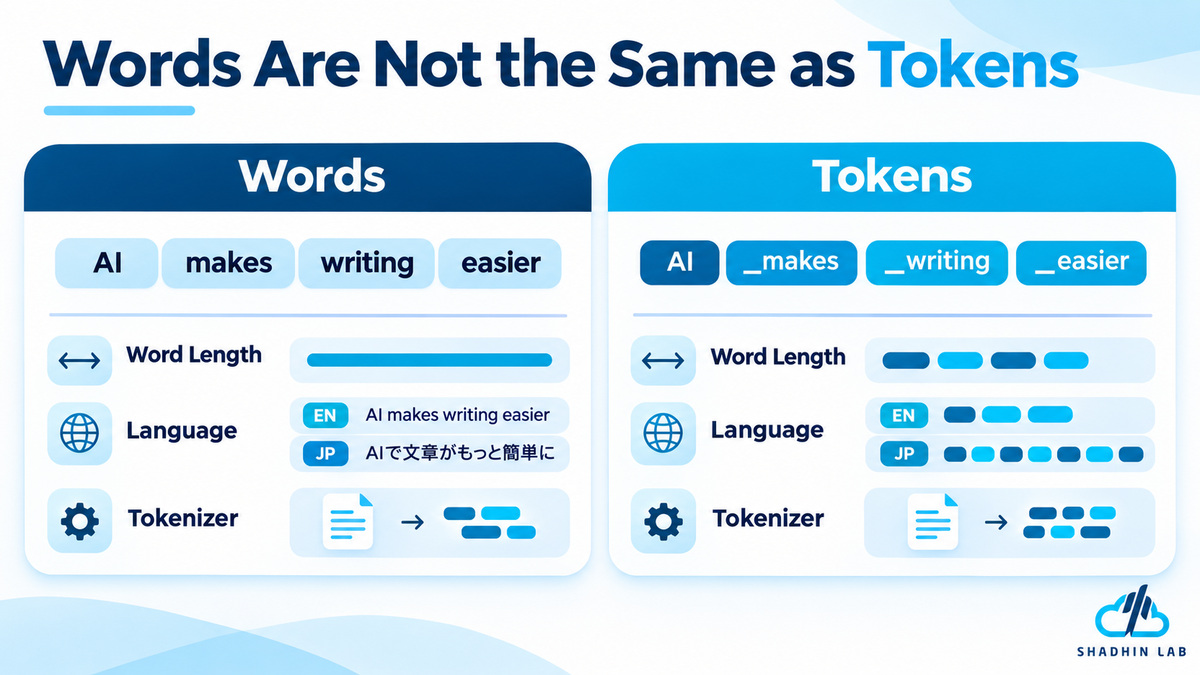
No. Words and tokens are different units of measurement.
A familiar word may be represented by a single token, while a longer or less common word may be divided into multiple tokens. Punctuation, spaces, formatting, and other text patterns can also influence tokenization.
The following examples illustrate the concept rather than guarantee exact token counts.
| Text | What to understand |
| cat | A common word may be represented by one token. |
| unbelievable | A longer word may be represented by one or several tokens. |
| AI-powered | A hyphenated expression may be split into multiple tokens. |
| Hello! | The word and punctuation may be represented separately or together. |
Different models can tokenize the same sentence differently. Therefore, a word count cannot provide an exact token count.
Why Do AI Models Use Tokens?
Tokenization allows language models to process common words, uncommon words, word fragments, and different text patterns without requiring a separate vocabulary entry for every possible word.
Instead of treating every complete word as an indivisible unit, a tokenizer can represent text using reusable pieces. This approach helps models handle unfamiliar terms, technical vocabulary, and variations in written language.
For developers and businesses, understanding tokenization is useful when estimating API usage, managing context limits, and designing AI-powered applications.
How Do AI Tokens Work?
AI token processing follows a sequence of steps that transforms a user’s input into a generated response.
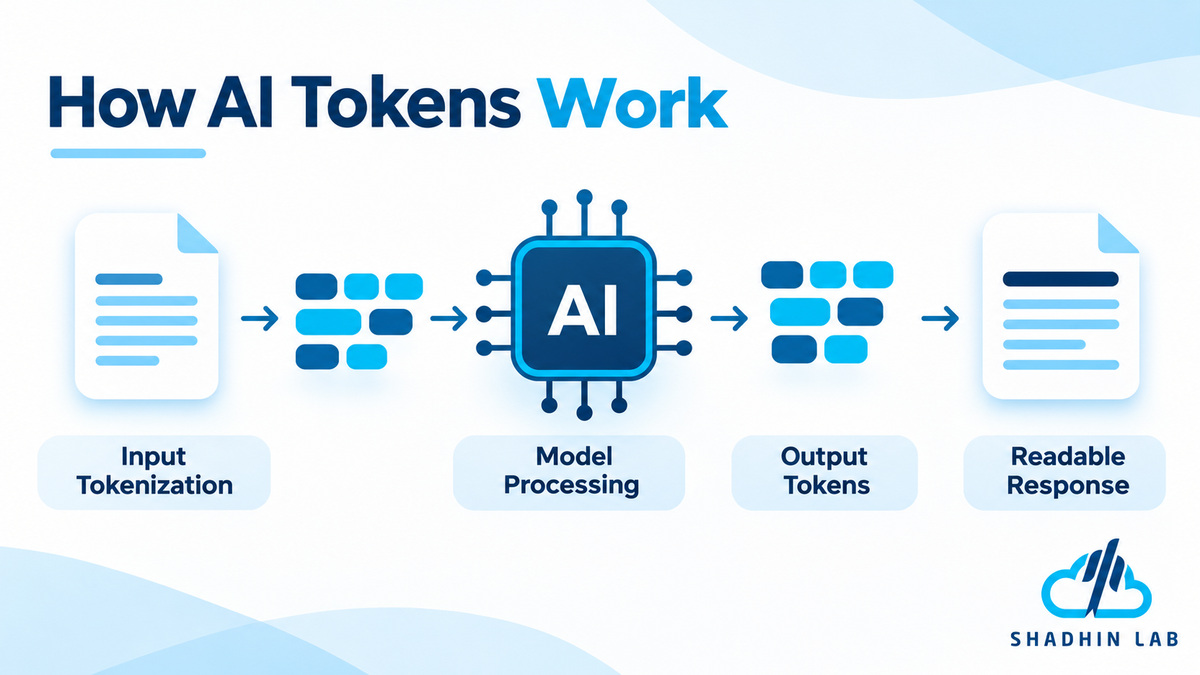
Step 1: The Input Is Tokenized
When you submit a prompt, the tokenizer divides the text into tokens and maps those tokens to numerical identifiers called token IDs.
For example, a prompt asking an AI assistant to summarize a report is converted into a sequence of token IDs before the model processes it.
Step 2: The Model Processes the Token Sequence
The model processes numerical representations of the input using patterns and relationships learned during training.
It considers the supplied context to determine which response is appropriate. This process involves more than looking up individual tokens or retrieving prewritten answers.
The model’s architecture, training, instructions, and available context all influence its response.
Step 3: The Model Generates Output Tokens
The model generates a response as a sequence of output tokens. These tokens are then converted back into readable text.
For instance, when you request a short summary of a business report, the model processes the input and generates tokens that form the summary.
The basic workflow is:
User Prompt → Tokenization → Model Processing → Output Tokens → Readable Response
Tokenization is one part of the overall process. The model must also interpret the available context and generate a response that addresses the user’s request.
How Many Tokens Are in a Word?
There is no universal conversion between words and tokens. As a rough planning estimate, English text often averages around 1.3–1.5 tokens per word, although the actual ratio varies by text and tokenizer.
Using this estimate, 1,000 English words might correspond to approximately 1,300–1,500 tokens.
This is useful for rough planning, but it should not be treated as an exact calculation. The actual token count can differ significantly depending on the content.
What Affects Token Count?
Several factors influence how text is converted into tokens:
- Word length and frequency: Common words may tokenize efficiently, while uncommon or specialized terms may require multiple tokens.
- Punctuation and formatting: Symbols, punctuation, and formatting patterns can affect token boundaries.
- Programming code and structured data: Code, JSON, and other structured formats may tokenize differently from ordinary prose.
- Language and writing system: Different languages can have different tokenization patterns and token-to-word ratios.
- Tokenizer design: Each tokenizer has its own vocabulary and rules for dividing text.
Do Different Languages Use Different Numbers of Tokens?
Yes. Token efficiency can vary across languages, including English, Bengali, Japanese, and other languages.
For example, an English word-to-token estimate should not automatically be applied to a Bengali document. Differences in vocabulary, writing systems, and tokenizer coverage can change the resulting token count.
If precise usage matters for an application, use a tokenizer compatible with the specific model whenever possible. For actual API billing, check the provider’s usage reports.
Input Tokens vs. Output Tokens vs. Reasoning Tokens
AI usage reports may separate tokens into different categories. Understanding these categories helps developers estimate costs and identify where consumption occurs.
| Token category | Meaning | Example |
| Input tokens | Information supplied to the model | Prompts, instructions, and conversation history |
| Output tokens | Tokens generated by the model | Answers, summaries, and generated content |
| Reasoning tokens | Tokens associated with internal reasoning in models that expose this category | Model-specific reasoning usage |
| Cached input tokens | Previously processed input eligible for cached processing | A reusable prompt prefix |
Not every model or provider reports these categories separately. Reasoning-token accounting and cached-input pricing also depend on the provider’s implementation.
How Does Token Usage Add Up?
Consider a hypothetical API request that uses 800 input tokens and generates 300 output tokens.
The combined input and output usage is:
800 + 300 = 1,100 tokens
This calculation does not account for additional token categories or provider-specific billing rules.
The total number of tokens does not determine the cost on its own. The model selected, the rates for different token categories, and the provider’s pricing structure all affect the final amount.
What Is an AI Context Window?
An AI context window is the amount of tokenized information a model can handle within a particular context.
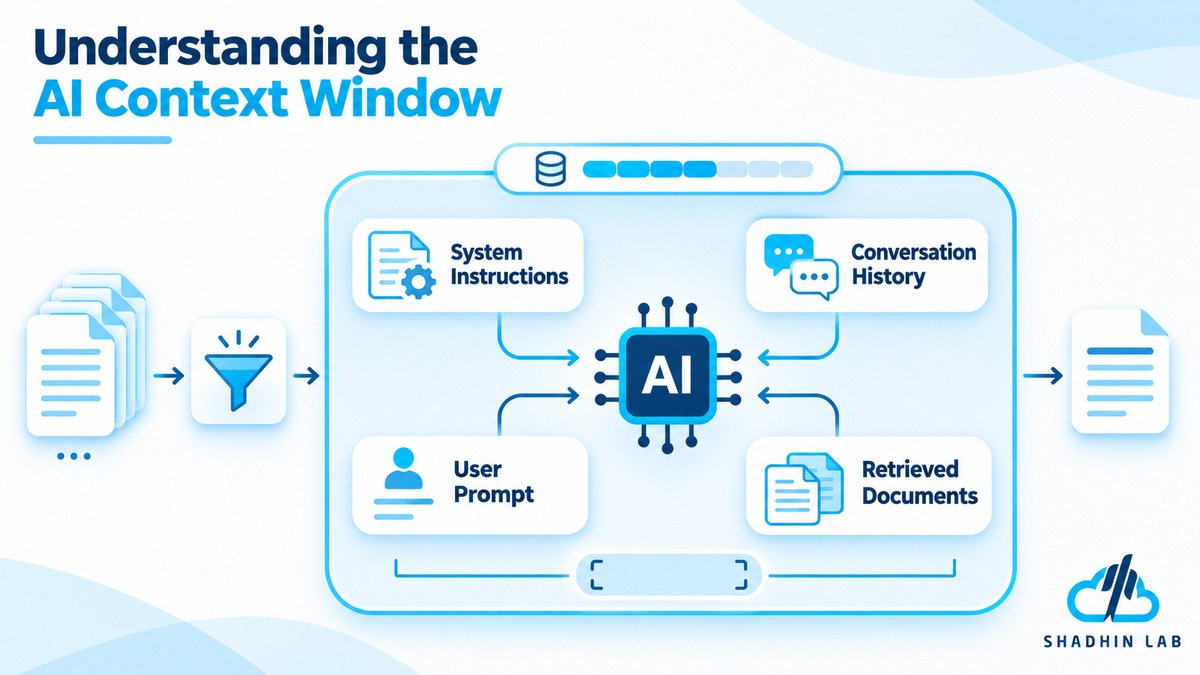
Think of it as the working information available to the model while it processes a request. Depending on the application and model, the context may include:
- System instructions that define the assistant’s behavior
- Previous conversation messages
- The current user prompt
- Retrieved documents or other supplied information
- Tool results and other inputs used by the application
Depending on the model’s limits, generated output may also count toward the available context.
What Happens When an AI Reaches Its Context Limit?
When the available context becomes too large, an application may need to manage the information sent to the model.
Possible approaches include shortening conversation history, summarizing earlier messages, retrieving relevant passages, or removing information that is no longer necessary.
Reaching a context limit does not necessarily mean information has been permanently forgotten. It means that some information may no longer be included in the active context used for the current request.
Does a Larger Context Window Always Mean Better Answers?
No. A larger context window can help a model work with lengthy documents, extensive conversation histories, and complex information. However, it does not automatically guarantee better answers.
The relevance of the supplied information, the model’s capabilities, and the quality of context management also matter.
For example, a business might use AI to analyze a lengthy company handbook. Sending the entire handbook with every question may increase token consumption unnecessarily. Retrieving only the relevant sections can make the workflow more efficient while providing the information needed to answer accurately.
How Do AI Token Costs Work?
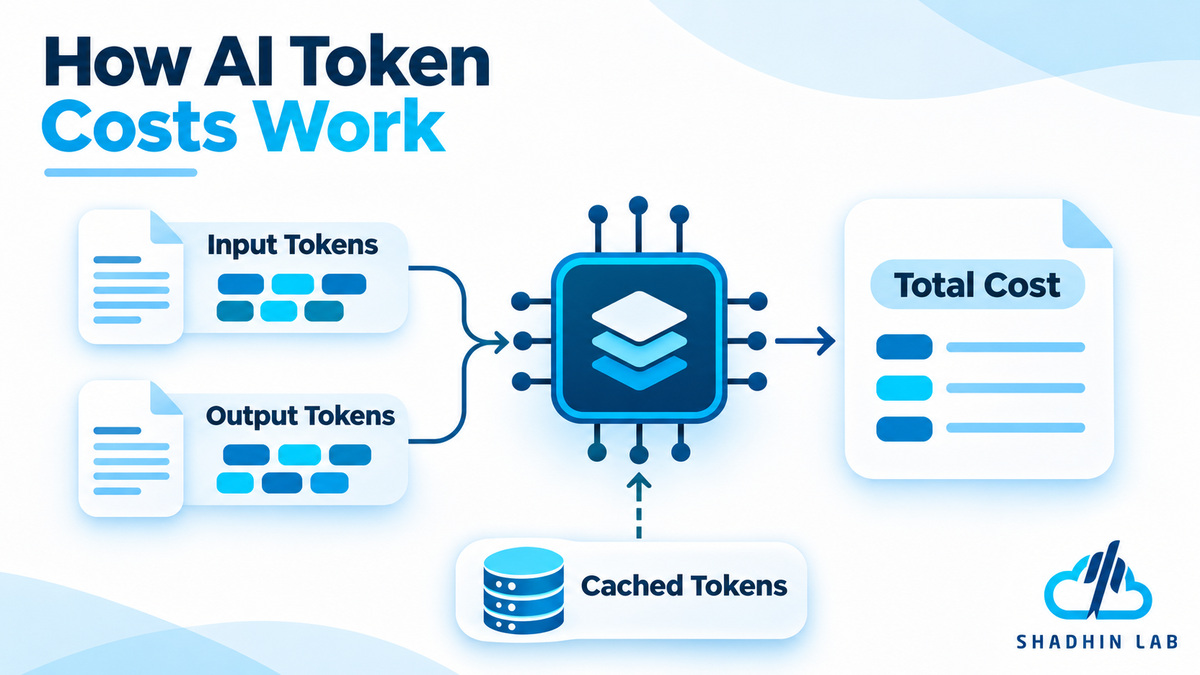
AI token costs depend on the service and its pricing model. Many AI APIs charge separately for input and output tokens, while some offer different rates for cached input or other usage categories.
Consumer AI products may instead use subscriptions, credits, or usage quotas. Therefore, not every AI interaction has a direct per-token charge visible to the user.
A Simple AI Token Cost Calculation
Suppose a fictional AI API charges:
- $2 per million input tokens
- $8 per million output tokens
An application processes a request containing 10,000 input tokens and generates 2,000 output tokens.
| Calculation | Cost |
| Input: 10,000 ÷ 1,000,000 × $2 | $0.020 |
| Output: 2,000 ÷ 1,000,000 × $8 | $0.016 |
| Total | $0.036 |
The total cost for this hypothetical request is $0.036.
These rates are fictional and demonstrate the calculation only. They are not current prices for any specific AI model or provider.
Why Does Token Pricing Matter for Businesses?
A small cost per request can accumulate when an application processes thousands or millions of requests.
For example, a customer support assistant may handle inquiries throughout the day, while an AI-powered reporting system may process large documents and perform several model calls for each report.
Total spending depends on token consumption, model pricing, output length, and the number of model interactions required to complete each task.
Understanding AI token costs helps businesses estimate operating expenses, compare model options, and make informed decisions about AI application design.
Why AI Token Costs Can Add Up Faster Than Expected
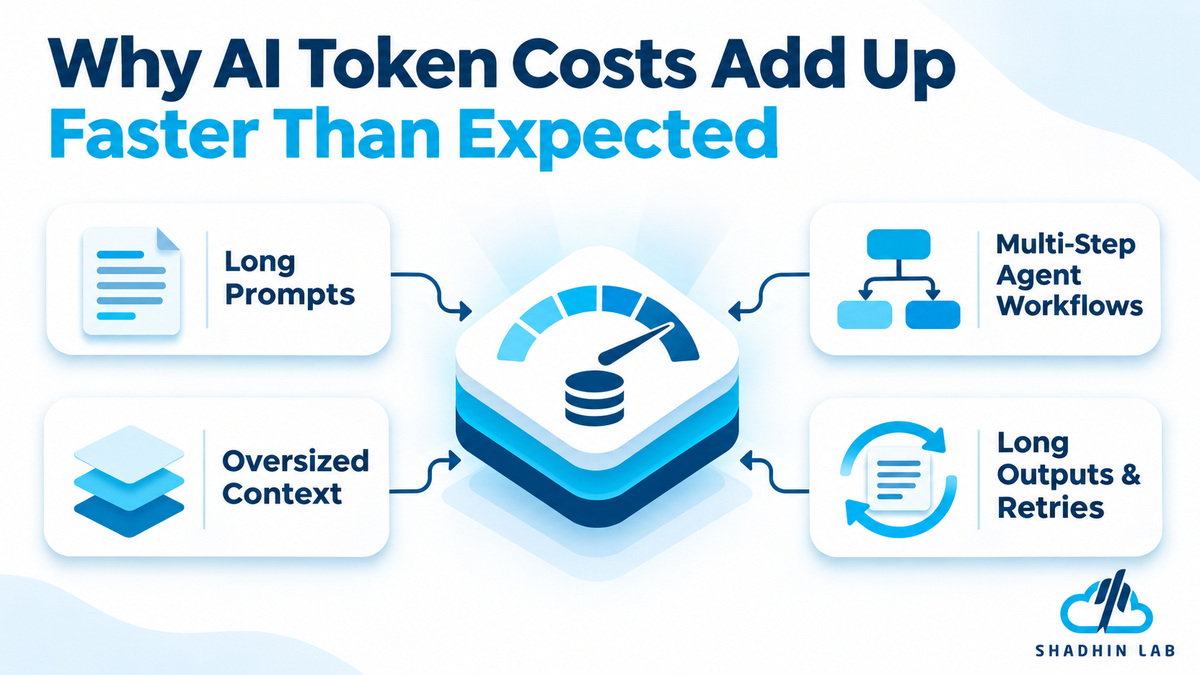
Low token prices do not necessarily translate into low operating costs. Businesses may spend more than expected because their applications consume excessive tokens, use more expensive models, or perform unnecessary processing.
Long Prompts and Repeated Context
System instructions, conversation history, and background information can increase input token consumption.
If an application repeatedly sends the same lengthy instructions or duplicates information across requests, it may use more tokens than necessary. Caching may help in supported situations, but its availability and billing benefits depend on the provider.
The solution is to retain essential instructions and relevant context while removing unnecessary repetition.
Oversized Context and Unnecessary Retrieval
AI applications often retrieve information from documents, databases, or knowledge bases before generating an answer.
Sending entire documents or large collections of retrieved passages can increase token usage without improving the response proportionally.
Selecting relevant passages helps the model focus on the information needed for the task. Better retrieval can improve efficiency while reducing irrelevant context.
Multi-Step AI Agent Workflows
An AI agent may retrieve information, call external tools, evaluate results, and generate a final response through multiple model interactions.
Each additional call can introduce more input, output, or reasoning-token usage, depending on the model and workflow.
Consider a chatbot answering a straightforward question compared with an AI agent preparing a sales report using CRM data, calculations, and multiple checks. The reporting agent may require more processing because it performs several distinct operations.
However, there is no universal multiplier for agent token consumption. Actual usage depends on the task, context, model, and workflow design.
Long Outputs, Retries, and Repeated Requests
Long responses can consume more output tokens than necessary. Failed attempts, repeated API calls, and poorly designed workflows can also increase usage.
For example, if an application repeatedly asks a model to regenerate a report because the initial output format was unclear, it may consume additional tokens without producing proportional value.
Clear instructions, appropriate output limits, and effective error handling can help prevent this waste.
How to Reduce AI Token Consumption Without Sacrificing Quality
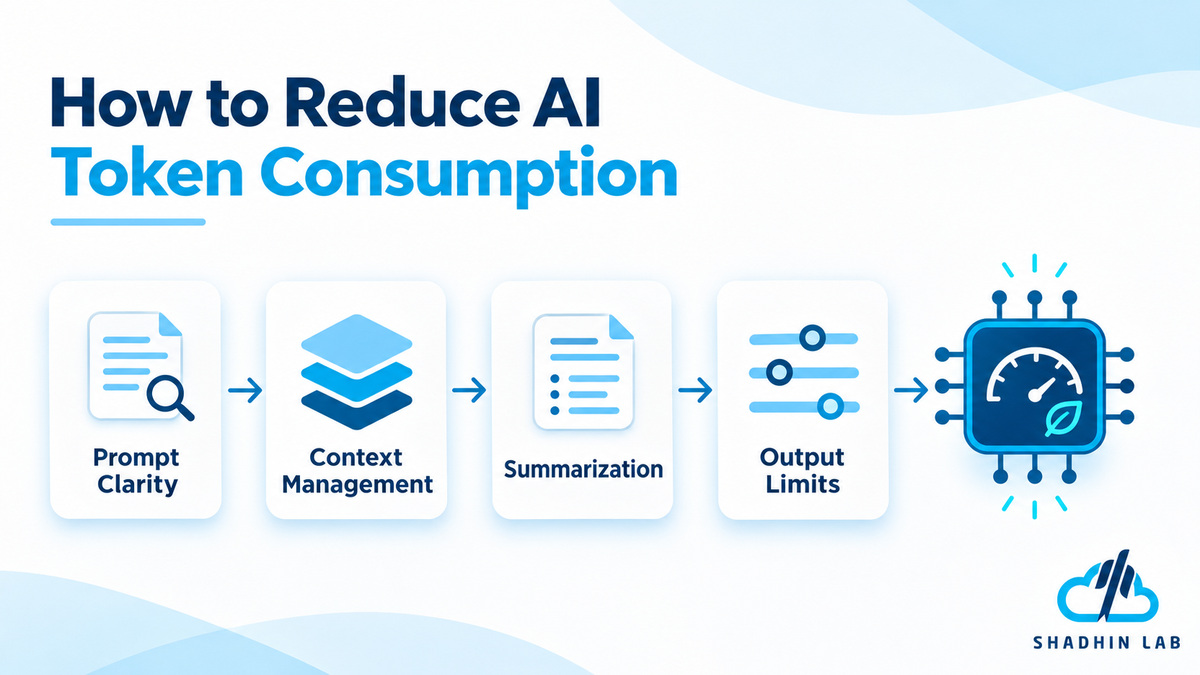
AI token optimization is not simply about using fewer tokens. The goal is to achieve the required result with less unnecessary processing while preserving accuracy, reliability, and task performance.
Make Prompts Focused and Remove Redundancy
Review prompts and remove repeated instructions, irrelevant background information, and unnecessary examples.
For instance, an application that generates product descriptions may not need to include the same formatting rules multiple times in every request.
However, do not remove information the model needs to produce a reliable answer. Conciseness is valuable only when the necessary context remains intact.
Retrieve Relevant Information Instead of Sending Everything
Document retrieval, filtering, summarization, and retrieval-augmented generation (RAG) can help AI applications provide relevant information without repeatedly supplying entire document collections.
RAG is an approach that retrieves relevant information from an external knowledge source and supplies it to a model as context.
For example, an AI assistant answering questions about company policies can retrieve the relevant policy sections instead of processing the entire policy library for every question.
Retrieval quality matters: missing important information can reduce accuracy even when token consumption decreases.
Choose Models Based on Task Complexity
Different tasks require different levels of model capability.
A straightforward classification or formatting task may not require the same reasoning capabilities as a complex analysis task. Businesses should evaluate models against representative workloads rather than automatically selecting either the cheapest or most powerful option.
Compare output quality, reliability, latency, and total cost to determine which model best fits each task.
Control Output Length and Repeated Calls
Set appropriate output limits and request concise responses when detailed explanations are unnecessary.
For AI agents, examine whether each model call, reasoning step, and tool interaction contributes meaningful value to the final result.
Removing redundant calls and improving error handling can reduce consumption while maintaining the required workflow.
Use Caching Where Appropriate
Supported caching mechanisms can reduce the cost of processing repeated inputs under eligible conditions.
For example, an application that frequently uses the same long instruction prefix may benefit from a provider’s prompt-caching feature.
Caching rules, eligibility requirements, implementation details, and potential savings vary by provider. Review the relevant documentation before relying on caching as an optimization strategy.
Businesses building AI-powered workflows need to consider model selection, data access, integrations, workflow design, and usage monitoring together. Explore ShadhinLab’s relevant AI development services to discuss potential implementation options for your business.
How to Measure AI Token Efficiency in Real Applications
Token count alone does not reveal whether an AI application is efficient. A system that consumes fewer tokens but produces inaccurate answers may be less useful than one that uses more tokens and reliably completes the intended task.
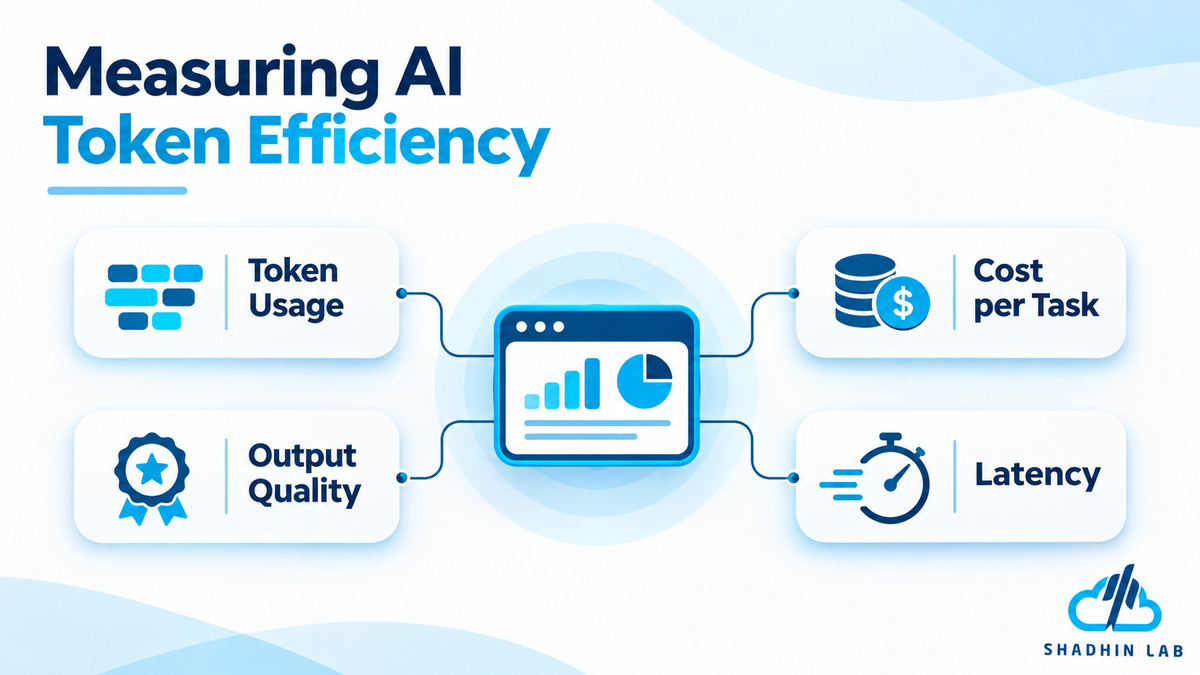
A practical measurement framework combines token consumption, operating cost, and task outcomes.
Tokens per Request or Task
Track input and output tokens for individual requests and completed tasks. This helps identify usage-heavy operations and compare similar workloads.
For multi-step applications, include all model calls required to complete a task rather than measuring only the final response.
Cost per Successful Task
Measure the total cost of achieving the intended result instead of focusing exclusively on the cost of one API call.
For example, compare two customer support workflows by including their model calls, retries, and additional processing. The workflow with the lower cost per successful resolution may be more efficient, provided that service quality remains acceptable.
Task Success Rate and Output Quality
Measure how often the application completes its task accurately and reliably.
Depending on the use case, evaluation may involve defined quality criteria, human review, or suitable automated evaluation methods.
This helps identify whether token optimization has reduced quality or affected the application’s ability to complete its intended work.
Model Calls and Response Latency
Track the number of model calls, retries, and the time required to complete a task.
These metrics can reveal unnecessary processing, inefficient tool use, and performance bottlenecks. They also help businesses understand whether an optimization improves cost at the expense of response speed.
Establish a Baseline Before Optimizing
Record token usage, cost, output quality, and task completion before changing the workflow. Then test the revised version against comparable tasks.
| Metric | What it measures | Why it matters |
| Tokens per task | Token consumption for a completed task | Identifies usage-heavy workflows |
| Cost per successful task | Cost of achieving the intended outcome | Connects spending to business value |
| Task success rate | How often the workflow meets its objective | Protects reliability during optimization |
| Model calls per task | Number of model interactions required | Helps identify unnecessary processing |
| Response latency | Time required to complete a task | Shows whether optimization affects speed |
These are practical operational metrics rather than a universal standardized scoring system. Select metrics according to the application’s purpose, available usage data, and business requirements.
Frequently Asked Questions About AI Tokens
What Are AI Tokens in Simple Terms?
AI tokens are units that an AI model processes when reading or generating information. In language models, a token can represent a complete word, part of a word, punctuation, or another text element. Tokenization converts text into these units before model processing.
How Many Tokens Are in 1,000 Words?
There is no exact conversion. A rough estimate for English is around 1,300–1,500 tokens per 1,000 words, but the actual count depends on the text and tokenizer. Use a compatible tokenizer when an accurate count is important.
Do AI Tokens Cost Money?
Tokens do not inherently cost money. The cost depends on the AI service and its pricing model. Some APIs charge according to input and output token usage, while consumer products may use subscriptions, credits, or usage quotas.
What Is the Difference Between Tokens and Parameters?
Tokens are units of information processed by a model. Parameters are learned numerical values within the model that influence its behavior. Tokens represent the input or output being processed, while parameters are part of the model itself.
Why Do AI Models Have Token Limits?
Models have limits on how much tokenized information they can process within a given context or generate in a response. These limits depend on the model and service. Applications may manage long inputs by summarizing conversation history or retrieving relevant information.
Do AI Agents Use More Tokens Than Chatbots?
They can. AI agents that perform multiple steps, retrieve information, call tools, or evaluate results may use more tokens than a simple chatbot interaction. Actual consumption depends on the model, task complexity, context, and workflow design.
How Can I Check My AI Token Usage?
A tokenizer compatible with the relevant model can estimate or count tokens in text. For API applications, usage reports provide information about actual consumption and, where available, the token categories used for billing. Consult the provider’s documentation for model-specific tools and reporting options.
Conclusion
AI tokens are fundamental to how language models process and generate information. Understanding them helps individuals and businesses interpret token limits, estimate usage, manage API costs, and design more efficient AI-powered applications.
Three principles are especially important: token counts are not the same as word counts, context limits and pricing vary across models and providers, and fewer tokens do not automatically mean better performance.
The most effective approach is to reduce unnecessary context and model calls while maintaining accuracy, reliability, and task success.
If your business is planning an AI-powered application or workflow, explore ShadhinLab’s relevant AI development services to learn about suitable implementation options.

Abrar Rafid
Abrar Rafid is a Project Coordinator and Content Writer at Shadhin Lab LLC. He coordinates software development projects, manages client and team communication, and oversees project progress. He also creates and reviews professional content for business communication, proposals, and digital platforms.
Related Post
ERP vs CRM: Which Is Right for Your Business?
Imagine a growing business where sales representatives track leads in spreadsheets while the operations team manages...
Vibe Coding Security Risks: What to Watch For
Vibe coding makes it easier to build applications by describing what you want and letting AI...
Best AI Agent Builders: 7 Tools Compared
AI agent builders make it possible to create AI systems that do more than answer questions....
