
How to Implement AI in Business Implementation
Table of Contents
Are you wondering how your business can stay competitive in today’s rapidly evolving marketplace? Your competitors are automating processes, making data-driven decisions faster, and delivering personalized customer experiences that make your offerings look outdated. Artificial intelligence could be the game-changing solution you have been searching for.
Businesses across every industry face unprecedented pressure to improve efficiency, reduce operational costs, and deliver exceptional customer experiences. Your traditional systems and manual workflows might be limiting your scalability and slowing down your decision-making processes. Does this sound familiar to you?
Artificial intelligence is not just a futuristic concept anymore. It is a transformative technology that enables companies like yours to automate processes, analyze massive datasets, and make smarter decisions in real-time. Successful AI adoption does not require you to be a tech giant. You simply need a clear strategy, proper infrastructure, and well-defined business objectives.
By the end of this guide, you will understand exactly how to implement AI in business operations effectively. We will explore practical strategies, real-world applications, and actionable steps that you can start implementing immediately. Let us dive into this transformative journey together.
Key Takeaways
- Readers will be able to understand how to strategically implement AI in business to improve efficiency, decision-making, and scalability.
- Identify key business problems and opportunities where AI can deliver the highest impact.
- Define clear, measurable AI objectives aligned with overall business goals.
- Prepare data and infrastructure to ensure successful AI deployment and performance.
- Choose the right AI tools and platforms based on integration, scalability, and business needs.
- Apply a step-by-step implementation roadmap including building, testing, and optimizing AI systems.
- Explore practical AI use cases across marketing, customer support, operations, and finance.
- Evaluate benefits such as cost reduction, improved efficiency, and competitive advantage.
- Recognize challenges like data quality, system integration, and skill gaps before implementation.
- See how solutions from Shadhin Lab help businesses implement scalable and ROI-driven AI strategies successfully.
Table of Contents
What Does AI Implementation in Business Mean?
Have you ever wondered what AI implementation actually looks like in practice? AI implementation is the strategic process of integrating artificial intelligence technologies into your business operations, workflows, and decision-making systems.
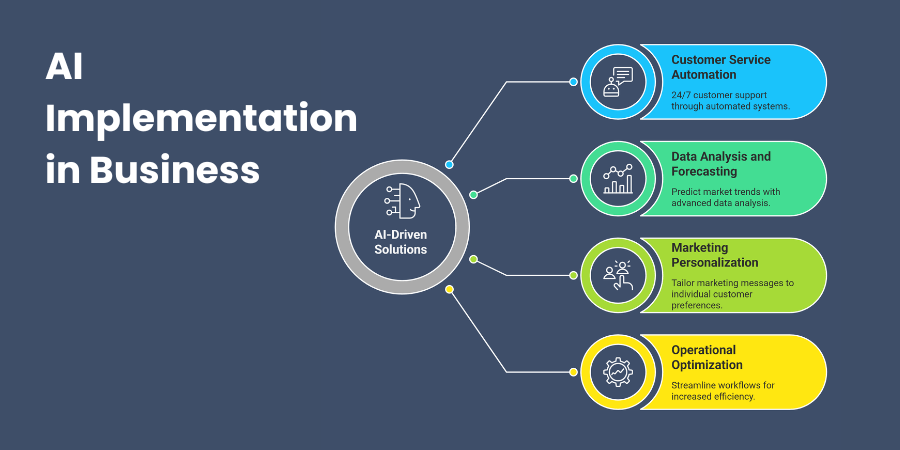
Think about your daily business challenges. AI can support multiple functions across your organization, transforming how you operate:
- Customer service automation that handles inquiries 24/7
- Data analysis and forecasting that predicts market trends
- Marketing personalization that speaks directly to individual customers
- Operational optimization that streamlines your workflows
AI implementation is not just about deploying fancy technology. It is about aligning AI capabilities with your specific business goals and creating measurable value for your organization.
When you implement AI effectively, you are essentially giving your business superpowers. You can process information faster, make more accurate predictions, and automate repetitive tasks that currently consume your team’s valuable time.
Core Technologies Used in Business AI
Wondering what technologies actually power AI applications in your business environment? Machine learning serves as the brain of your AI systems, recognizing patterns and making predictions based on your data.
Natural language processing helps your systems understand and respond to text and conversations, perfect for customer service applications. Computer vision analyzes images and videos, which you might use for quality control or security purposes.
AI agents and automation tools execute tasks automatically, handling routine processes without human intervention. The beauty of these technologies is that you do not need to understand their technical complexities.
Why Businesses Are Investing in AI
Are you curious about what is driving this massive shift toward AI adoption? The answer lies in the tangible competitive advantages that organizations are achieving through strategic AI implementation.
Your competitors are investing in AI because they recognize it as a strategic capability rather than just a technology trend. Automating repetitive tasks frees up your team to focus on high-value activities. Improving decision-making through data insights gives you a significant competitive edge.
Enhancing customer engagement creates loyalty and increases revenue. Reducing operational costs directly impacts your bottom line. Companies that embrace AI early often become market leaders in their industries.
They can respond to customer needs faster, optimize their operations more effectively, and innovate at a pace that leaves competitors struggling to keep up. AI technology has become more accessible and affordable than ever before.
How to Implement AI in Business
Ready to transform your business with AI? Here is your practical roadmap for successful AI adoption. This step-by-step approach will guide you through the entire implementation process.
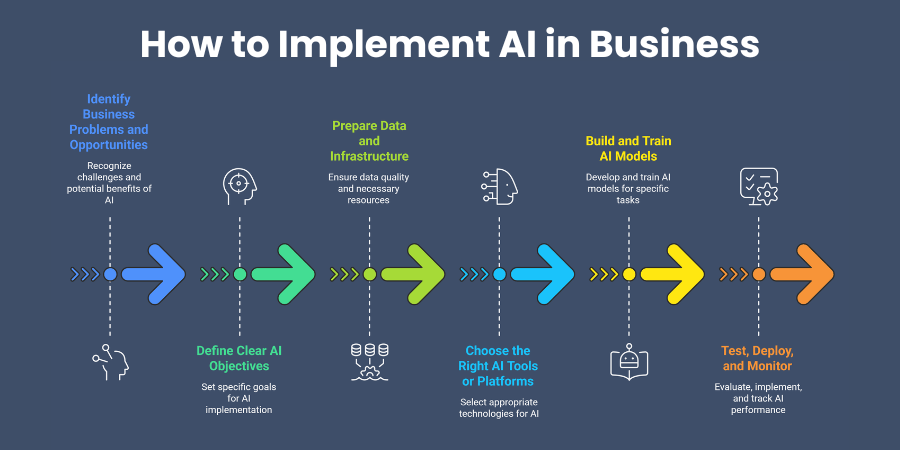
Identify Business Problems and Opportunities
What specific challenges are you facing in your daily operations? The first step in your AI journey involves identifying areas where AI can create measurable impact for your business.
Focus on processes that involve repetitive tasks, large data volumes, or decision-making inefficiencies. Perhaps you are spending too much time on customer inquiries, struggling with inventory management, or finding it difficult to personalize marketing campaigns.
Look for opportunities where automation could save time, where data analysis could improve decisions, or where personalization could enhance customer experiences. These are your prime candidates for AI implementation.
Define Clear AI Objectives
Have you established specific, measurable goals for your AI initiatives? Without clear objectives, your AI implementation might lack direction and fail to deliver expected results.
Your AI objectives should align directly with your business goals. Are you looking to improve customer support efficiency by reducing response times? Do you want to optimize your supply chain to reduce costs?
Define success metrics that you can measure and track. This might include percentage improvements in efficiency, cost reductions, or customer satisfaction scores. Clear objectives will guide your technology choices and help you measure return on investment.
Prepare Data and Infrastructure
Is your data ready to power AI systems effectively? This step is crucial because AI systems require reliable, high-quality data to function properly.
You need to ensure data quality, accessibility, and integration with your existing systems. Clean, organized data will produce better AI results, while poor data quality will limit your success.
Assess your current infrastructure to determine what upgrades might be necessary. You might need cloud storage solutions, improved data processing capabilities, or better integration tools.
Choose the Right AI Tools or Platforms
Feeling overwhelmed by the numerous AI options available? The key is evaluating AI platforms, automation tools, and software vendors that match your specific needs and technical capabilities.
Consider factors like ease of use, integration capabilities, scalability, and cost. Some platforms are designed for technical experts, while others cater to business users with minimal technical experience.
Look for solutions that offer good customer support, comprehensive training resources, and proven track records in your industry.
Build and Train AI Models
Wondering how to get your AI systems working effectively? AI models must be trained using relevant datasets and optimized to produce accurate results for your specific use cases.
This process involves feeding your AI system examples of the types of decisions or predictions you want it to make. The more relevant data you provide, the better your AI system will perform.
Work with your chosen platform or vendor to ensure proper model training. Many modern AI platforms simplify this process significantly.
Test, Deploy, and Monitor
How do you ensure your AI implementation delivers the results you expect? Start with pilot programs that allow you to test AI systems on a small scale before full deployment.
Measure performance against your defined objectives and gather feedback from users. Use this information to refine and improve your AI models continuously.
Monitor your AI systems regularly to ensure they continue performing effectively as your business evolves.
AI Use Cases Across Business Functions
Curious about how AI can transform different areas of your business? Let me show you specific applications that are delivering real results for companies across various industries.
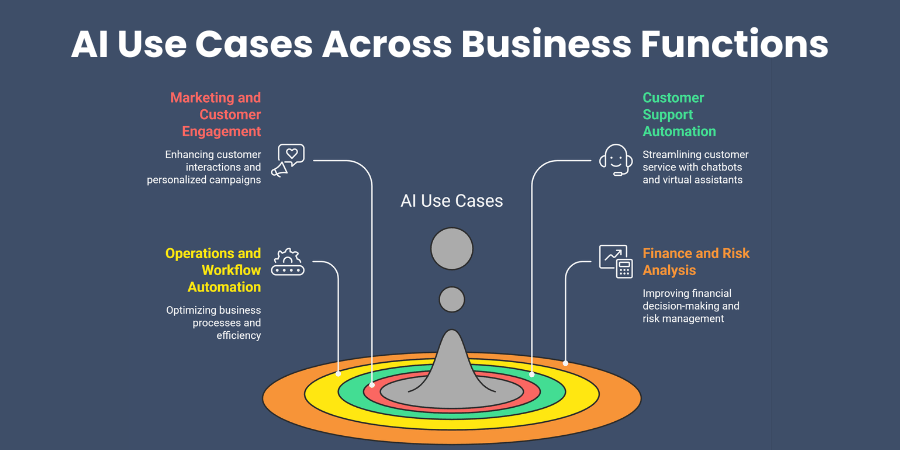
Marketing and Customer Engagement
Are you struggling to create personalized experiences for your customers? AI enables sophisticated customer segmentation, personalized campaign creation, and predictive analytics that anticipate customer behavior.
You can use AI to analyze customer data and create highly targeted marketing messages. AI systems can predict which products customers are most likely to purchase and when they are most likely to make buying decisions.
Personalization engines can customize website experiences, email campaigns, and product recommendations for individual customers, significantly improving engagement and conversion rates.
Customer Support Automation
Tired of your team spending countless hours on repetitive customer inquiries? AI chatbots and virtual assistants can handle common questions, process simple requests, and escalate complex issues to human agents.
These systems work around the clock, providing instant responses and improving customer satisfaction. They can access your knowledge base, process transactions, and even learn from interactions to improve over time.
Your human agents can focus on complex problems that require empathy and creative problem-solving, while AI handles routine tasks efficiently.
Operations and Workflow Automation
What if you could eliminate bottlenecks and streamline your internal processes? AI helps automate repetitive tasks, optimize scheduling, and improve resource allocation across your organization.
Inventory management systems can predict demand and optimize stock levels. Scheduling algorithms can optimize employee shifts and resource allocation. Process automation can handle document processing, data entry, and routine approvals.
Finance and Risk Analysis
Worried about financial risks and fraud in your business? AI models excel at detecting unusual patterns, assessing risks, and supporting financial forecasting.
Fraud detection systems can identify suspicious transactions in real-time. Risk assessment models can evaluate loan applications or investment opportunities. Financial forecasting tools can predict cash flow and budget requirements more accurately.
Benefits of Implementing AI in Business
What tangible outcomes can you expect from your AI investment? Let me outline the measurable benefits that organizations are achieving through strategic AI implementation.
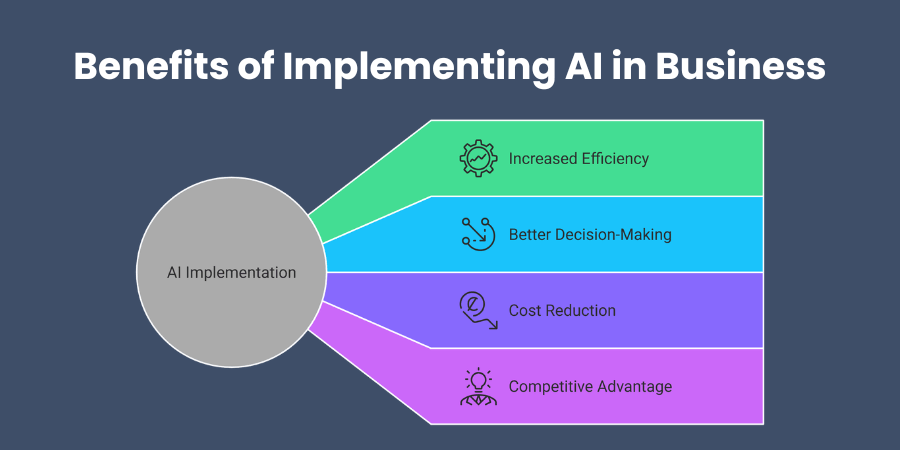
Increased Efficiency
Imagine reducing the time your team spends on routine tasks by 50% or more. AI automation accelerates workflows and eliminates manual bottlenecks that slow down your operations.
Your employees can focus on strategic activities that require human creativity and judgment, while AI handles repetitive processes with consistent accuracy.
Better Decision-Making
How confident are you in your current decision-making process? Advanced analytics provide insights that support strategic decisions with data-driven evidence rather than gut feelings.
AI systems can analyze vast amounts of information quickly, identifying trends and patterns that humans might miss. This leads to more informed decisions and better business outcomes.
Cost Reduction
Looking to improve your bottom line? Automation reduces operational expenses by minimizing manual labor requirements and improving resource utilization.
Many organizations see significant cost savings within months of implementing AI solutions, particularly in areas like customer service, data processing, and routine administrative tasks.
Competitive Advantage
Want to stay ahead of your competition? Businesses that leverage AI effectively can innovate faster, respond to market changes more quickly, and deliver superior customer experiences.
AI gives you the ability to scale operations without proportionally increasing costs, adapt to customer needs in real-time, and optimize processes continuously.
Challenges of AI Implementation
Wondering what obstacles you might encounter during your AI journey? Let me address the realistic barriers that organizations face and how you can prepare for them.
Data Quality and Availability
Are you confident in the quality of your business data? AI systems depend heavily on clean, reliable datasets to function effectively.
Poor data quality can lead to inaccurate predictions and unreliable results. You might need to invest time and resources in data cleaning and organization before implementing AI solutions.
Consider conducting a data audit to identify gaps and quality issues that need addressing.
Integration with Existing Systems
Concerned about how AI will work with your current technology infrastructure? Connecting AI solutions with legacy systems can be complex and time-consuming.
You might need to upgrade certain systems or invest in integration tools to ensure smooth operation. Planning for these requirements early in your implementation process will save time and frustration later.
Skills and Talent Gap
Do you have the right expertise on your team to manage AI systems? Organizations often need specialized knowledge to build, deploy, and maintain AI solutions effectively.
You might need to hire new talent, train existing employees, or partner with external experts to bridge this gap. Consider your long-term talent strategy as part of your AI implementation planning.
Future of AI in Business
Excited about what lies ahead for AI in business? The evolution of AI technology promises even more transformative capabilities that will reshape how organizations operate.
AI Agents and Autonomous Systems
Imagine AI systems that can manage complex, multi-step processes independently. These autonomous agents will handle entire workflows, make decisions within defined parameters, and coordinate with other systems seamlessly.
Your business processes will become increasingly self-managing, requiring minimal human intervention for routine operations.
Hyperautomation
What if you could automate entire business workflows from start to finish? The integration of AI, robotic process automation, and advanced analytics will create comprehensive automation solutions.
This approach will transform entire departments, enabling unprecedented levels of efficiency and consistency in business operations.
AI-Driven Decision Intelligence
How would your business change if every decision was supported by comprehensive AI analysis? Organizations will increasingly rely on AI systems to provide strategic insights and recommendations for complex business decisions.
This evolution will enable faster, more accurate decision-making across all levels of your organization.
How Shadhin Lab Helps Businesses Implement AI
Looking for expert guidance on your AI implementation journey? Shadhin Lab serves as your strategic technology partner, helping organizations design, deploy, and scale AI solutions effectively.
Our expertise spans AI strategy development, system integration, workflow automation, and data-driven optimization. We understand that every business has unique needs and challenges, which is why we create customized AI solutions that align with your specific objectives.
Whether you are just beginning to explore AI possibilities or looking to expand existing implementations, Shadhin Lab provides the technical expertise and strategic guidance you need to succeed.
We focus on delivering measurable results and ensuring that your AI investments generate real business value. Our team works closely with you throughout the implementation process, providing training and support to ensure long-term success.
Conclusion
You are now equipped with a comprehensive understanding of how to implement AI in business effectively. The journey from traditional operations to AI-powered efficiency represents one of the most significant opportunities available to modern businesses.
Successful AI implementation is not about adopting the most advanced technology available. It is about identifying your specific business needs, choosing appropriate solutions, and implementing them strategically to create measurable value.
Start with clear goals, invest in quality data foundations, and choose scalable AI solutions that can grow with your business. Your AI transformation journey begins with a single step, and that step can position your organization for long-term success.
The future belongs to businesses that embrace AI strategically and implement it effectively. You have the knowledge and framework needed to join their ranks.
Frequently Asked Questions
How long does it typically take to implement AI in business?
You can expect AI implementation timelines to vary significantly based on project complexity and scope. Simple automation projects might take 2-3 months, while comprehensive AI transformations can require 6-18 months. Starting with pilot projects allows you to see results quickly while building toward larger implementations.
What is the average cost of implementing AI in business?
AI implementation costs depend heavily on your specific needs and chosen approach. Small businesses might start with solutions costing a few thousand dollars monthly, while enterprise implementations can require significant six-figure investments. Many cloud-based AI platforms offer scalable pricing that grows with your usage.
Do I need technical expertise to implement AI in my business?
You do not need to become a technical expert, but having some technical understanding helps significantly. Many modern AI platforms are designed for business users with minimal technical backgrounds. However, partnering with AI specialists or hiring technical talent often accelerates implementation and improves results.
How do I measure the success of AI implementation?
Success measurement should align with your original objectives and include both quantitative and qualitative metrics. Track efficiency improvements, cost reductions, revenue increases, and customer satisfaction scores. Establish baseline measurements before implementation to demonstrate clear improvements and return on investment.
What are the biggest risks of implementing AI in business?
Your primary risks include poor data quality leading to inaccurate results, integration challenges with existing systems, and potential job displacement concerns among employees. Mitigate these risks through careful planning, gradual implementation, and transparent communication with your team about AI’s role in enhancing rather than replacing human capabilities.

Shaif Azad
Shaif Azad Rahi is an AI/ML professional and Solution Engineer at Shadhin Lab, specializing in AI-powered solutions and scalable software systems, with a focus on applying AI to solve real-world business challenges.
Related Post
AI for Lead Generation: Strategies, Tools, and Workflows
Generating leads is not just about finding more potential customers. Businesses need to identify the right...
AI Email Assistant Guide: Write, Reply, and Save Time
Email can quietly consume hours of your workweek. Reading long threads, drafting replies, rewriting awkward messages,...
AI Risk Management: Frameworks, Challenges & Best Practices
Are you someone who lies awake wondering if your AI systems might suddenly make catastrophic decisions?...
