
Prompt Engineering Guide: How to Write Better AI Prompts
Table of Contents
You ask an AI model a simple question and get a generic answer. You rewrite the prompt, add some context, explain the audience, specify the format, and suddenly the response is much more useful.
That is the basic idea behind prompt engineering.
Prompt engineering is not about finding a secret phrase that makes an AI model produce perfect answers. It is the process of designing and refining instructions, context, examples, constraints, and output requirements so an AI model has a clearer understanding of the task.
The approach matters whether you’re using AI for writing, research, coding, data analysis, customer support, or business automation.
In this guide, you’ll learn what prompt engineering is, how it works, how to write better prompts, which prompting techniques are useful, how to create reusable prompt templates, and how prompting changes when AI is connected to tools and business workflows.
Key Takeaways
- AI is becoming a practical business capability for entrepreneurs, covering everything from idea validation and product development to marketing, sales, operations, and business analysis.
- The AI landscape extends beyond chatbots, with assistants, AI-powered software, automation, and AI agents serving different roles in business workflows.
- A practical AI stack connects the right tools and workflows instead of relying on a large collection of disconnected AI applications.
- The choice between existing tools, automation platforms, and custom AI depends on workflow complexity, business data, integrations, and long-term requirements.
- Effective AI adoption also involves managing accuracy, security, human oversight, implementation, and measurable business impact
Table of Contents
What Is Prompt Engineering?
Prompt engineering is the process of designing and refining instructions, context, examples, constraints, and output requirements to get more useful and reliable results from an AI model.
A prompt is more than a question. Depending on the task, it can contain instructions, background information, examples, source material, constraints, formatting requirements, and criteria for evaluating the result.
What Is a Prompt?
A prompt can contain:
- Instructions
- Context
- Input or data
- Examples
- Constraints
- Output format
- Evaluation criteria
You don’t need every component in every prompt. A simple question may need only an instruction. A production AI workflow may require all of them.
Prompt Engineering vs. Simply Asking AI a Question
Consider this basic prompt:
Write a blog post about AI agents.
The model has to guess almost everything:
- Who is the audience?
- What is the purpose?
- How long should it be?
- What topics should it cover?
- What tone should it use?
- What information should it avoid?
- How should the article be structured?
Now consider an engineered version:
Write a 1,500-word educational article for operations managers explaining how AI agents automate multi-step workflows. Use simple English, include five practical examples, avoid unsupported statistics, and structure the article with H2 and H3 headings.
The second prompt gives the model a clearer target.
The lesson isn’t that longer prompts are always better. Specificity and relevant context matter more than unnecessary complexity.
How Prompt Engineering Works
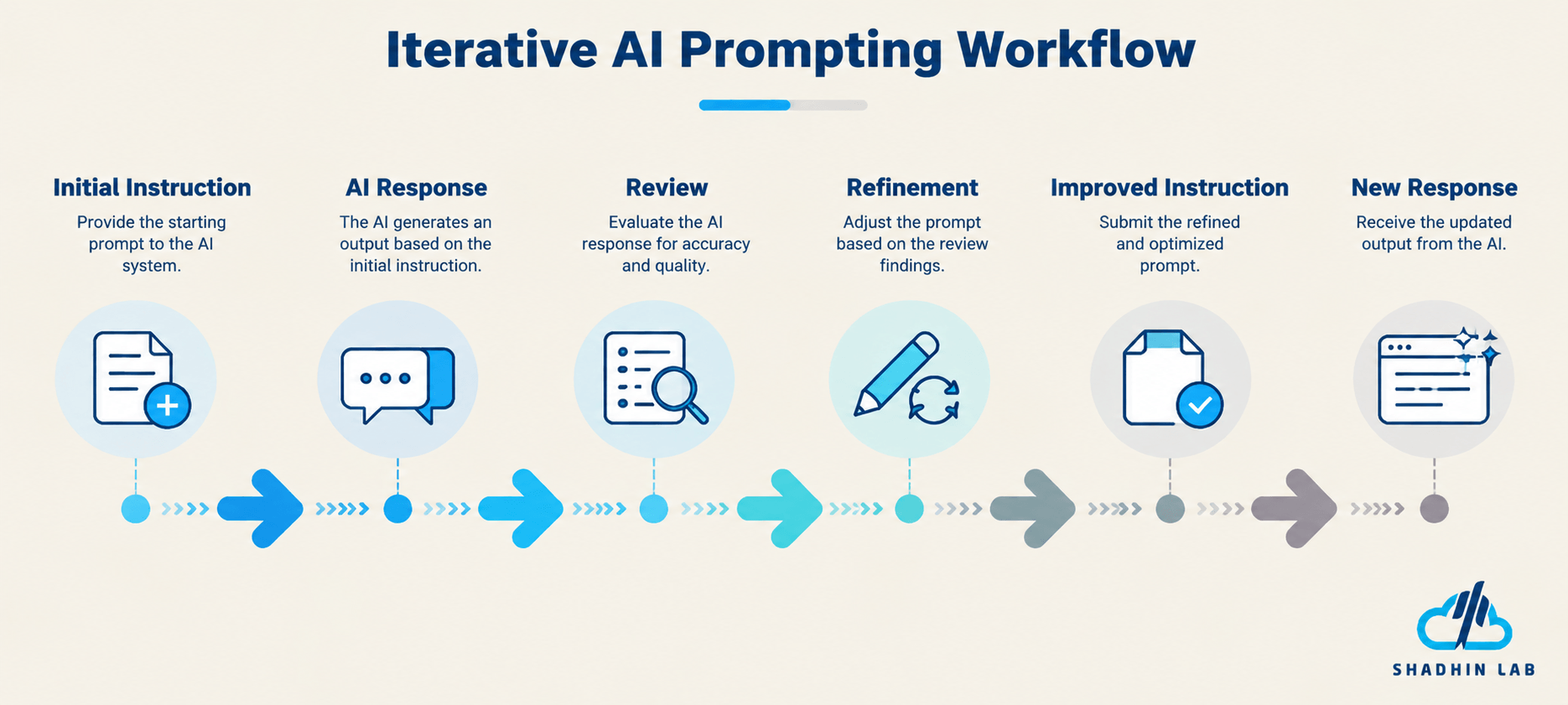
At a basic level, prompt engineering is an iterative process:
Prompt → Output → Evaluate → Refine → Test again
You give the model instructions and relevant context. The model interprets those inputs and generates a response. You then evaluate the result and change the prompt when something doesn’t meet the requirement.
For example:
- You ask AI to write a customer email.
- The response is too formal.
- You specify a friendly but professional tone.
- The next version is closer.
- You add the target customer’s context.
- You specify a 120-word maximum.
- You test the prompt against several customer scenarios.
This is prompt engineering in practice.
Current Google guidance describes prompt design as iterative: developers should experiment, observe model responses, and refine prompts for their specific use case.
Prompt Engineering Does Not Guarantee Accuracy
A well-written prompt can improve instruction following, relevance, structure, and consistency.
It does not automatically make the model factually correct.
If the task depends on information the model does not have, you may need:
- Retrieval
- Grounding
- Tool use
- Source verification
- Human review
For example, asking:
What were our company’s sales last month?
doesn’t become reliable simply because you rewrite it as a detailed prompt.
The system needs access to the relevant sales data.
This distinction becomes especially important when moving from everyday prompting to production AI applications.
The Anatomy of a Good Prompt
A useful way to think about prompt design is to break a prompt into seven possible components.
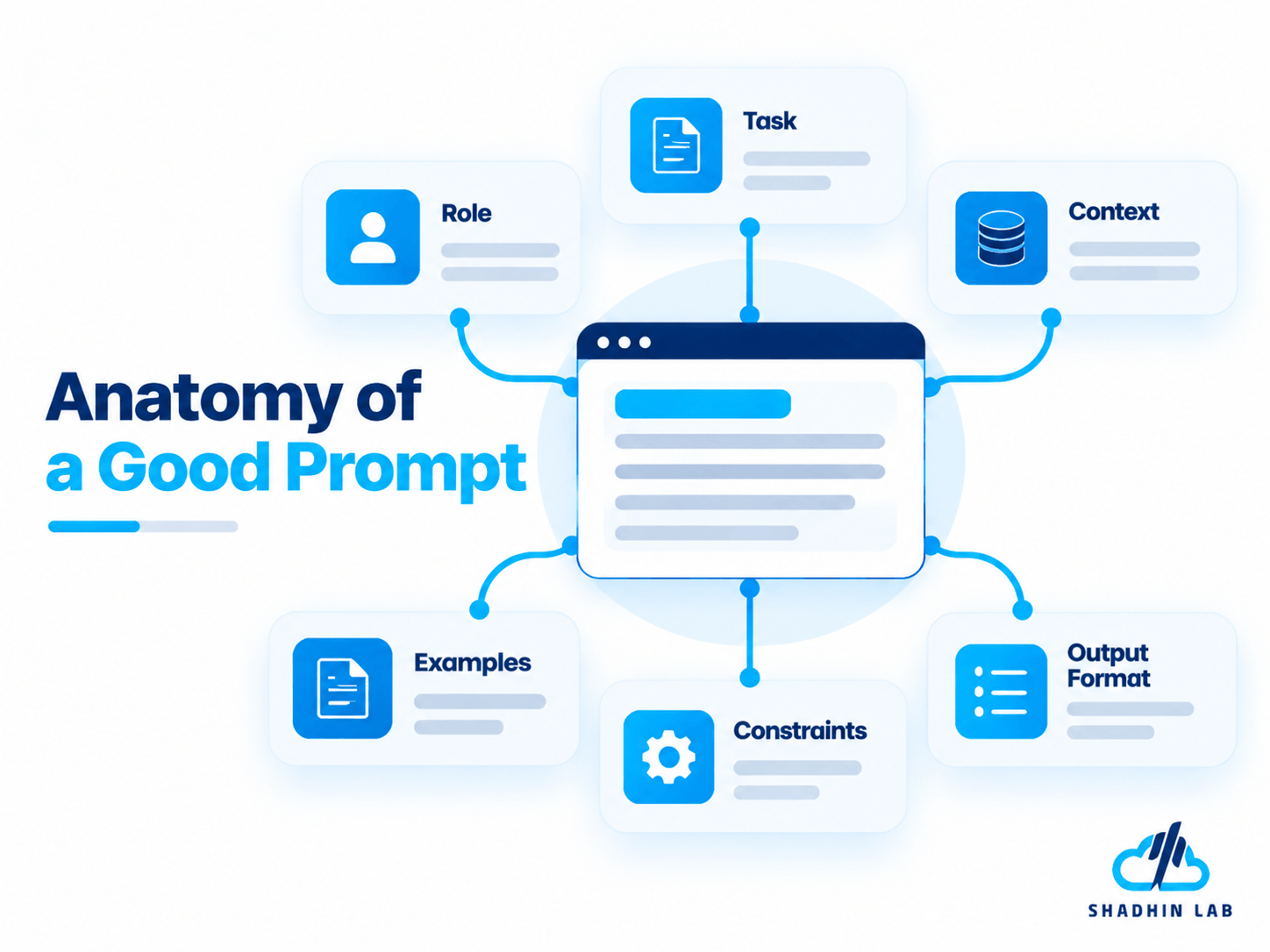
The 7-Part Prompt Framework
1. Role
Give the model a relevant perspective when doing so helps the task.
You are an experienced B2B content strategist.
A role can establish the expected perspective, vocabulary, and style. It doesn’t need to be elaborate.
2. Task
Tell the model exactly what you want it to do.
Create an SEO content outline for a guide about AI agents.
The task should be an action, not just a topic.
3. Context
Provide information the model needs to complete the task.
The audience is SaaS founders with limited technical knowledge.
Useful context may include the audience, industry, business situation, existing material, objective, or background information.
4. Constraints
Explain boundaries the response should follow.
Avoid unsupported statistics and unnecessary technical jargon.
Constraints can include word count, tone, sources, formatting, terminology, exclusions, or compliance requirements.
5. Examples
Show the model what a successful result looks like.
Examples are especially useful when you need a specific format, classification pattern, writing style, or output structure.
6. Output Format
Tell the model how the answer should be returned.
Return the recommendations as a table with four columns.
This is particularly important when the output will later be reused in another workflow.
7. Evaluation Criteria
Define what makes the result successful.
The final outline should cover search intent, related entities, FAQs, and content gaps.
Evaluation criteria turn a vague request into a more testable task.
Do You Need All Seven?
No.
A simple request such as:
Rewrite this sentence to sound more professional.
doesn’t need a seven-part prompt.
The framework is a checklist for complex tasks, not a requirement to make every prompt longer.
A Simple Prompt Formula
A practical formula is:
Role + Task + Context + Constraints + Examples + Output Format + Quality Criteria
You can turn it into a reusable template:
# Role
You are a [role].
# Task
Your task is to [specific task].
# Context
Here is the relevant context:
[context]
# Constraints
– [constraint]
– [constraint]
# Examples
[examples]
# Output format
Return the answer as:
[format]
# Quality criteria
The response should:
– [criterion]
– [criterion]
For complex prompts, clear headings or delimiters can make the boundaries between instructions, source material, examples, and inputs easier to understand.
Anthropic specifically recommends XML-style tags for complex prompts, while Google’s current guidance recommends clear structure and delimiters.
For example:
<context>
[background information]
</context>
<task>
[what the model should do]
</task>
The important principle is consistency. Don’t add structure simply because it looks sophisticated. Use it when it makes the task easier to interpret and maintain.
15 Essential Prompt Engineering Techniques
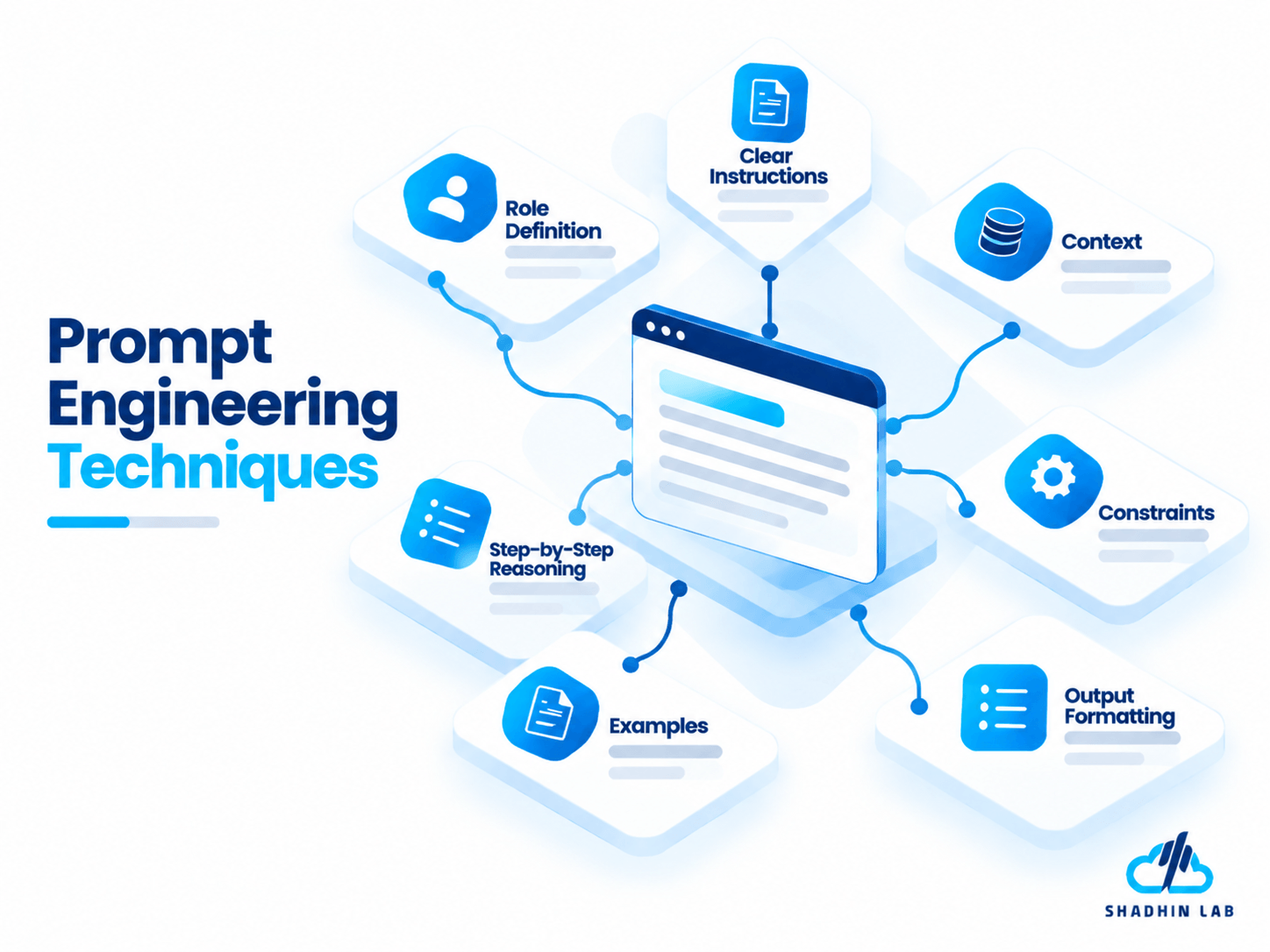
1. Be Clear and Specific
Vague prompts force the model to make unnecessary assumptions.
Weak:
Write about marketing.
Better:
Explain three practical ways a B2B SaaS company can use AI to improve lead qualification.
The second prompt identifies the subject, audience context, and desired scope.
Clear, specific instructions are a common recommendation across current model documentation.
2. Provide Context
Context tells the model what situation it is working within.
Useful context can include:
- Audience
- Industry
- Goal
- Existing content
- Business situation
- Technical environment
- Constraints
Compare:
Write an email about our new feature.
with:
Write a product announcement email for existing SaaS customers. The new feature is an AI reporting dashboard that automatically summarizes weekly account activity. The audience already uses our analytics product.
The second prompt gives the model information it can actually use.
3. Specify the Output Format
If the format matters, say so.
Examples:
Return a table with four columns.
Give me five options, each under 20 words.
Use H2 and H3 headings.
Return the result as valid JSON.
Output instructions are particularly important when an AI response is going into another system or workflow.
4. Use Examples — Few-Shot Prompting
Few-shot prompting means giving the model examples of the expected behavior.
There are three common terms:
- Zero-shot: No examples are provided.
- One-shot: One example is provided.
- Few-shot: Multiple examples are provided.
Zero-Shot
Classify this customer review as positive, neutral, or negative.
Few-Shot
Review: “Amazing support.”
Label: Positive
Review: “It works, but setup was difficult.”
Label: Neutral
Review: “[new review]”
Label:
The examples demonstrate the desired relationship between input and output.
Few-shot examples can be particularly useful when you need consistent formatting, classification behavior, tone, or structure. Google and Anthropic both document few-shot prompting as a useful technique.
However, more examples aren’t automatically better. Poor, inconsistent, or irrelevant examples can teach the wrong pattern.
5. Break Complex Tasks Into Steps
Complex tasks often become easier to manage when you decompose them.
Instead of:
Analyze this company and create a marketing strategy.
Try:
- Identify the target audience.
- Analyze the current positioning.
- Identify positioning gaps.
- Develop strategic options.
- Recommend priorities based on the stated criteria.
This approach is especially useful for research, content production, data analysis, and business workflows.
The goal isn’t to force every model to expose its internal reasoning. The goal is to make the task itself clear and manageable.
6. Use Delimiters
Delimiters help separate instructions from information.
For example:
<context>
Company: SaaS
Audience: Operations managers
Product: AI workflow platform
</context>
<task>
Create a product positioning statement.
</task>
This makes the boundaries explicit.
You can also use Markdown headings:
## Context
[background]
## Task
[instructions]
## Output
[format]
Choose one structure and use it consistently.
7. Give the Model Relevant Constraints
Constraints prevent unwanted output.
Useful constraints may include:
- Word count
- Reading level
- Tone
- Audience
- Allowed sources
- Formatting
- Required sections
- Things to avoid
For example:
Write for non-technical business leaders. Use simple English. Keep the answer under 800 words. Don’t invent statistics.
Avoid adding constraints that don’t matter. Every unnecessary instruction makes the prompt harder to maintain.
8. Define the Desired Tone and Style
“Make it good” isn’t a useful style instruction.
Instead, describe what good means:
Write in a professional, direct tone for senior business leaders. Use short paragraphs and avoid unnecessary technical jargon.
Possible style characteristics include:
- Professional
- Friendly
- Technical
- Concise
- Conversational
- Executive-level
- Educational
If you need a specific style, examples can be more effective than a long list of adjectives.
9. Ask for Missing Information
For important workflows, don’t force the model to guess.
Use an instruction such as:
If critical information is missing, list the missing information before completing the task.
This can be particularly useful for:
- Business analysis
- Legal or policy documents
- Technical specifications
- Research
- Customer support
- Data analysis
The purpose is to make uncertainty visible rather than allowing assumptions to silently enter the output.
10. Ground the Model in Provided Information
When working with documents, define what information the model should rely on.
For example:
Use only the information contained in the provided document. If the answer is not supported by the document, say so.
This can reduce unsupported additions, but it does not replace proper retrieval or source validation.
If the underlying document is incomplete or incorrect, the model cannot make it authoritative merely because the prompt says to use it.
11. Request Self-Checks
For important tasks, you can ask the model to verify the output against explicit requirements.
For example:
Before finalizing, check the response against the requirements above and correct any missing items.
This can be useful for structured content, coding, mathematics, and document transformation.
But don’t automatically add self-check instructions to every prompt. For simple tasks, they may add unnecessary complexity, latency, or output.
12. Use Structured Output
When another person or system needs to consume the result, define a predictable structure.
Useful formats include:
- Markdown
- Tables
- JSON
- XML
- Lists
- Defined fields
For example:
{
“title”: “”,
“audience”: “”,
“summary”: “”,
“recommendations”: []
}
Structured output is particularly useful in AI applications where model responses become inputs to another part of a workflow.
13. Iterate Instead of Starting Over
Prompt improvement is often incremental.
Version 1
Write an email about our product.
Version 2
Write a professional product announcement email for existing SaaS customers.
Version 3
Write a 150-word product announcement email for existing SaaS customers. Explain the new AI reporting feature, highlight one practical benefit, and end with a CTA to try it.
Each revision removes ambiguity.
Instead of trying to write the “perfect prompt” immediately, start with a reasonable baseline and improve it based on actual output.
14. Match the Prompt to the Model
A prompt that works well with one model may not perform identically with another.
Models differ in:
- Instruction following
- Reasoning behavior
- Context handling
- Output style
- Tool use
- Verbosity
- Supported controls
Anthropic’s current documentation provides model-specific prompting guidance, while Google’s Gemini 3 documentation explicitly recommends more concise and direct instructions for its newer reasoning models.
This means you should test prompts against the actual model and version you’re using.
15. Evaluate the Output, Not Just the Prompt
A prompt isn’t successful because it looks sophisticated.
It’s successful when the resulting output meets the intended requirements.
Evaluate factors such as:
- Accuracy
- Relevance
- Completeness
- Format compliance
- Consistency
- Factual grounding
- Latency
- Cost
This changes prompt engineering from “writing clever instructions” into a measurable optimization process.
Prompt Engineering Examples
The following examples show how a vague request can become more useful when you define the task and requirements.
| Use case | Weak prompt | Improved approach |
| Writing | Write a blog | Define audience, topic, intent, length, structure and style |
| Research | Research AI agents | Define scope, sources, date range and output |
| Summarization | Summarize this | Define audience, length and required points |
| Write an email | Define recipient, purpose, tone and CTA | |
| Coding | Fix this code | Define environment, error and expected behavior |
| Data analysis | Analyze this data | Define metrics, questions and output |
| SEO | Optimize this page | Define keyword, intent, audience and constraints |
| Customer support | Reply to customer | Define policy, tone and escalation rules |
Writing Prompt
You are a B2B technology content writer. Write a 1,500-word educational article for operations managers about AI agents. Explain what they are, how they work, and five practical business use cases. Use simple English, short paragraphs, descriptive H2 headings, and avoid unsupported statistics.
Research Prompt
Research the current use of AI agents in customer service. Focus on information published between January 2025 and September 2026. Prioritize official company documentation, academic research, and reputable industry sources. Separate documented facts from vendor claims and return the findings in a table.
Summarization Prompt
Summarize the following report for a senior executive. Keep the summary under 300 words. Include the main finding, three important supporting points, major risks, and recommended next steps. Do not introduce information that isn’t in the report.
Email Prompt
Write a professional but friendly 150-word email to an existing SaaS customer announcing a new AI reporting feature. Explain the practical benefit, avoid exaggerated claims, and end with a clear invitation to try the feature.
Coding Prompt
Review the following Python function. Identify the error, explain why it occurs, and provide a corrected version. Assume Python 3.12. Do not rewrite unrelated parts of the function.
Data Analysis Prompt
Analyze this sales dataset to identify monthly revenue trends, the three highest-revenue products, and any unusual changes. Show the calculations used, summarize the findings in five bullet points, and clearly distinguish observations from possible explanations.
SEO Prompt
Create an SEO content outline for the keyword “AI agent use cases.” The audience is business leaders evaluating AI automation. Cover search intent, semantic entities, practical examples, implementation considerations, FAQs, and content gaps. Avoid unsupported statistics.
Customer Support Prompt
Respond to this customer using a helpful and professional tone. Follow the refund policy provided below. If the request falls outside the policy or requires an exception, do not promise a refund; escalate it to a human support representative.
Prompt Templates You Can Reuse
General AI Prompt Template
You are [role].
Task:
[what you want done]
Context:
[relevant information]
Requirements:
– [requirement]
– [requirement]
– [requirement]
Output:
[desired format]
Before finalizing, verify that the response satisfies all requirements.
Content Writing Prompt
You are a [type of writer].
Write [content type] about [topic].
Audience:
[target audience]
Purpose:
[goal]
Key information:
[context/source material]
Requirements:
– [length]
– [tone]
– [structure]
– [required points]
– [things to avoid]
Output:
[desired format]
Research Prompt
Research [topic].
Scope:
[topic boundaries]
Time period:
[date range]
Prioritize:
– Primary sources
– Official documentation
– Academic research
– Reputable industry sources
Requirements:
– Separate facts from opinions
– Identify uncertainty
– Cite important claims
Return:
[table/report/summary]
Summarization Prompt
Summarize the material below.
Audience:
[audience]
Length:
[word limit]
Include:
– Main finding
– Key supporting points
– Important risks
– Relevant conclusions
Do not:
– Add unsupported information
– Change the meaning
– Omit critical qualifications
Data Analysis Prompt
Analyze the provided dataset.
Business question:
[question]
Metrics:
[metrics]
Tasks:
- [task]
- [task]
- [task]
Output:
– Key findings
– Supporting calculations
– Table
– Limitations
Coding Prompt
You are a [language/framework] developer.
Environment:
[environment]
Task:
[task]
Existing code:
[code]
Problem:
[error/undesired behavior]
Expected behavior:
[expected result]
Constraints:
[constraints]
Return:
- Diagnosis
- Corrected code
- Brief explanation
Email Prompt
Write an email.
Recipient:
[recipient]
Purpose:
[purpose]
Context:
[context]
Tone:
[tone]
Requirements:
– [length]
– [key message]
– [CTA]
Avoid:
[things to avoid]
SEO Prompt
Act as an SEO content strategist.
Primary keyword:
[keyword]
Audience:
[audience]
Search intent:
[intent]
Create:
[outline/content/audit]
Requirements:
– Cover related entities
– Address secondary search intent
– Include FAQs
– Identify content gaps
– Avoid unsupported claims
Output:
[format]
Customer Support Prompt
You are a customer support representative.
Customer message:
[message]
Relevant policy:
[policy]
Customer context:
[context]
Rules:
– Follow the provided policy
– Do not invent information
– Escalate exceptions
– Use a professional and empathetic tone
Return the response only.
Document Analysis Prompt
Analyze the provided document.
Task:
[specific task]
Use only information supported by the document.
Return:
– Direct answer
– Supporting evidence
– Missing information
– Important limitations
If the document does not support an answer, say so.
Advanced Prompt Engineering Techniques
Once you understand the fundamentals, you can move into techniques used for more complex AI applications.
Chain-of-Thought and Reasoning
Chain-of-thought prompting refers to techniques intended to encourage step-by-step reasoning.
For most users, however, the goal should not be to demand or expose a model’s private reasoning. A better approach is to ask for a structured solution, verification, or concise explanation of the result.
For example:
Solve the problem, verify the calculation, and provide the final answer with a short explanation.
Useful alternatives include:
- Breaking complex tasks into stages
- Asking for verification
- Defining intermediate outputs when necessary
- Using reasoning-capable models appropriately
Modern reasoning models can reduce the need for elaborate instructions designed to force a particular reasoning process. Google’s current Gemini 3 guidance, for example, recommends concise, direct instructions rather than older prompting techniques intended to force reasoning behavior.
Chain-of-Thought vs. Structured Reasoning
The distinction is important.
You generally need the result and useful verification, not a private reasoning transcript.
Instead of:
Show every hidden step of your reasoning.
Try:
Solve the problem, check the result, and provide the final answer with the relevant calculation.
That gives you something useful without making hidden reasoning the objective.
Self-Consistency
Self-consistency involves generating or evaluating multiple candidate solutions and comparing them.
It can be useful for tasks where consistency matters, but it isn’t necessary for ordinary requests.
For example, a system might generate several possible classifications and then use another evaluation step to determine whether they agree.
Treat this as an advanced technique rather than a default prompting strategy.
Prompt Chaining
Prompt chaining divides a larger workflow into multiple AI tasks.
For example:
Research → Analyze → Draft → Review → Finalize
Instead of asking one prompt to research a topic, write an article, fact-check it, optimize it, and publish it, each stage can have its own instructions and evaluation criteria.
This can be useful for:
- Content production
- Research
- Document processing
- Business workflows
- AI applications
Role Prompting
Roles can help establish the perspective, audience, or style relevant to a task.
For example:
You are a B2B sales operations analyst.
But role prompts shouldn’t become decorative.
Adding:
You are the world’s greatest genius marketing strategist…
doesn’t automatically improve the result.
Use a role when it provides meaningful context.
Long-Context Prompting
Large documents require careful organization.
For long-context tasks, place source material in a clearly defined section and separate it from the instructions and question.
Anthropic’s current guidance recommends placing long-form data toward the beginning and the query or instructions toward the end for large-context tasks.
A practical structure is:
<documents>
[large source material]
</documents>
<task>
Based on the documents above, identify the three most important findings.
</task>
This makes the relationship between the source material and the task explicit.
Prompt Engineering for AI Agents
Prompting a chatbot and designing instructions for an AI agent are not the same problem.
A conversational model may simply produce text.
An AI agent can potentially:
- Use tools
- Call APIs
- Retrieve information
- Take actions
- Maintain state or context
- Follow business rules
- Escalate to humans
That means an agent prompt needs to define not only what the model should say, but also what it is allowed to do.
Agent Prompt Structure
A useful framework is:
Goal → Context → Tools → Rules → Permissions → Decision Boundaries → Output/Action → Escalation
For example:
You are a customer-support agent.
You may access the customer’s order status and knowledge base.
You may not issue refunds above $100 without human approval.
Escalate billing disputes to a human agent.
This is fundamentally different from:
Answer customer questions.
The first prompt defines an operating environment.
For production agents, the prompt should work alongside technical permissions, authentication, tool restrictions, monitoring, and application-level controls. Prompt instructions alone should not be treated as the security boundary.
Prompt Engineering vs. Context Engineering
As AI systems become more sophisticated, improving performance is no longer only about rewriting one prompt.
Teams may also need to engineer:
- Context
- Retrieval
- Memory
- Tools
- Instructions
- Examples
- Workflow state
- Evaluation
This is often discussed under the broader idea of context engineering.
The distinction is useful:
Prompt engineering focuses primarily on how instructions and relevant information are presented to the model.
Context engineering considers the larger system that determines what information, tools, memory, state, and instructions the model receives at a given point.
For a simple chatbot, prompt design may be enough.
For an enterprise AI system, it is only one component.
Common Prompt Engineering Mistakes
Mistake 1: Being Too Vague
Write something about AI.
The model has to guess the topic, audience, purpose, and scope.
Mistake 2: Adding Unnecessary Instructions
More instructions do not automatically produce better results.
Remove requirements that don’t contribute to the outcome.
Mistake 3: Giving Conflicting Requirements
For example:
Be extremely detailed. Keep the answer under 50 words.
Resolve contradictions before asking the model to complete the task.
Mistake 4: Providing Insufficient Context
If the model doesn’t know the audience, environment, source data, or objective, it may make assumptions.
Mistake 5: Using Irrelevant Examples
Examples should represent the behavior you want.
Bad examples can teach the wrong pattern.
Mistake 6: Making the Prompt Unnecessarily Long
Long prompts can be justified by complex tasks, but length itself isn’t the objective.
Mistake 7: Assuming One Prompt Works for Every Model
Test prompts against the actual model and version.
Mistake 8: Not Specifying the Output Format
If the format matters, define it.
Mistake 9: Trusting Generated Facts Without Verification
A polished answer can still contain incorrect information.
Mistake 10: Never Testing Edge Cases
A prompt that works on one example may fail on unusual inputs.
Mistake 11: Treating Prompt Engineering as a Substitute for Retrieval or Tools
If current information is required, connect the system to current information.
Mistake 12: Ignoring Cost, Latency, and Reliability
A prompt can produce excellent output while still being impractical for production because it consumes too many tokens, takes too long, or performs inconsistently.
How to Test and Improve a Prompt
Prompt engineering becomes much more useful when you treat it as an evaluation problem.
Step 1: Define the Desired Outcome
What does “good” actually mean?
For a customer-support prompt, that might mean:
- Correct answer
- Correct policy
- Appropriate tone
- No unsupported promises
- Correct escalation
Step 2: Create a Baseline Prompt
Start with a simple version.
Step 3: Test Representative Inputs
Don’t test only the easiest example.
Use examples that represent real-world variation.
Step 4: Identify Failure Patterns
Look for recurring problems.
Does the model:
- Miss important context?
- Use the wrong format?
- Invent information?
- Ignore a constraint?
- Fail on unusual inputs?
Step 5: Change One Variable at a Time
If you completely rewrite the prompt every time, you won’t know what caused the improvement.
Step 6: Retest
Compare the new result against the baseline.
Step 7: Test Edge Cases
Include difficult or unusual inputs.
Step 8: Document the Final Version
For production applications, keep track of prompt versions and their evaluation results.
Simple Evaluation Matrix
| Criterion | Score |
| Accuracy | /5 |
| Relevance | /5 |
| Completeness | /5 |
| Format compliance | /5 |
| Consistency | /5 |
This is a testing framework, not a universal scoring standard.
The right evaluation criteria depend on the application.
Prompt Engineering for Different AI Tasks
Different tasks require different information.
Writing
Focus on:
- Audience
- Purpose
- Tone
- Structure
- Examples
- Editing criteria
Example:
Write for technical decision-makers, use a professional tone, keep paragraphs short, and explain each technical term the first time it appears.
Research
Focus on:
- Scope
- Date range
- Sources
- Evidence
- Citation requirements
Example:
Use sources published from January 2025 onward and distinguish primary-source facts from company claims.
Coding
Focus on:
- Programming language
- Framework
- Environment
- Existing code
- Expected behavior
- Error
- Constraints
Data Analysis
Focus on:
- Dataset
- Business question
- Metrics
- Required calculations
- Output format
Image Generation
Focus on:
- Subject
- Composition
- Style
- Lighting
- Camera or viewpoint where relevant
- Aspect ratio
- Negative constraints
For example:
Create a 16:9 flat-vector technology illustration with a white background, navy and blue palette, minimal geometric shapes, and no people or text.
AI Agents
Focus on:
- Objective
- Tools
- Permissions
- Policies
- Escalation
- Success criteria
An agent prompt should describe the operating boundaries, not just the desired conversation.
Do Longer Prompts Produce Better Results?
No.
A longer prompt can be better when the task requires additional context, examples, constraints, or output requirements.
But unnecessary instructions can make a prompt harder to maintain and can introduce conflicting requirements.
The better principle is:
Optimize for clarity and relevance, not prompt length.
This matters even more as newer reasoning models become better at interpreting natural-language instructions. Google’s current Gemini 3 guidance explicitly recommends concise, direct prompting and warns against unnecessarily elaborate techniques designed for older models.
The right question isn’t:
How long should my prompt be?
It’s:
What information does the model actually need to complete this task reliably?
Does Prompt Engineering Still Matter With Better AI Models?
Yes, but the way people practice it is changing.
Why It Still Matters
Clear requirements remain useful because AI systems still need to understand:
- What you want
- Why you want it
- Who the output is for
- What information they should use
- What constraints apply
- What format they should return
Production systems also need rules, evaluation, and reliable interfaces with data and tools.
What Is Changing
Modern models are increasingly capable of interpreting natural language and handling complex tasks without elaborate prompting tricks.
That means some techniques that were popular with earlier models may be less important with newer reasoning models.
For example, Google’s current Gemini 3 guidance recommends direct, concise instructions, while Anthropic’s current guidance provides model-specific recommendations for its latest models.
So prompt engineering isn’t about memorizing a fixed collection of tricks.
It’s about understanding how to specify a task for the model you’re actually using.
When Prompt Engineering Isn’t Enough
Sometimes the problem isn’t the prompt.
Suppose you want an AI system to answer:
Which customers haven’t renewed their contracts this month?
You can write an excellent prompt.
But if the model doesn’t have access to your CRM or billing system, the prompt cannot provide the missing data.
This is where the progression becomes important:
Prompt → Context → Retrieval → Tools → Workflow → AI Agent → Full AI System
You may need more than prompting when:
- The model lacks necessary information.
- Current data is required.
- Business systems need integration.
- The workflow requires API calls.
- Persistent memory is needed.
- Permissions must be enforced.
- Human approval is required.
- The process needs monitoring.
- Reliability must be measured.
Prompt engineering remains important, but it becomes one layer of a larger architecture.
If your team has moved beyond one-off AI prompts and needs AI connected to real business workflows, ShadhinLab can help design AI agents, automation workflows, and custom AI systems around your existing tools and data.
How Businesses Can Use Prompt Engineering
Prompt engineering becomes more valuable when it is connected to actual workflows.
Businesses can use it for:
- Marketing content
- Sales research
- Customer support
- Internal knowledge
- HR workflows
- Data analysis
- Software development
- Document processing
- Reporting
- AI agents
- Business automation
Marketing
Marketing teams can use structured prompts to create content briefs, repurpose source material, analyze campaign data, and generate variations for different audiences.
Sales
Sales teams can use prompts to summarize accounts, analyze customer information, prepare meeting briefs, and draft follow-up messages.
Customer Support
Support systems can use instructions that define tone, policies, escalation rules, and the information the model is allowed to use.
Internal Knowledge
Employees can use AI to search and summarize internal documentation when the system is properly connected to approved sources.
Document Processing
AI can extract structured information from contracts, forms, reports, invoices, and other documents.
AI Agents
Prompt engineering can define an agent’s objective, available tools, decision boundaries, and escalation rules.
The key is to focus on the workflow, not simply on giving employees another AI chatbot.
When to Build a Custom AI Workflow
Businesses often move beyond individual prompts when they need AI connected to their existing technology stack.
That can include:
- CRM systems
- ERP platforms
- Help desks
- Knowledge bases
- Databases
- Internal documents
- APIs
- Business applications
For example, a customer-support workflow might look like:
Customer message → AI classification → Knowledge retrieval → Customer/account lookup → Draft response → Policy check → Human approval → CRM update
A prompt is part of that workflow.
It isn’t the entire workflow.
A production implementation may also require retrieval, authentication, API integrations, monitoring, evaluation, permissions, and human-in-the-loop controls.
This is where AI workflow engineering becomes different from simply writing better ChatGPT prompts.
Prompt Engineering Tools
Prompt engineering can be practiced through consumer AI interfaces, APIs, development environments, and evaluation systems.
Consumer AI Interfaces
Examples include:
- ChatGPT
- Claude
- Gemini
These interfaces are useful for experimenting with prompts and learning how different models respond.
Developer/API Environments
Developers can build AI applications using APIs from providers such as:
- OpenAI
- Anthropic
These environments provide more control over model selection, application logic, tool use, structured outputs, and integration.
Prompt Testing and Evaluation
Production teams may also use:
- Prompt versioning
- Evaluation datasets
- Automated testing
- Observability
- Model evaluations
- Application monitoring
The exact tools change quickly, so evaluate them based on your current model, application architecture, and testing requirements rather than choosing a platform solely because it is popular.
Prompt Engineering FAQs
What are the 5 components of a good prompt?
A useful prompt may include a clear task, relevant context, constraints, examples, and output requirements. More complex prompts can also include a role and evaluation criteria.
What are the most important prompt engineering techniques?
Start with clarity and specificity. Then use context, output formatting, relevant examples, constraints, task decomposition, structured inputs, and iterative testing where they improve the result.
Does prompt engineering require coding?
No. You can practice prompt engineering without writing code. Coding becomes more relevant when you use prompts inside APIs, AI applications, automation systems, or agents.
Is prompt engineering difficult to learn?
The fundamentals are relatively straightforward. The more difficult part is learning how to test prompts systematically and design reliable instructions for complex production workflows.
What is zero-shot prompting?
Zero-shot prompting means asking the model to complete a task without providing examples of the desired behavior.
Conclusion
Good prompt engineering isn’t about writing the longest or most complicated prompt.
It’s about giving an AI model the information it needs to complete a specific task successfully.
A practical approach is:
Start simple → add relevant context → define the output → use examples when useful → test → refine → evaluate.
For simple everyday tasks, that may be all you need.
For more demanding applications, prompt engineering becomes one part of a larger system involving retrieval, context, tools, memory, APIs, workflows, permissions, evaluation, and human oversight.
That is why the most useful prompt engineering skill isn’t memorizing dozens of prompt tricks. It’s learning how to identify what the model needs to know, what it needs to do, what boundaries it must follow, and how you’ll determine whether the result is good enough.
Need to move from experimenting with AI prompts to implementing AI across your business? ShadhinLab can help design custom AI agents, automation workflows, and AI-powered business systems around your real processes.

Shaif Azad
Shaif Azad Rahi is an AI/ML professional and Solution Engineer at Shadhin Lab, specializing in AI-powered solutions and scalable software systems, with a focus on applying AI to solve real-world business challenges.
Related Post

10 Best AI Sales Agents in 2026: Which One Fits You?
AI sales agents are no longer one clearly defined product category. Some automate outbound prospecting, while...

AI Automation Use Cases to Boost Efficiency
Are you overwhelmed by repetitive tasks that consume hours of your valuable time each day? Businesses...
Generative AI for Startups: Growth & Innovation
Are you struggling to compete with industry giants while operating on a limited budget? You face...
