
AI Infrastructure for LLMs: Components, Costs, and Deployment
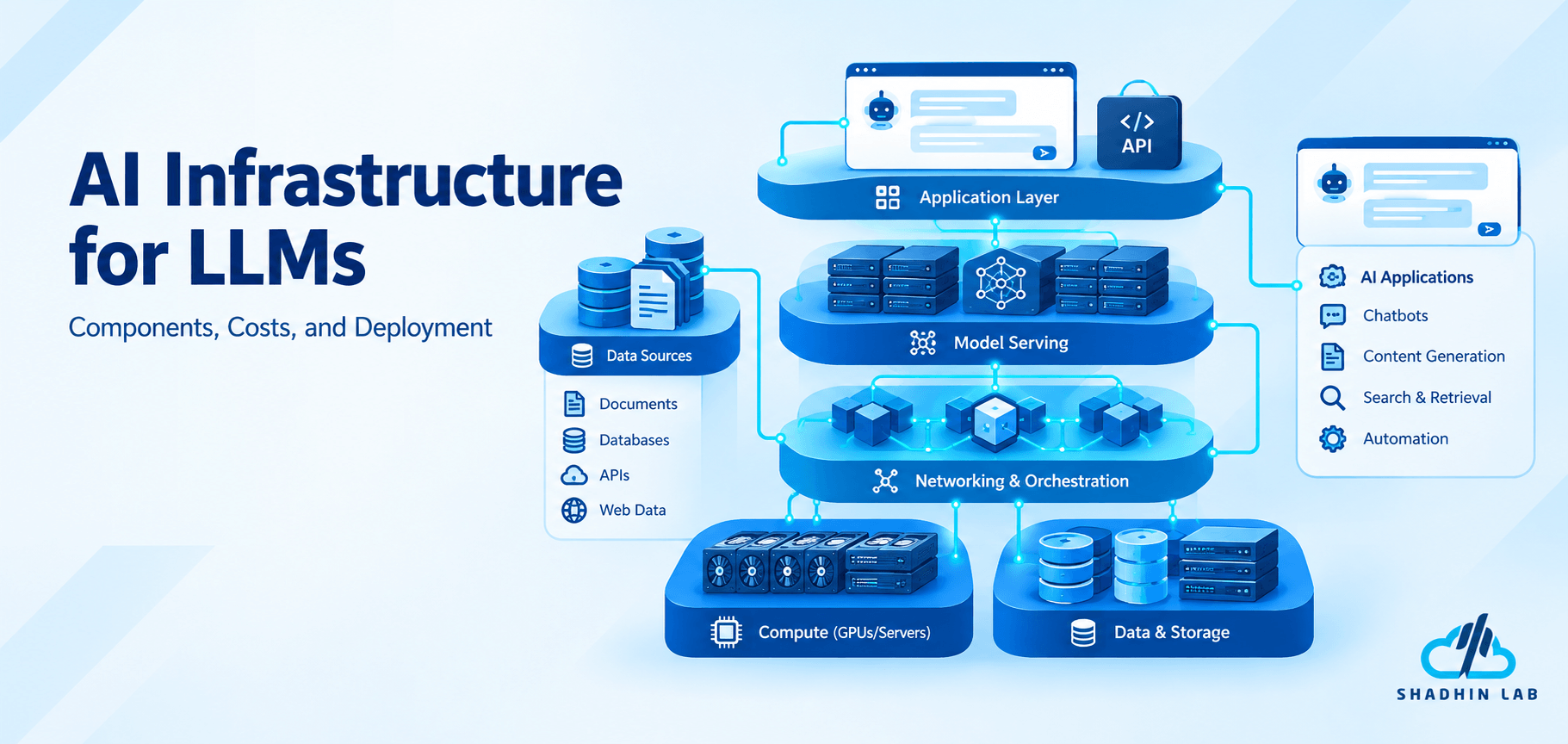
Table of Contents
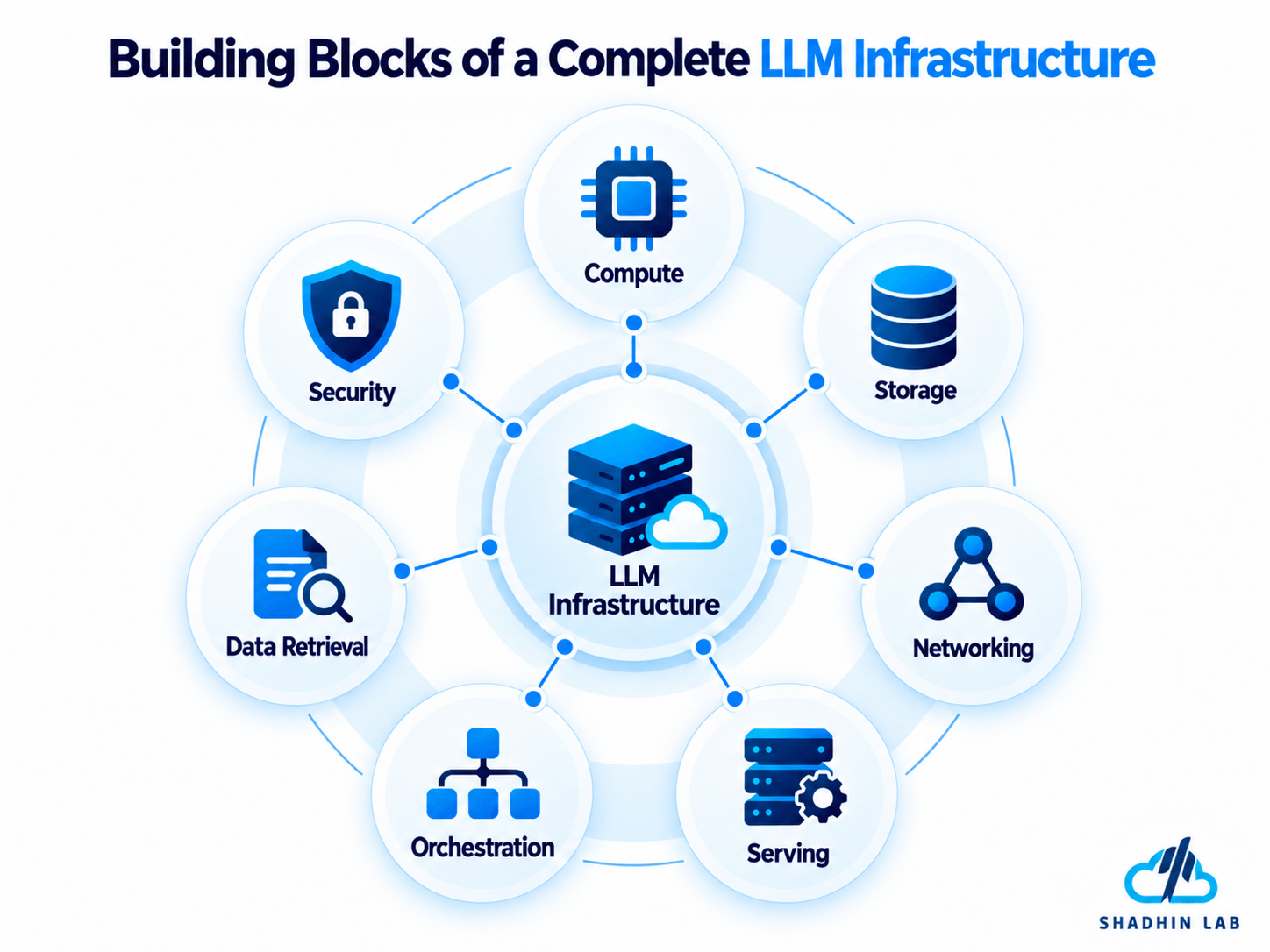
Large language models (LLMs) need more than a powerful GPU to operate reliably in production. They depend on a connected infrastructure stack that includes compute, storage, networking, model serving, data retrieval, security, and monitoring.
The right setup depends on what you are building. An internal knowledge assistant using a hosted model API has very different infrastructure requirements from a customer-facing application serving an open-weight model to thousands of concurrent users.
For technical leaders, the challenge is choosing an architecture that meets performance, security, and reliability requirements without introducing unnecessary cost or operational complexity.
This guide explains the core components of AI infrastructure for LLMs, compares deployment models, and provides a practical framework for building and optimizing production systems.
Table of Contents
Key Takeaways
- LLM infrastructure is a complete system: Compute, storage, networking, inference, data pipelines, security, and monitoring work together.
- Training and inference have different requirements: Training focuses on learning or adapting model parameters, while inference serves requests and generates outputs.
- Not every application needs GPUs: Businesses using hosted LLM APIs can often build applications without managing model-serving hardware.
- Deployment choices involve trade-offs: Hosted APIs simplify operations, while self-hosting provides more control at the cost of greater engineering responsibility.
- Workload characteristics determine infrastructure needs: Model size, context length, concurrency, latency targets, and utilization all affect capacity planning.
- Start simple and optimize with evidence: Validate the application, measure actual performance, and introduce more complex infrastructure only when necessary.
What Is AI Infrastructure for LLMs?
AI infrastructure for LLMs is the combination of hardware, software, data systems, and operational services required to develop, deploy, serve, and maintain large language model applications.
It includes the resources that run a model and the surrounding systems that make the model useful in a real application. These systems may authenticate requests, retrieve company documents, manage prompts, enforce access controls, monitor quality, and handle failures.
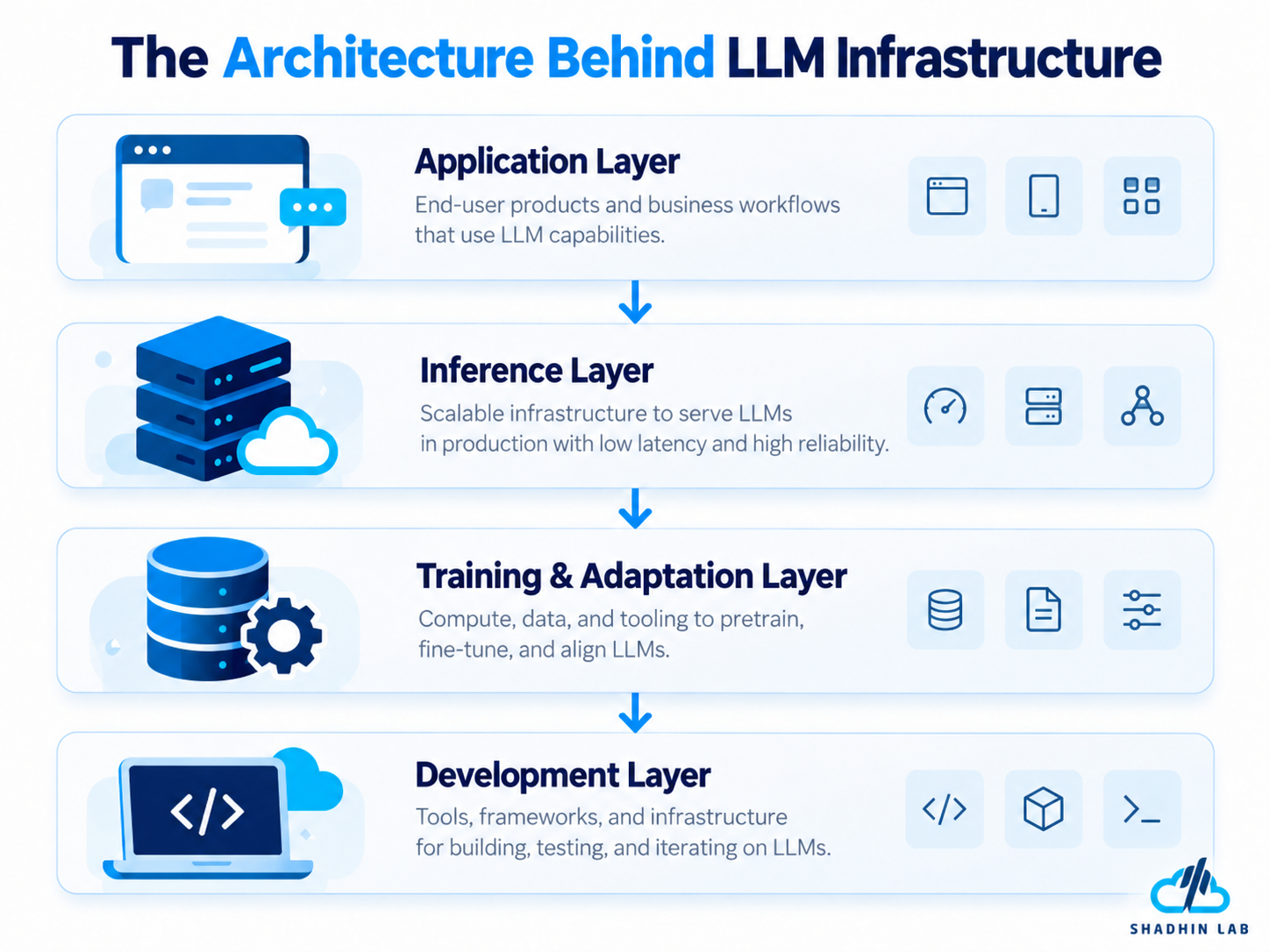
LLM infrastructure generally falls into four categories:
| Infrastructure layer | Primary purpose | Typical components |
|---|---|---|
| Development | Experiment with models and evaluate performance | Notebooks, test environments, evaluation datasets |
| Training and adaptation | Train or fine-tune models | GPUs, distributed compute, datasets, checkpoints |
| Inference | Run trained models and generate responses | Model-serving engines, accelerators, APIs |
| Application | Connect the model to business workflows | APIs, retrieval systems, prompt management, authentication, monitoring |
These layers can overlap, but they serve different purposes. A company fine-tuning an open-weight model may need dedicated training resources, while a business building an AI assistant on a commercial API may need only application infrastructure and a reliable connection to the model provider.
How an LLM Infrastructure Stack Works
Consider an AI assistant that answers questions using a company’s internal documentation. Its request lifecycle might look like this:
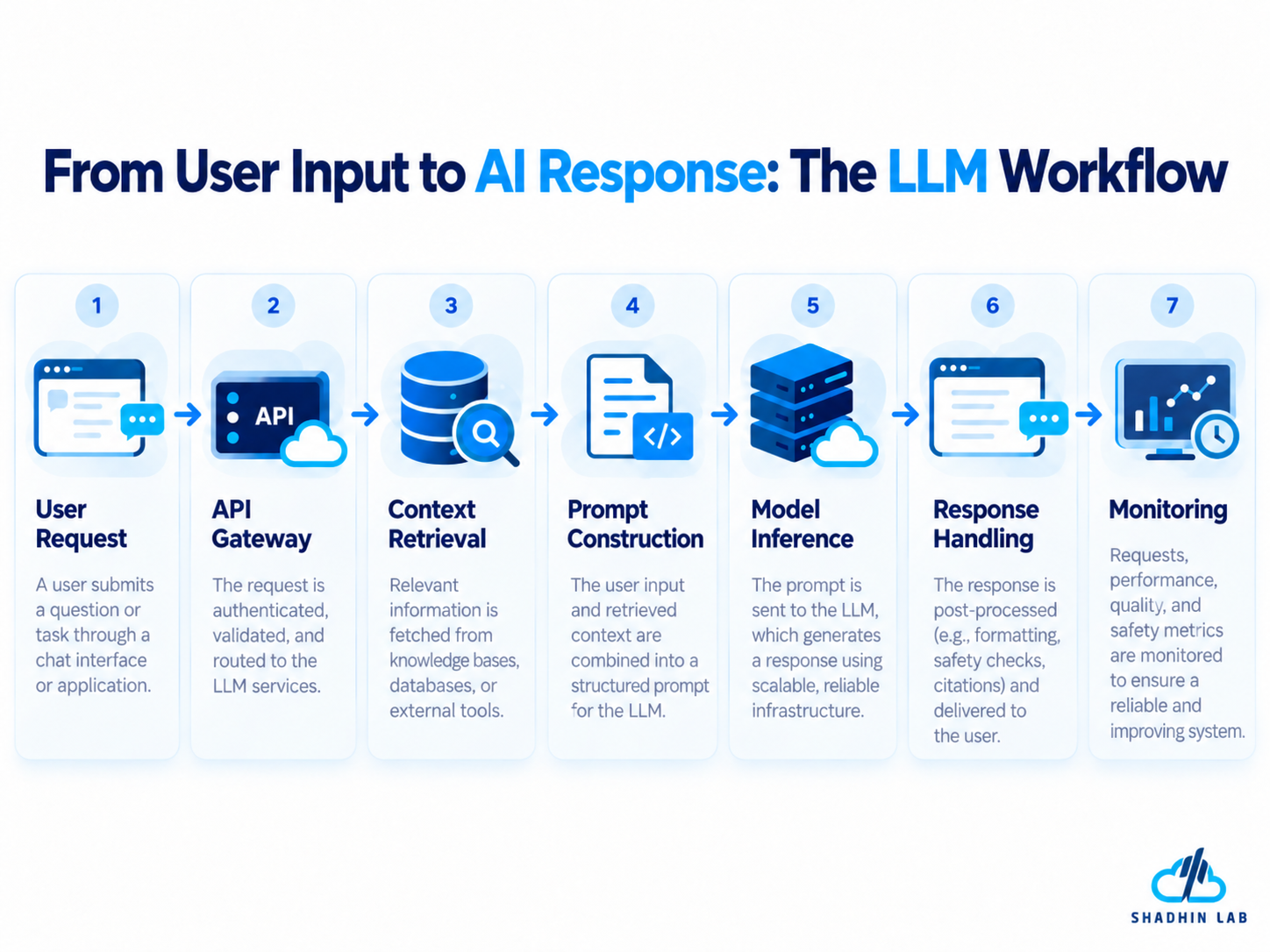
- Application request: A user submits a question through a web application or internal tool.
- API gateway: The system authenticates the request, checks permissions, validates inputs, and applies rate limits.
- Context retrieval: If the question requires company knowledge, a retrieval system searches authorized documents and selects relevant passages.
- Prompt construction: The application combines the question, retrieved context, and applicable instructions.
- Model inference: A hosted API or self-hosted inference engine processes the request and generates an answer.
- Response handling: The application validates the response where necessary and returns it to the user.
- Monitoring: The system records operational metrics, errors, token usage, latency, and relevant quality signals.
Not every application needs every component. A simple text-generation feature may not require a retrieval system, while an enterprise assistant needs stronger identity controls, document permissions, and auditability.
The important point is that the model is only one part of the production system.
Why LLM Infrastructure Differs From Traditional Application Infrastructure
Traditional web applications often execute predefined business logic and database queries. LLM applications introduce additional variables because requests can contain different amounts of context and generate responses of unpredictable length.
These differences create several infrastructure challenges:
- GPU memory: Model weights and runtime state may require substantial accelerator memory.
- Variable workloads: A short classification request consumes different resources from a long-context conversation.
- Generation latency: Users may care about both the time before the first token appears and the speed of subsequent tokens.
- Throughput: The system must serve concurrent requests without unacceptable delays.
- Model artifacts: Model weights and checkpoints can be large and require controlled storage and versioning.
- Cost per request: Input tokens, output tokens, hardware utilization, and operational overhead all affect economics.
As a result, infrastructure planning should begin with the application workload—not a hardware purchase.
Core Components of AI Infrastructure for LLMs
1. Compute: GPUs, CPUs, and AI Accelerators
Compute resources perform the calculations required to train models or generate responses.
GPUs are widely used for LLM workloads because they can perform many parallel operations. Other specialized AI accelerators may also be suitable, depending on model compatibility, software support, availability, and performance requirements.
CPUs remain important for request handling, preprocessing, orchestration, data movement, and other application tasks that do not need to run on a GPU.
The required hardware depends on more than the model’s parameter count. Important factors include:
- Model weights: The model’s parameters and their numerical representation determine a major part of memory demand.
- Quantization: Representing weights at lower precision can reduce memory requirements, subject to quality and compatibility considerations.
- Context length: Longer prompts and conversations increase runtime memory requirements.
- Concurrency: Multiple simultaneous requests compete for compute and memory resources.
- Performance targets: Low-latency applications may need more capacity than asynchronous or batch-processing workloads.
A smaller model may fit on one GPU, while a larger model or demanding workload may require multiple GPUs. Some models can be distributed across devices, but doing so adds communication overhead and operational complexity.
Practical recommendation: Estimate memory requirements and benchmark the intended workload before choosing GPU types or counts. Avoid treating any single model-size-to-GPU rule as universal.
2. Storage and Model Artifacts
LLM infrastructure requires storage for more than the model itself. Depending on the application, the system may store training datasets, evaluation results, fine-tuning checkpoints, embeddings, retrieved documents, logs, and configuration files.
Storage design affects model loading, data preparation, recovery, and reproducibility.
Object storage is useful for model artifacts, datasets, and archived evaluation results. High-throughput storage may be important when large models must load quickly or when training pipelines process substantial amounts of data. Databases and search indexes serve different purposes, such as storing application records or retrieving relevant documents.
A production environment should also maintain versioned model artifacts and controlled access to sensitive data. Teams need to know which model version, prompt configuration, and evaluation results correspond to a particular deployment.
Storage performance should be designed around actual access patterns. Not every LLM application requires a high-performance distributed storage system.
3. Networking and Distributed Computing
Networking connects application services, storage systems, CPUs, and accelerators. Its importance increases when a model is distributed across multiple GPUs or machines.
For example, a multi-GPU deployment may require frequent communication between devices. Slow interconnects can become a bottleneck even when the accelerators themselves are powerful. Data transfer between storage and compute can also affect model loading and training throughput.
Distributed computing becomes relevant when a workload exceeds the capacity of a single device or needs additional serving capacity. Techniques such as tensor parallelism and pipeline parallelism divide model computation across devices in different ways.
However, distributing a model introduces new concerns, including synchronization, network traffic, failure handling, and deployment complexity.
A small application using a hosted model API generally does not need to manage GPU-to-GPU networking at all. A self-hosted system should introduce high-bandwidth interconnects and multi-node architecture only when workload requirements justify them.
4. Model Serving and Inference Engines
An inference engine loads a model, manages execution, schedules requests, and generates output tokens. It forms a central part of the serving layer in a self-hosted LLM deployment.
Tools such as vLLM and NVIDIA TensorRT-LLM provide specialized capabilities for serving and optimizing LLMs. Managed model-serving services offer another route for teams that want to deploy models without maintaining every underlying component.
When evaluating a serving solution, consider the following:
- Throughput: How many requests or tokens can the system process over a given period?
- Latency: How quickly does a request begin producing a response, and how fast are subsequent tokens generated?
- Batching: Can the engine combine work from multiple requests to improve hardware utilization?
- Memory management: How efficiently does it manage model weights and the key-value (KV) cache used during generation?
- Compatibility: Does it support the chosen model architecture, precision, hardware, and required features?
- Operations: How difficult is it to deploy, update, debug, and maintain the system?
An inference stack may separate the API frontend from the model-serving backend. The frontend handles requests, routing, queues, and metrics; the backend executes model computation.
The best engine is not automatically the one with the highest published benchmark. Benchmark the intended model and request patterns under realistic conditions, and account for the engineering work required to operate it.
5. Orchestration and Scaling
Orchestration manages how application services and model-serving workloads are deployed, updated, restarted, and scaled.
Docker containers package applications and their dependencies. Kubernetes can coordinate these containers across a cluster, manage deployments, and support scaling and controlled updates.
For an LLM application, orchestration may help with:
- Deploying and updating model-serving workers.
- Distributing requests across available instances.
- Scaling capacity as demand changes.
- Performing health checks and replacing failed workloads.
- Managing configuration and secrets.
- Rolling out new application or model versions.
Kubernetes can be useful for complex production systems, but it is not a requirement for every LLM project. A managed API, serverless service, or simpler deployment may be a better choice for an early-stage application with modest traffic.
Choose orchestration based on the operational requirements of the application, not because it is a standard component in every large-scale architecture.
6. Data and Retrieval Infrastructure
Many business applications need an LLM to answer questions using internal documents, product information, customer records, or other data that may not be included in the model’s training.
Retrieval-augmented generation (RAG) addresses this requirement by retrieving relevant information and supplying it to the model as context.
A typical RAG pipeline includes:
- Ingesting documents from approved sources.
- Cleaning and splitting content into manageable chunks.
- Generating embeddings, which represent content as numerical vectors.
- Indexing the content in a vector database or another retrieval system.
- Retrieving relevant passages for a user query.
- Passing authorized context to the LLM to generate a grounded response.
The infrastructure may also need metadata filters, document permissions, scheduled updates, and deletion workflows.
Retrieval is an application-level capability, not a replacement for model-serving infrastructure. A vector database cannot compensate for an unreliable inference system, and a fast inference engine cannot fix poor retrieval quality.
For enterprise applications, access control must apply during retrieval—not only when users log in. Otherwise, the model may receive information that the requesting user is not authorized to see.
7. Monitoring, Security, and Reliability
An LLM application can remain technically available while producing poor answers, becoming too expensive, or exposing sensitive information. Production monitoring must therefore cover both system performance and application quality.
Core operational metrics include latency, throughput, request failures, availability, input and output token usage, and cost. Quality monitoring may evaluate response accuracy, retrieval relevance, instruction adherence, and task completion.
Security controls should include authentication, authorization, secrets management, encryption where appropriate, and restricted access to model endpoints. Teams should also define how sensitive prompts, retrieved documents, and generated outputs are logged or retained.
Model and prompt versioning help teams investigate regressions and reproduce behavior. Automated evaluations can test representative tasks before releases, while production reviews identify problems that tests may not capture.
Reliability also requires clear failure handling. Applications should define timeouts, retries, fallback behavior, rate limits, and escalation paths. Repeated retries should not turn a temporary provider problem into a larger cost or availability incident.
Choosing the Right LLM Infrastructure Deployment Model
The right deployment model depends on control, engineering capacity, privacy requirements, traffic patterns, and total cost of ownership.
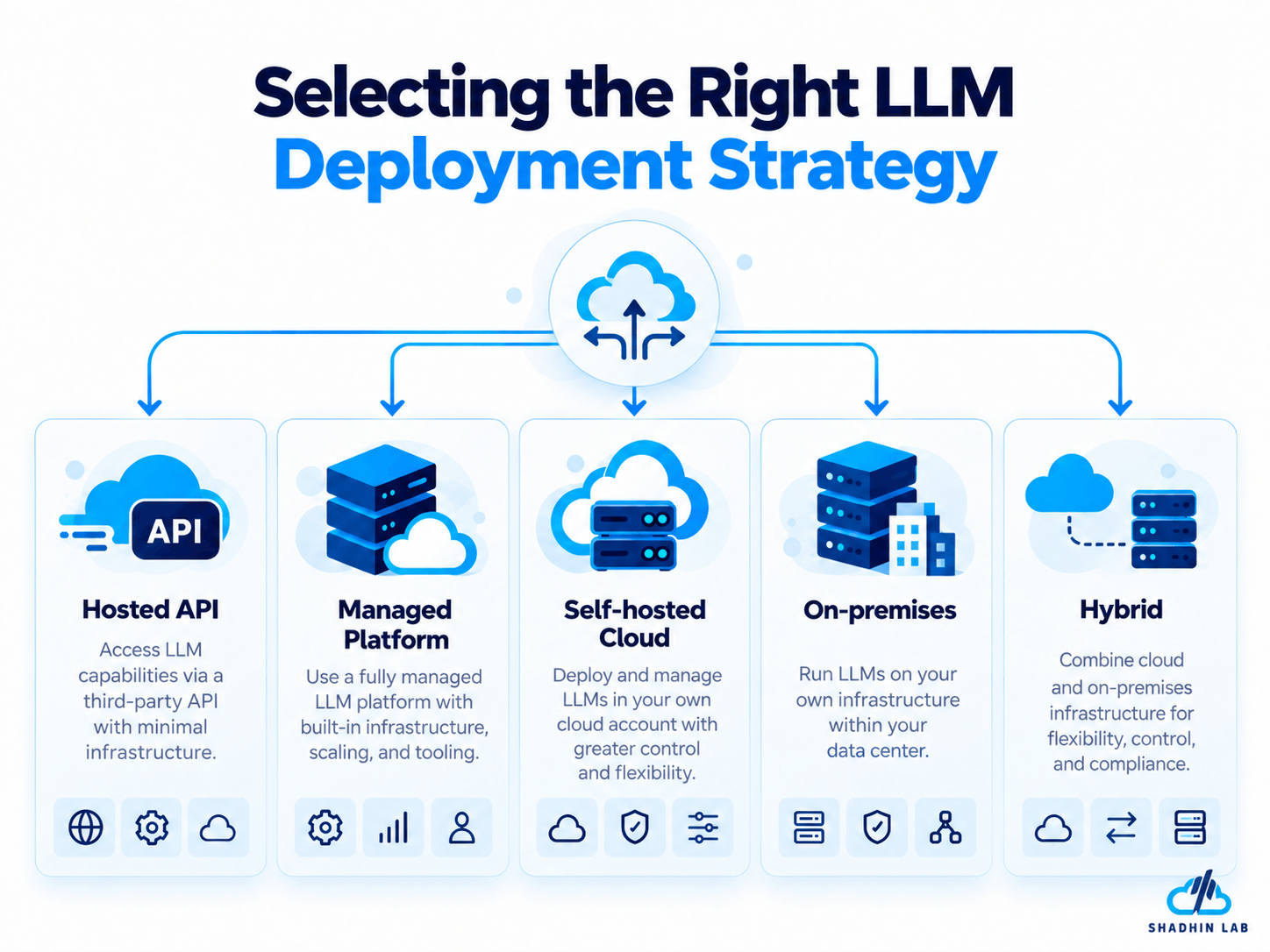
| Deployment model | Best suited for | Main trade-off |
|---|---|---|
| Hosted LLM API | Fast development and variable workloads | Less control over the underlying serving infrastructure |
| Managed model platform | Teams needing model choices and deployment controls | Platform constraints and service costs |
| Self-hosted cloud infrastructure | Workloads needing control over models, serving, or configuration | Greater operational responsibility |
| On-premises infrastructure | Specific data residency, control, or hardware requirements | Capital expense and maintenance |
| Hybrid infrastructure | Workloads with different privacy, performance, or cost needs | More complex architecture and governance |
Hosted APIs are often the simplest starting point. The provider manages model serving, and the application team focuses on integration, data handling, evaluation, and user experience.
Managed platforms offer a middle ground by providing deployment tools and infrastructure controls without requiring teams to operate every layer themselves.
Self-hosting gives organizations more control over model versions, serving configuration, and infrastructure. It can make sense when there are clear requirements that hosted options cannot satisfy, but it also introduces capacity planning, patching, monitoring, scaling, and incident-response responsibilities.
On-premises and hybrid deployments can address particular security, regulatory, latency, or integration requirements. Those benefits need to be weighed against infrastructure costs and the effort of operating multiple environments.
There is no universally cheapest or most secure option. Compare total cost of ownership, including engineering time, idle capacity, support, networking, data transfer, security, and reliability—not just API charges or hardware prices.
If you are planning a production LLM application, ShadhinLab can help assess the application requirements and design an AI implementation approach around the business workload, integration needs, and operational constraints.
How to Choose Infrastructure for Your LLM Workload
Use the following decision framework before committing to an architecture.
Step 1: Define the Workload
Clarify what the application must do. Is it calling a hosted model API, deploying an open-weight model, fine-tuning an existing model, training from scratch, running a RAG application, or supporting an AI agent that serves multiple customers?
These use cases have substantially different infrastructure needs. Training a model from scratch, for example, requires a different compute and data strategy from serving an existing model through an API.
Step 2: Estimate Model and Memory Requirements
For self-hosted deployments, account for model weights, runtime overhead, KV cache, context length, and concurrent requests. Identify the supported hardware and precision options for the chosen model.
Do not estimate capacity using model parameters alone. A deployment that fits in memory may still fail to meet its latency or throughput targets.
Step 3: Set Performance Targets
Define measurable requirements before benchmarking:
- Time to first token.
- Token generation speed.
- Requests per second.
- Expected and peak concurrency.
- Availability and recovery objectives.
The acceptable response time for a background document-processing job may be very different from the requirement for an interactive customer-support assistant.
Step 4: Estimate Workload and Cost
Estimate input and output token volumes, traffic patterns, utilization, and expected growth. For self-hosted systems, include accelerator costs, idle capacity, storage, networking, maintenance, and engineering time. For managed services, include usage-based charges, platform costs, and any additional application infrastructure.
Use a representative workload rather than an idealized request to make cost estimates more meaningful.
Step 5: Select the Simplest Viable Architecture
Start with the least complex option that meets the requirements. If a hosted API can validate the use case, there may be no reason to begin with a GPU cluster.
Move to managed or self-hosted infrastructure when measured costs, control requirements, latency, privacy, or model compatibility justify the change.
How to Optimize LLM Infrastructure Costs and Performance
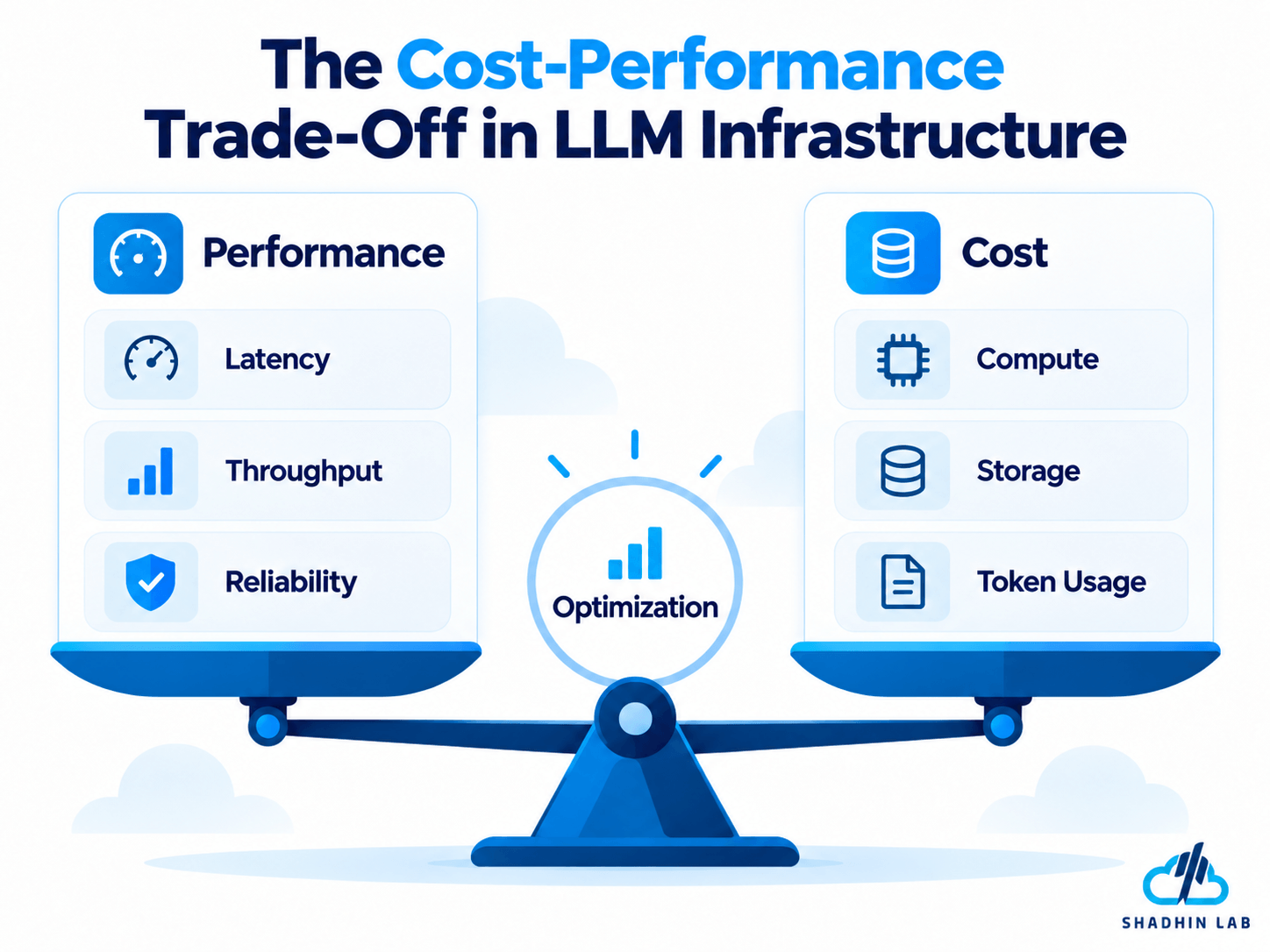
Optimization should improve the economics of delivering useful results—not merely reduce hardware usage or token prices.
Choose the Right Model
A smaller model may be sufficient for classification, structured extraction, summarization, and other narrowly defined tasks. More complex tasks may require a more capable model.
Evaluate quality against representative inputs before selecting a model based on cost alone. In some applications, routing simple requests to a smaller model and reserving a more capable model for difficult requests can balance cost and quality.
Use Quantization Where Appropriate
Quantization represents model weights or other values at lower numerical precision. It can reduce memory requirements and may improve serving efficiency, depending on the model, hardware, and implementation.
However, lower precision can affect output quality or feature compatibility. Test it against the application’s quality requirements and measure the actual performance change before deploying it broadly.
Improve Batching and Request Scheduling
Batching allows an inference engine to process work from multiple requests together, potentially improving accelerator utilization. Dynamic or continuous batching can adapt scheduling as requests arrive and finish.
The trade-off is latency: waiting to form a larger batch can delay individual requests. Tune batching around the service’s response-time objectives and real traffic patterns.
Use Caching Strategically
Caching can avoid repeated work when requests share reusable information. Prompt or prefix caching may help when requests reuse the same prompt prefix, while retrieval caching can reduce repeated searches for unchanged content.
Semantic caching can reuse answers for sufficiently similar queries, but it requires careful handling. Two similar-looking questions may have different permissions, dates, or business context. Use it only when the application’s correctness and freshness requirements permit it.
Right-Size Compute and Scaling
Provision enough capacity to meet performance and availability targets, but avoid keeping expensive resources idle without a reason.
Autoscaling can adjust capacity as demand changes, provided the serving platform supports it and scaling can happen quickly enough for the workload. Model-loading time, accelerator availability, and traffic spikes can limit how effective reactive scaling is.
Measure utilization and queueing behavior before increasing hardware capacity. A bottleneck in retrieval, networking, or request scheduling may not be solved by adding GPUs.
Monitor Cost per Useful Output
Token costs alone do not show whether an application is economical. Track cost alongside response quality, latency, reliability, and successful task completion.
For example, a cheaper model that frequently requires retries or human correction may cost more per completed task than a more capable model that succeeds on the first attempt. The appropriate metric depends on the application’s business objective.
Common LLM Infrastructure Mistakes
Several infrastructure decisions create avoidable cost or reliability problems:
- Overengineering too early: Building a distributed serving cluster before validating demand increases complexity without proving value.
- Choosing hardware before defining the workload: Model size alone does not determine memory, throughput, or latency requirements.
- Treating training and inference as the same problem: Their compute patterns, resource needs, and optimization goals differ.
- Ignoring operational overhead: Self-hosting requires maintenance, security updates, monitoring, capacity planning, and incident response.
- Skipping evaluation and observability: A service can return successful HTTP responses while producing inaccurate or unhelpful answers.
- Scaling without diagnosing bottlenecks: More compute may not fix slow retrieval, poor scheduling, or storage delays.
- Underestimating data preparation: Document quality, chunking, permissions, and refresh workflows affect the performance of RAG applications.
- Exposing unsecured model endpoints: Public or internal endpoints still need appropriate authentication, rate limits, and access controls.
- Comparing only direct prices: Hosted API charges and hardware costs are not equivalent unless engineering, idle resources, and maintenance are included.
A Practical Roadmap for Building Production LLM Infrastructure
A staged implementation helps teams reduce risk and make infrastructure decisions using evidence.
Stage 1: Prototype. Use a hosted API or suitable managed platform to test the use case. Establish initial quality, latency, and security requirements before investing in specialized infrastructure.
Stage 2: Validate. Test representative requests and real business data where permitted. Estimate traffic, context lengths, token usage, privacy requirements, and operating costs. Identify the failures that matter most to users.
Stage 3: Build the production foundation. Implement authentication, access controls, monitoring, evaluation, data handling, timeouts, and failure recovery. Add retrieval and business-system integrations where the use case requires them.
Stage 4: Optimize. Compare models and serving configurations. Evaluate quantization, batching, caching, compute allocation, and request routing. Keep changes that demonstrate measurable improvements without unacceptable quality or reliability trade-offs.
Stage 5: Scale deliberately. Introduce orchestration, redundancy, advanced routing, or distributed inference when workload measurements and service requirements justify them.
This approach avoids committing to infrastructure before the product’s needs are understood. It also creates a repeatable way to decide when the next level of complexity is worthwhile.
Frequently Asked Questions
What is the difference between LLM training and inference infrastructure?
Training infrastructure supports the computation and data processing required to learn or adapt model parameters. Inference infrastructure serves requests using an existing model and generates outputs. Training typically involves different compute patterns, while inference places particular emphasis on latency, throughput, concurrency, and serving efficiency.
How can businesses reduce LLM infrastructure costs?
Businesses can evaluate smaller models, use quantization where appropriate, improve batching, apply suitable caching, right-size compute, and scale capacity according to demand. They should measure these changes against output quality, latency, reliability, and cost per completed task.
What infrastructure is required for a RAG application?
A RAG application typically needs document ingestion, chunking, embedding generation, a vector database or other retrieval index, metadata filtering, access controls, and an LLM to generate responses using retrieved context. It also needs monitoring and processes to update or remove source content.
When should a company self-host an LLM instead of using an API?
Self-hosting may be appropriate when a company needs specific model control, deployment flexibility, or infrastructure characteristics that hosted options cannot meet. It can also be worth evaluating when workload economics support it. The decision should account for engineering effort, hardware utilization, maintenance, security, and performance—not just the direct price of model inference.
Conclusion
AI infrastructure for LLMs is not a single hardware purchase. It is a connected system of compute, storage, networking, model serving, data retrieval, security, and monitoring. Each component contributes to whether an application can deliver useful responses reliably and at an acceptable cost.
The best architecture depends on the workload, data sensitivity, engineering capacity, traffic, and performance targets. Validate the application first, measure real behavior, and add complexity only when evidence supports it.
For organizations developing production LLM applications, ShadhinLab offers an entry point to explore AI development and implementation support. Start with your application requirements and integration challenges, then identify the architecture that fits your business—not the most complicated stack available.

Shaif Azad
Shaif Azad Rahi is an AI/ML professional and Solution Engineer at Shadhin Lab, specializing in AI-powered solutions and scalable software systems, with a focus on applying AI to solve real-world business challenges.
Related Post
Prompt Engineering Guide: How to Write Better AI Prompts
You ask an AI model a simple question and get a generic answer. You rewrite the...
10 Best AI Sales Agents in 2026: Which One Fits You?
AI sales agents are no longer one clearly defined product category. Some automate outbound prospecting, while...

AI Automation Use Cases to Boost Efficiency
Are you overwhelmed by repetitive tasks that consume hours of your valuable time each day? Businesses...
