
AI Risk Management: Frameworks, Challenges & Best Practices
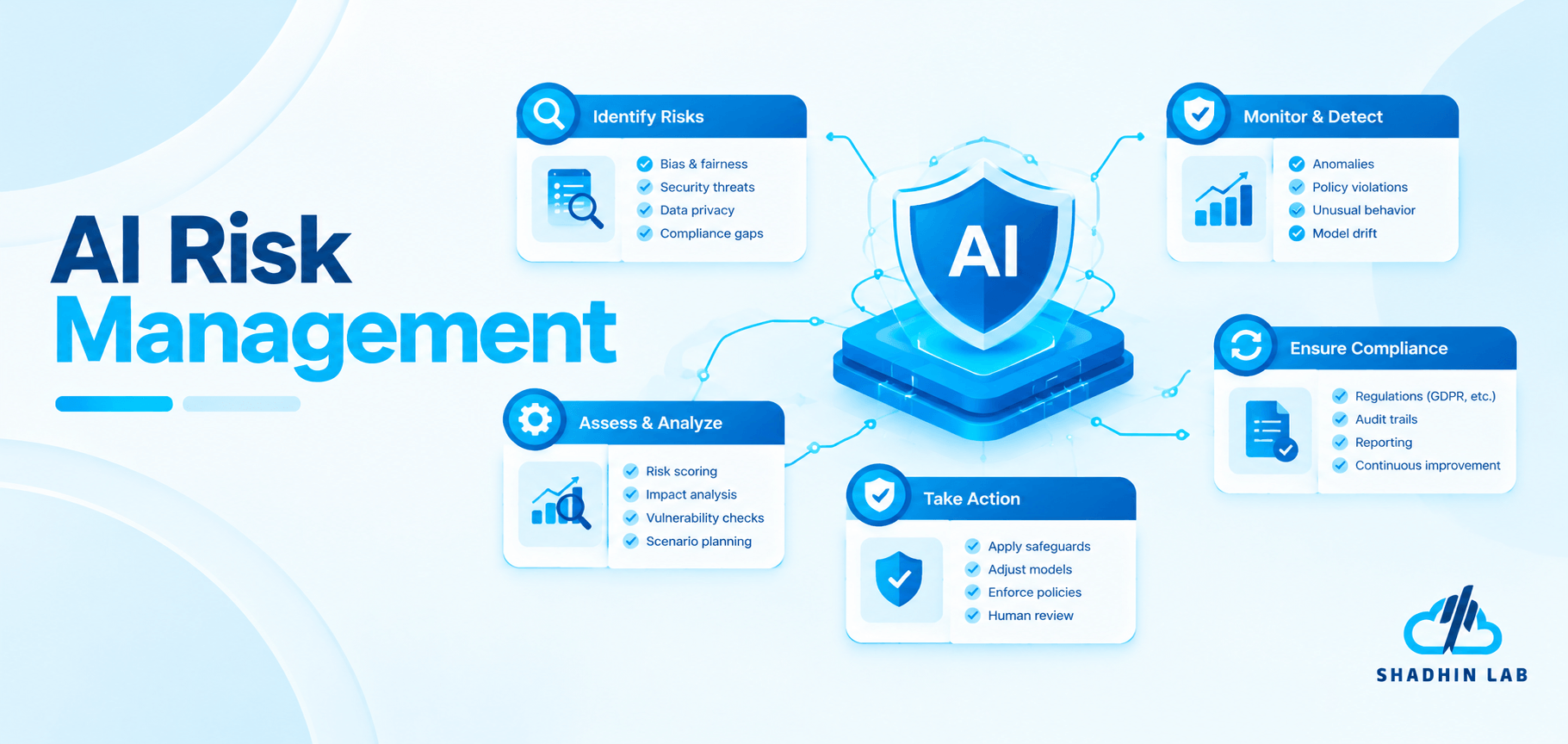
Table of Contents
Are you someone who lies awake wondering if your AI systems might suddenly make catastrophic decisions? Have you ever found yourself staring at your organization’s latest AI implementation, asking what could possibly go wrong? If you are nodding your head right now, you are definitely not alone in this concern.
What if I told you that artificial intelligence is becoming the backbone of your business operations? Your organization increasingly relies on AI systems for decision-making, automation, customer interactions, and data analysis. Every day, you trust these systems with more critical aspects of your business.
However, here is something that might surprise you: AI systems also introduce entirely new risk categories. These risks touch everything from data privacy and algorithmic bias to transparency, security, and regulatory compliance. When these risks materialize, they can devastate your business operations, destroy customer trust, and create serious legal responsibilities.
By the end of this guide, you will understand exactly how ai risk management can transform your approach. You will discover a structured methodology that helps your organization identify, assess, and mitigate risks associated with developing AI systems. Let us explore this critical topic together and give you the confidence you need.
Table of Contents
What Is AI Risk Management?
Have you ever wondered what exactly happens when your AI systems encounter situations they were never trained for? AI risk management represents the systematic process of identifying, evaluating, and mitigating risks that emerge from designing, deploying, and using artificial intelligence systems in your organization.
Here is something fascinating about AI risks: they often emerge from the inherent complexity of machine learning models. The quality of your training data and the unpredictable ways AI systems interact with real-world environments create unique challenges. Unlike traditional software, your AI systems learn and adapt, which means their behavior can evolve unexpectedly.
When you implement ai risk management in your organization, you are working toward several key objectives that directly impact success:
- Ensuring safe and responsible AI deployment across all your systems
- Protecting sensitive data and maintaining user privacy standards
- Preventing biased or harmful outcomes that could damage your reputation
- Maintaining compliance with evolving regulatory requirements
Your organization needs ai risk management frameworks to ensure that AI technologies serve your business goals responsibly. Think of it as your safety net in an increasingly complex technological landscape.
AI Risk Management vs. AI Governance
AI governance and AI risk management are related, but they solve different problems.
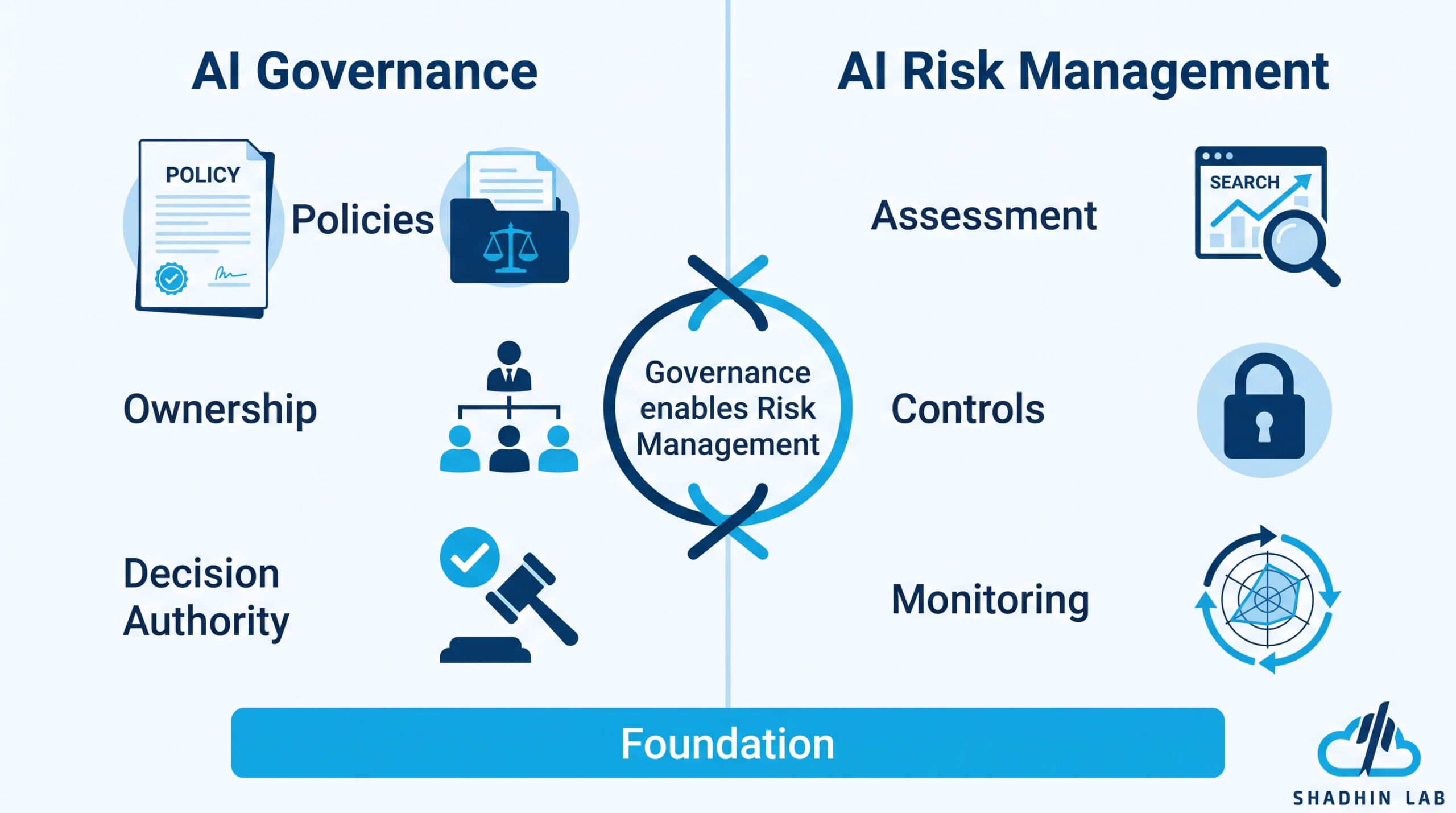
AI governance defines organizational policies, responsibilities, decision-making authority, and acceptable use. AI risk management identifies specific threats and determines how to assess, reduce, and monitor them.
For example, a governance policy might prohibit an AI system from making final hiring decisions without appropriate human oversight. Risk management would then examine potential bias, define evaluation criteria, establish review procedures, and monitor the system’s recommendations.
Governance establishes the structure within which risk management operates. Without clear ownership and decision-making authority, even well-designed technical controls can fail to address business risks.
Why AI Risk Management Matters to Businesses
AI risk can affect financial performance, operations, customer relationships, and legal obligations.
An inaccurate AI-generated product recommendation may create customer complaints. A privacy failure could expose confidential information. An unreliable automation could disrupt a business process, while a biased decision system could unfairly affect individuals.
However, not every AI use case requires the same level of oversight. An internal tool that rewrites meeting notes generally needs fewer controls than an AI system used to assess loan applications or make consequential employment recommendations.
The objective is to match the level of review and protection to the likelihood and severity of potential harm.
The Most Important AI Risks Businesses Need to Manage
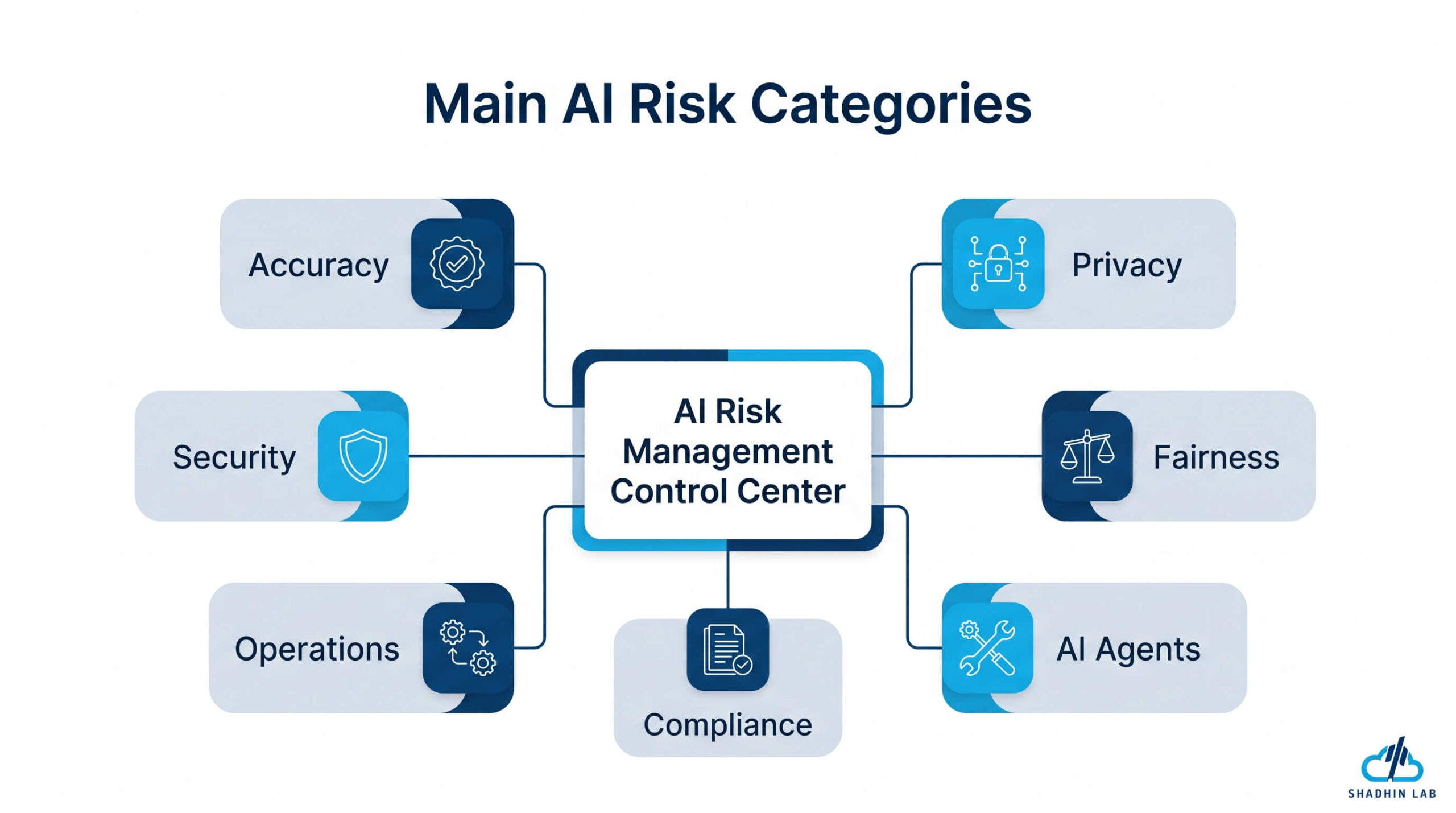
1. Accuracy and Reliability Risks
AI systems can produce incorrect, inconsistent, or outdated outputs. Generative AI may also hallucinate, meaning it produces information that sounds plausible but is unsupported or false.
Consider a customer support assistant that invents a return deadline or an internal assistant that incorrectly summarizes a contract clause. If employees trust the output without checking the source, the error can affect business decisions.
Useful controls include grounding responses in approved information, testing representative scenarios, validating important outputs, and defining when a human must review the result.
Monitoring should examine more than whether the application is available. Teams also need to evaluate whether responses remain accurate and useful as models, source data, and user behavior change.
2. Data Privacy and Confidentiality
AI applications may process personal information, customer records, proprietary documents, financial details, or confidential business plans. Risk arises when this information is shared with an unapproved tool, retained inappropriately, or exposed to users who should not have access.
Organizations should classify data by sensitivity and define which categories can be processed by approved AI tools. Vendor reviews should cover relevant data-retention practices, access controls, contractual terms, and whether customer data may be used for model training.
Internal AI assistants also need to preserve existing document permissions. An employee should not gain access to confidential information simply because an AI system can retrieve it.
Controls should be tested in practice, including whether prompts, logs, retrieved documents, and generated responses expose information beyond the intended audience.
3. Security Risks
AI introduces security concerns that extend beyond the underlying model.
Prompt injection occurs when instructions embedded in a user input or external content attempt to manipulate an AI system’s behavior. For example, a document retrieved by an assistant might contain malicious instructions designed to make the system disclose sensitive information or misuse connected tools.
Other risks include insecure integrations, excessive permissions, API abuse, sensitive-data disclosure, and attacks against systems that process untrusted content.
Security measures should include authentication, least-privilege access, input and output validation, rate limits, secret management, and security testing. Applications that use external documents or tools should also be tested against adversarial inputs.
No single prompt instruction or model-level safeguard can guarantee security. Protection must extend across the entire application, including data sources, APIs, connected tools, and execution logic.
4. Bias, Fairness, and Discrimination
AI systems can produce unfair outcomes when their training data, design, evaluation, or deployment context does not adequately account for relevant differences between people.
This matters in recruitment, lending, eligibility assessment, customer service, and other areas where decisions affect individuals.
For example, an AI recruitment tool might systematically rank certain candidate profiles lower because its behavior reflects patterns in historical data. A human reviewer may also place too much trust in the system’s recommendations.
Organizations should define appropriate fairness criteria, test representative groups and scenarios, document decision logic where possible, and investigate meaningful differences in outcomes. Human oversight is particularly important for consequential decisions, but reviewers need the authority and information to challenge the system rather than simply approve its recommendations.
5. Legal, Regulatory, and Intellectual Property Risks
AI adoption can raise questions about privacy, copyright, transparency, recordkeeping, consumer protection, and contractual responsibility.
The applicable requirements depend on the organization’s jurisdiction, industry, use case, and role in the AI supply chain. A company developing an AI product may have different obligations from a business using a third-party system.
Before deployment, organizations should identify relevant legal and contractual requirements, document the purpose of the system, review data-use rights, and establish appropriate records and disclosures.
They should also distinguish between internal risk guidance and legal obligations. Adopting a voluntary framework does not automatically establish compliance with every law that may apply.
6. Operational and Third-Party Risks
AI systems often depend on external model providers, cloud platforms, data services, and software integrations. Provider outages, model updates, API changes, unexpected usage charges, or integration failures can disrupt business operations.
Organizations may also have limited visibility into how a third-party model was developed or how its behavior changes over time.
Practical controls include vendor due diligence, documented dependencies, service monitoring, change management, fallback procedures, and contingency plans. Teams should understand what happens if a provider becomes unavailable or a model update causes a measurable decline in output quality.
Third-party services can reduce operational burdens, but they do not eliminate the organization’s responsibility to manage risks within its own application and business process.
7. Risks From AI Agents and Autonomous Workflows
AI agents deserve specific attention because they may use tools, access systems, and take actions rather than simply generate text.
An AI sales agent might update CRM records, send prospect emails, or trigger follow-up workflows. A poorly constrained agent could modify the wrong record, send inaccurate information, or execute an action outside its intended scope.
The risk depends on what the agent can access and do without human approval.
Organizations should apply least-privilege permissions, restrict available actions, validate tool inputs and outputs, require approval for sensitive operations, and maintain audit logs. Where possible, provide a way to reverse or recover from consequential actions.
Start with narrow permissions and limited autonomy. Expand the agent’s authority only after testing demonstrates that the controls work reliably.
AI Risk Management Frameworks
Wondering which framework will work best for your organization’s unique situation? Several established frameworks help organizations manage AI risks systematically, but choosing the right approach depends on your industry requirements.
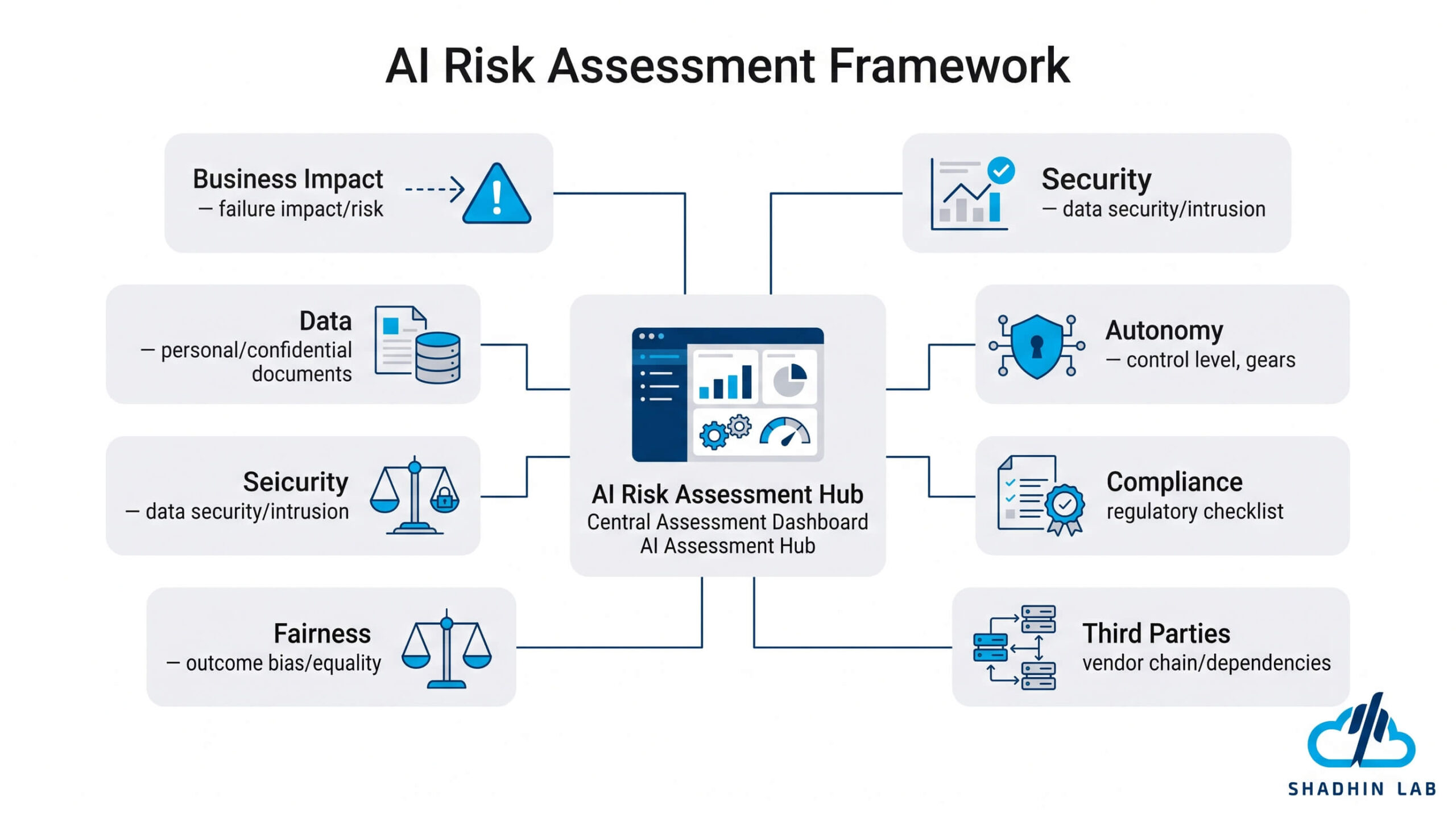
Commonly referenced frameworks that you should consider include:
Risk governance frameworks define clear accountability structures and oversight processes that ensure someone in your organization is always responsible. These frameworks establish who makes decisions, who provides oversight, and how information flows through your organization.
Model risk management frameworks, particularly those used in financial services, provide rigorous approaches to validating, monitoring, and controlling AI models. If you operate in a heavily regulated industry, these frameworks offer proven approaches.
Responsible AI frameworks focus specifically on fairness, transparency, and ethical use of AI systems. These frameworks help you build AI systems that align with your organizational values and societal expectations.
Your organization will typically need to adapt these frameworks to your specific industry requirements, regulatory environment, and risk tolerance. No single framework works perfectly for every organization.
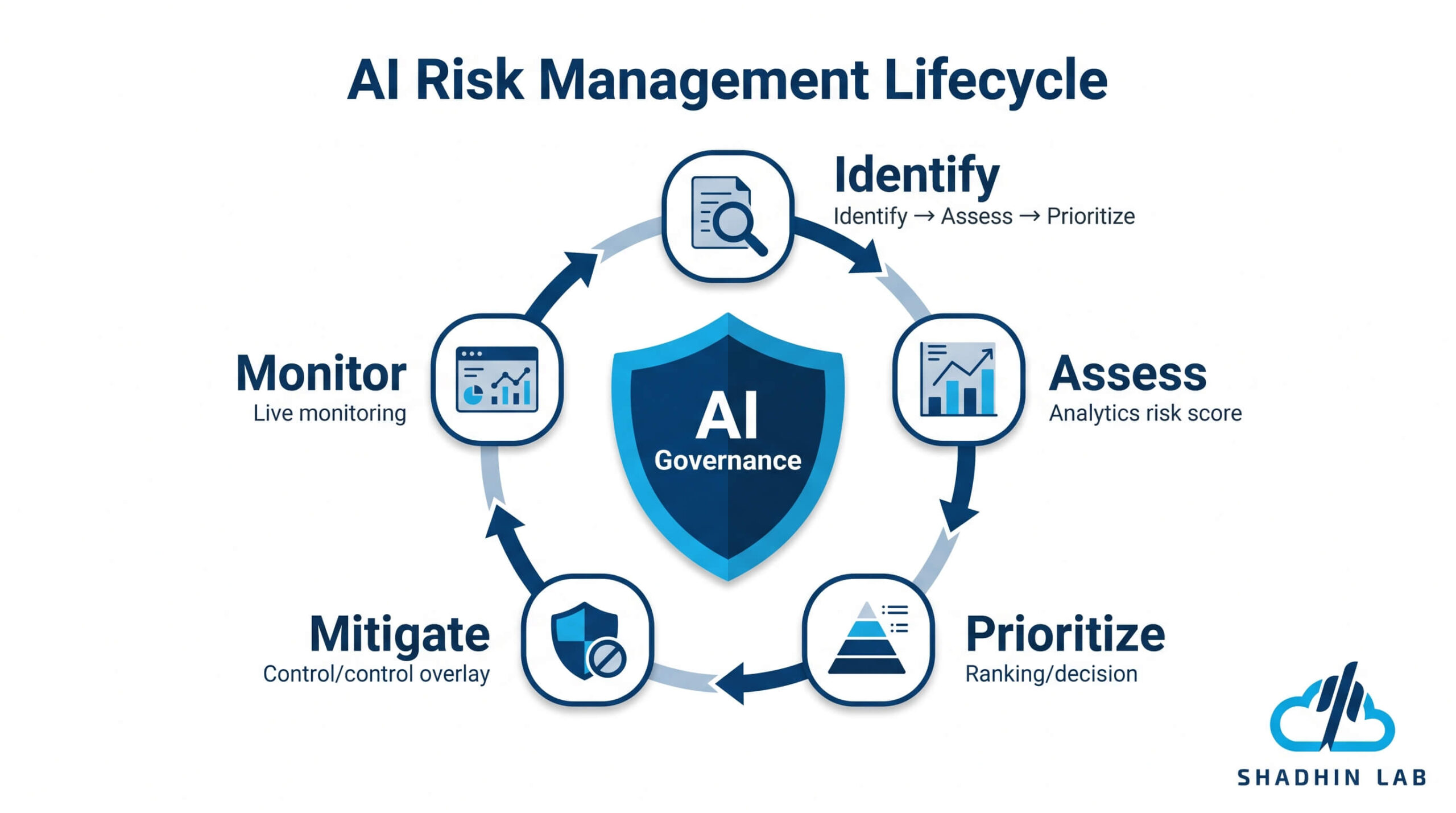
AI Risk Management Across the AI Lifecycle
Have you thought about how ai risk management needs change as your AI systems move from concept to production? Effective ai risk management requires different approaches and attention points throughout the entire AI development and deployment lifecycle.
Data Collection and Preparation
During the earliest stages of your AI projects, you need to address risks related to data privacy, bias, and quality. Your data collection practices determine the foundation for everything that follows, making this stage critical for long-term success.
Your data preparation processes should include privacy impact assessments, bias detection testing, and quality validation procedures that catch problems early. These foundational steps prevent issues from becoming embedded in your models.
Model Development and Training
When your team develops and trains AI models, you must ensure transparency in your development process, conduct comprehensive fairness testing, and validate performance across diverse scenarios and edge cases.
Your model development phase should include documentation practices that enable future auditing, testing procedures that detect bias and accuracy issues. Validation approaches must ensure your models work reliably in production environments.
Deployment and Integration
Before you deploy AI systems into production, they should undergo rigorous security testing and operational validation to ensure safe integration. Your existing systems and processes need careful consideration during this phase.
Your deployment processes need to include rollback procedures, monitoring system setup, and integration testing that verifies correct operation. AI systems must work correctly with other business systems before going live.
Monitoring and Governance
Once your AI systems are deployed and operating, they require continuous monitoring to detect performance drift, emerging bias patterns, or unexpected behavior. These ongoing processes help you identify issues before they become serious problems.
Your ongoing governance processes should include regular model performance reviews, bias audits, and stakeholder feedback mechanisms. These systematic approaches ensure your ai risk management remains effective over time.
Best Practices for AI Risk Management
What specific strategies can you implement immediately to improve your ai risk management? These practical approaches have proven effective across different industries and organizational contexts.
Effective ai risk management practices that you can implement include:
Establishing clear governance structures for AI oversight ensures that someone in your organization has authority and responsibility for decisions. Your governance structure should define roles, responsibilities, and decision-making processes clearly.
Implementing rigorous data management and quality controls protects your AI systems from garbage-in-garbage-out problems that can undermine everything. You build on top of poor data foundations at your own risk.
Conducting regular fairness and bias testing helps you identify discriminatory patterns before they affect real people and create problems. Legal or reputational problems from biased AI can devastate organizations.
Maintaining transparency and explainability in your AI systems enables stakeholders to understand and trust AI-driven decisions that affect them. Transparency also supports regulatory compliance and audit requirements.
Regularly auditing AI models and outputs provides ongoing assurance that your systems continue to perform as expected. These audits help ensure your systems meet your organizational standards over time.
These practices help you build trustworthy and responsible AI systems that support your business objectives while minimizing risks.
Tip: Begin with governance structures before diving into technical solutions – clear accountability makes everything else more effective.
Challenges of Managing AI Risks
What obstacles should you expect when implementing ai risk management in your organization? Understanding these challenges helps you prepare realistic timelines and resource requirements for your ai risk management initiatives.
Complexity of AI Systems
Many AI models operate as black boxes that make it extremely difficult for you to understand how specific decisions are made. This opacity creates challenges for explaining decisions to stakeholders, debugging problems, and ensuring compliance with transparency requirements.
Your organization needs strategies for managing AI systems that you cannot fully explain or predict, which requires different approaches. Traditional software risk management methods often fall short with AI systems.
Rapid Technological Change
AI technologies evolve at breakneck speed, making it challenging for your organization to keep risk frameworks current with developments. Emerging threat patterns and new AI capabilities constantly change the risk landscape.
Your ai risk management approaches need to be flexible and adaptable enough to accommodate new AI technologies, attack vectors, and regulatory requirements. Static frameworks quickly become obsolete in this rapidly evolving field.
Lack of Standardized Regulations
Global regulatory frameworks for AI are still developing and often conflict with each other, creating uncertainty for organizations. Operating in multiple jurisdictions compounds these compliance challenges significantly.
Your compliance strategies need to account for regulatory uncertainty and potential conflicts between different jurisdictional requirements. This complexity requires ongoing legal guidance and flexible implementation approaches.
Future of AI Risk Management
Where is ai risk management heading, and how should you prepare your organization for what comes next? Understanding emerging trends helps you make strategic decisions about your ai risk management investments.
Responsible AI Governance
Your organization will increasingly need structured governance models that emphasize ethical AI development, stakeholder accountability, and transparent decision-making processes. Future governance approaches will likely require more stakeholder involvement and greater transparency.
Future governance models will demand stronger accountability mechanisms than current practices. Your organization should prepare for more comprehensive oversight requirements and stakeholder engagement processes.
AI Regulation and Compliance
Governments worldwide are introducing comprehensive policies to ensure transparency, safety, and fairness in AI deployment. Your organization needs to prepare for more stringent regulatory requirements and enforcement actions.
Future regulations will likely require detailed documentation, regular auditing, and specific technical safeguards that go beyond current voluntary practices. Compliance costs and complexity will continue increasing across all industries.
Automated Risk Monitoring
AI-driven monitoring tools will help your organization detect anomalies, bias patterns, and model drift in real time, enabling faster response. Future monitoring systems will likely provide predictive insights about potential risks before they materialize.
These advanced monitoring capabilities will give you more time to implement preventive measures and respond to emerging threats. Automated ai risk management tools will become essential for managing complex AI portfolios.
How Shadhin Lab Supports AI Risk Management
Are you looking for expert guidance to navigate the complex landscape of ai risk management? Shadhin Lab serves as your trusted technology partner, helping organizations like yours build safe and responsible AI systems that drive business value.
Our expertise spans AI governance frameworks, continuous model monitoring, comprehensive risk assessment methodologies, and regulatory compliance strategies. We understand that every organization faces unique challenges and regulatory requirements.
Your partnership with Shadhin Lab provides access to proven methodologies, cutting-edge tools, and experienced professionals who have helped organizations across industries. We implement effective ai risk management programs tailored to your specific needs.
Conclusion
You now have a comprehensive understanding of why ai risk management is absolutely essential for responsible AI adoption in your organization. The stakes have never been higher, and the complexity continues to grow as AI becomes more integral.
What will you implement first in your organization? Organizations that proactively implement structured governance, continuous monitoring, and strong data practices position themselves to reduce risks. They maximize the transformative benefits of AI technologies while protecting their stakeholders.
Your journey toward effective ai risk management starts with a single step. Whether you begin with governance structures, risk assessments, or monitoring systems, the important thing is to start now. Waiting until risks materialize into serious problems costs significantly more than prevention.
The future belongs to organizations that can harness AI power responsibly. Your commitment to comprehensive ai risk management will differentiate your organization and build the foundation for sustainable AI-driven growth.
Frequently Asked Questions
What is the most important first step in AI risk management?
You should start by establishing clear governance structures and accountability frameworks before implementing technical solutions. Strong governance provides the foundation for all other ai risk management activities and ensures someone has authority to make critical decisions.
How often should we assess AI risks in our organization?
You need continuous monitoring for deployed systems and formal risk assessments at least quarterly or whenever you make significant changes. High-risk applications may require more frequent assessments based on your risk tolerance and regulatory requirements.
Can small organizations implement effective AI risk management?
Yes, you can implement effective ai risk management regardless of your organization size. Start with basic governance structures and risk identification processes, then gradually add more sophisticated monitoring and assessment capabilities as your AI usage grows.
What regulatory requirements should we prioritize?
You should focus on regulations that apply to your specific industry and geographic markets first. The EU AI Act, GDPR, and industry-specific requirements typically take priority, but your legal team should provide guidance based on your situation.
How do we measure the effectiveness of our AI risk management program?
You can measure effectiveness through metrics like incident reduction, compliance audit results, stakeholder satisfaction scores, and risk detection speed. Regular testing and validation exercises also provide valuable effectiveness indicators for your ai risk management program.

Shaif Azad
Shaif Azad Rahi is an AI/ML professional and Solution Engineer at Shadhin Lab, specializing in AI-powered solutions and scalable software systems, with a focus on applying AI to solve real-world business challenges.
Related Post
AI Infrastructure for LLMs: Components, Costs, and Deployment
Large language models (LLMs) need more than a powerful GPU to operate reliably in production. They...
Prompt Engineering Guide: How to Write Better AI Prompts
You ask an AI model a simple question and get a generic answer. You rewrite the...
10 Best AI Sales Agents in 2026: Which One Fits You?
AI sales agents are no longer one clearly defined product category. Some automate outbound prospecting, while...
